
U-869 off New Jersey: discovery, diver deaths and identification recounted at Long Branch talk
Get AI-powered insights, summaries, and transcripts
Subscribe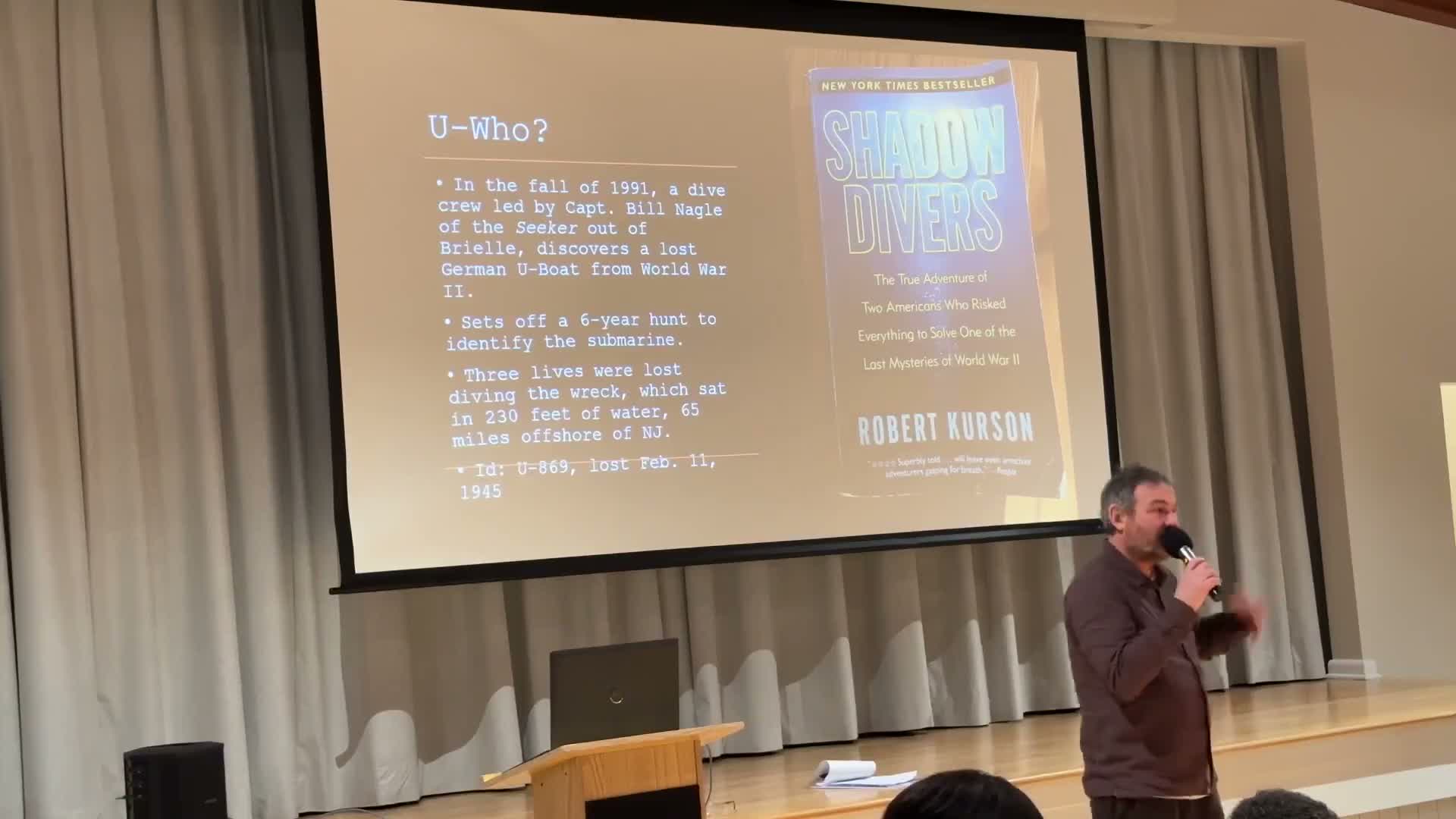
Summary
Speakers at a Long Branch lecture recounted the 1991 discovery of German submarine U-869 at roughly 230 feet, the deaths of divers during recovery efforts, and how a shipyard marker ultimately identified the wreck.
Speakers at a Long Branch City lecture recounted the discovery and identification of the German submarine U-869, a wartime wreck located off the New Jersey coast that has drawn both historical interest and controversy over its sinking.
Presenter remarks described early dives in 1991 that located a wreck at approximately 230 feet. Divers initially worked in secrecy, the presenter said, and reported difficult conditions: complete darkness, strong currents and very limited bottom time. The third dive retrieved artifacts and, eventually, a piece bearing the identifier "U-869," which allowed researchers to match the wreck to records and to tell relatives where sailors were resting.
Speakers also noted the human cost of those dives. The presenter described multiple fatalities tied to the recovery effort: Steve Feldman, who did not resurface during one descent; two divers (a father and son, Christopher Rouse and Christopher Rouse Jr.) who died in 1992; and other earlier diver fatalities mentioned in relation to deep wreck searches. Presenters emphasized the hazards of deep wreck exploration and the compressed working windows at such depths.
The cause of U-869’s sinking was discussed but not resolved at the event. The presenter relayed that some divers, including John Chatterton (as recounted), believed the submarine may have been lost after a circular torpedo strike, while other accounts credit depth charges or anti-submarine action from destroyers. Speakers did not present documentary evidence at the lecture to settle that dispute.
No formal research or official report was released during the event; speakers framed their comments as oral history and first-hand recollection. Attendees were urged to treat controversial details as unresolved unless corroborated by archival naval records.