
FEMs to automate gap-filling and add station on/off controls to reduce missing-data impacts
Get AI-powered insights, summaries, and transcripts
Subscribe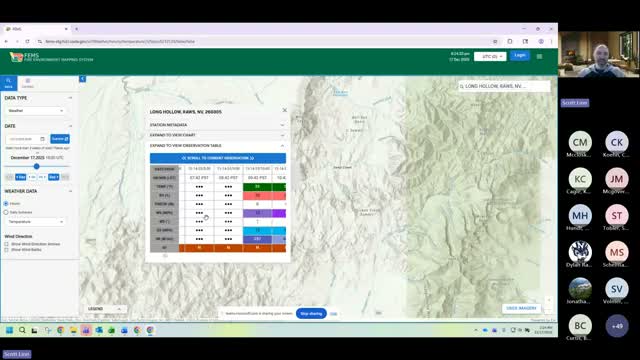
Summary
FEMs developers described a planned workflow to shorten automated lookback, fetch 2–3 day gap-filled files from DRI/WRCC when needed, flag gap-filled values, and add station-management controls so administrators can suppress problematic sensors or stop fire-danger calculations for a station.
Scott, a FEMs presenter, described a multi-part plan to reduce the operational effects of missing station data on NFDRS outputs. He said the current system looks back three days for data and, when missing persists, leaves blanks that cause downstream fuel-model and NFDRS calculation degradation. To address this, FEMs will shorten the automatic external lookback to one day and, if data remain missing, request a short (two- to three-day) gap-filled file from DRI or WRCC that FEMs will ingest and use to run NFDRS calculations automatically. Scott set a target of mid-spring for full implementation of this automated gap-filling cycle.
Scott said gap-filled observations will be visually flagged so users know they are not direct station observations. He also described station-management features that let administrators or users request that a station be turned off for visualization and/or fire-danger calculation when a station is damaged or providing erroneous values; the presenter emphasized a range of suppression options (turn off visualization only, stop fire-danger calculations, or stop weather ingest).
Why it matters: Scott said missing more than one day of observations significantly alters short-term fuel estimates and that three-day gaps can severely affect longer fuel classes now that FEMs uses hourly calculations. Automated gap filling and flagging should reduce manual user intervention and restore more consistent NFDRS outputs.
Quote: "We're going to then have our system grab any of the known missing data and populate it and then do a NFDRS calculation automatically," Scott said.
Next step: FEMs will finalize visualization/flagging choices and continue development on station-management controls; users should notify FEMs when stations fail so the team can apply the appropriate suppression.