
FEMs 03/06 update will add Mesonet stations, hourly fire-danger and new gap-filling, presenters say
Get AI-powered insights, summaries, and transcripts
Sign Up Free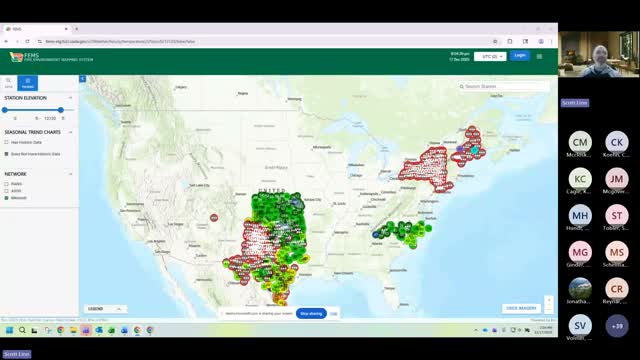
Summary
FEMs developers said a 03/06 release will bring Mesonet station ingest (including Texas, Oklahoma, Kansas, North Carolina and parts of Maine), hourly fire-weather/fire-danger displays, new filters for historic data, and an automated 2–3 day gap-filling workflow to reduce missing-data impacts.
Scott, a FEMs presenter, said the FEMs team will deploy a software update referred to during the call as the 03/06 release and that a short production outage is expected while updates are applied. The update will add direct ingest of several Mesonet networks—Scott named the Texas Mesonet, Oklahoma, Kansas, North Carolina and parts of Maine—and will show hourly fire-weather and fire-danger information for those stations. Scott noted that some networks (for example, certain West Texas sites and New York stations) are restricted by their owners and will be handled differently.
The change will bring data from Synoptic (an hourly summarized dataset, a project Scott said involved Chuck Maxwell) and forecasts from NOAA into FEMs; FEMs will summarize those hourly inputs to compute NFDRS fire-danger outputs. Because the newly ingested Mesonet stations do not yet have a period of record (POR) in FEMs, Scott said seasonal-trend charts will not be available immediately for those stations. For fully restricted networks that disallow downloadable raw data, FEMs will display daily maximum and minimum values only (a single daily value for weather and fire danger) rather than hourly data.
Scott also demonstrated new map filters, including a 'has historic data' option and network filters (ROS, ASOS, MesoNets), intended to help users find stations with seasonal-trend charts. He said FEMs will ingest an extended POR (a cleaned dataset for 2023–2024 up to 11/01/2025) and perform recalculations so more stations meet the three-year POR threshold back to 2022. The presenter cautioned that the team described several version numbers during the call (references to "3.6" and "3.5" appeared), and sequencing was not fully clarified in places.
Why it matters: missing or restricted station data can materially change NFDRS outputs. Scott said the additional Mesonet sources and the POR ingestion will expand coverage and allow more stations to show trend analytics, while restricted networks will be represented in a way that respects data-sharing limits.
What comes next: the team will complete the release, continue ingesting POR updates and notify users of any follow-up outages and availability changes. Office hours recordings and reference materials are being posted to the National Interagency Fire Center (NIFC) portal for users to review.
Quote: "We are getting the forecast information from NOAA"; "These restricted networks will be switched to a once-daily value going forward," Scott said during the call.
The session included participant questions about sensor heights and conversions for wind-speed measurements; Scott said the team assessed individual station sensor heights and applied unit conversions where needed so inputs meet NFDRS sensor-height requirements.