
CFTC chair outlines rulemaking agenda: tokenized collateral, onshoring perpetual contracts and rescoping event-contracts rules
Get AI-powered insights, summaries, and transcripts
Subscribe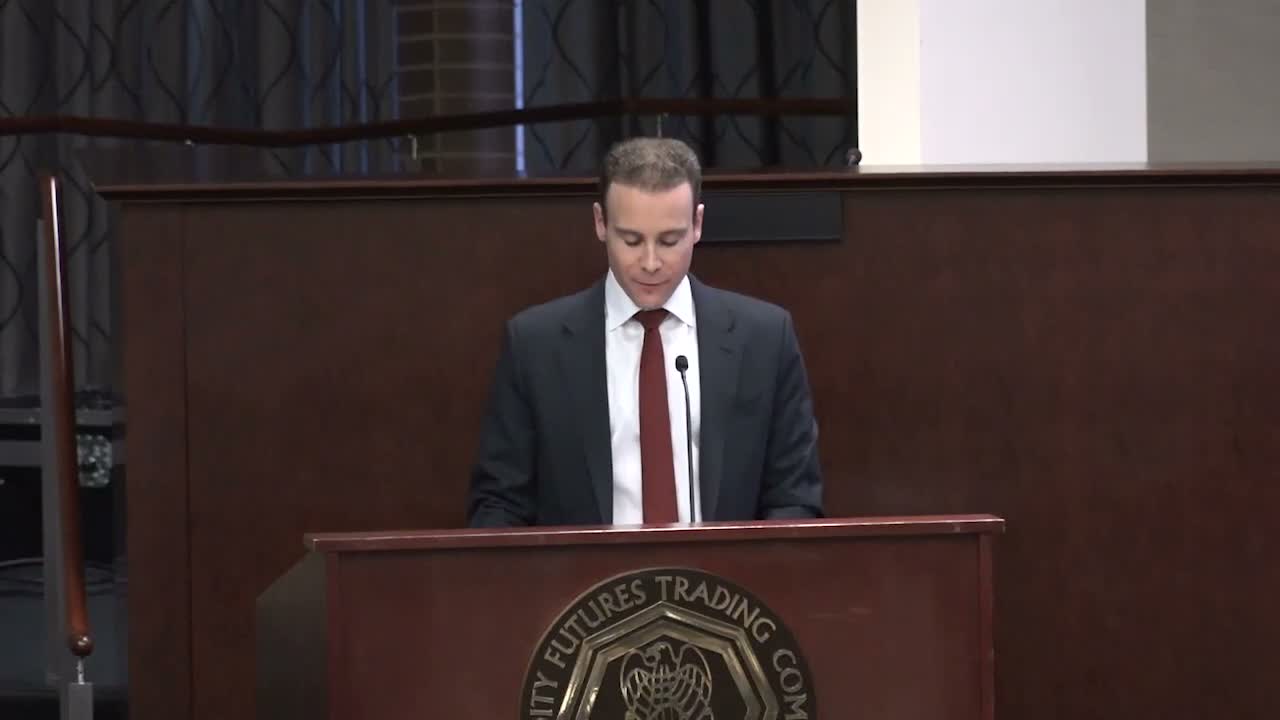
Summary
CFTC Chairman Michael Selig detailed an agenda that directs staff to draft rules for tokenized collateral, create pathways to onshore perpetual contracts, clarify retail-leverage trading rules, convert an industry CEO council into a FACA advisory committee and withdraw a prior event-contracts proposal and advisory.
CFTC Chairman Michael Selig used his first public remarks as chairman to lay out a multi-part rulemaking agenda focused on crypto-era market structure, telling attendees he has already directed staff to begin drafting several sets of rules.
Selig said he has ordered staff to "develop rules to enable the responsible deployment of additional forms of eligible tokenized collateral," arguing tokenization can improve liquidity and streamline post-trade processes if paired with appropriate safeguards. He also criticized prior administrations for failing to provide an onshore path for perpetual contracts — derivatives with no fixed maturity — and instructed staff to create frameworks that would allow such products to trade in the United States under common-sense protections.
On trading venues and retail activity, Selig directed staff to draft rules clarifying when off-exchange retail leverage and margining may be offered under an actual-delivery exception, to codify requirements for designated contract markets (DCMs) that choose to host these transactions, and to explore a new DCM category tailored to retail leverage, margin or finance crypto-asset trading.
Selig announced the withdrawal of a 2024 CFTC event-contracts rule proposal and a 2025 staff advisory that had cautioned registrants about sports-related event contracts, saying the prior advisory had increased market uncertainty. "I've directed CFTC staff to withdraw the 2024 event contracts rule proposal and the 2025 staff advisory," he said, and directed staff to proceed with a new rulemaking that will aim to provide clearer standards for event/prediction markets.
Selig also directed staff to reassess the commission's participation in pending federal litigation where jurisdictional questions are at issue and to work with SEC staff on a joint interpretation of Title 7 definitions to draw clearer lines between commodity options, security options, CFTC-regulated swaps and SEC-regulated security-based swaps.
To inform rule design, Selig said the CFTC's CEO innovation council (previously 15 announced CEOs) will now operate as a FACA innovation advisory committee; additional members will be named. He said the advisory committee and closer staff coordination will help the agency implement rules that allow innovation to grow "onshore" and under U.S. law.
Selig framed these initiatives as actions taken under the CFTC's existing statutory authority, but he also urged Congress to adopt enduring statutory definitions so the regulatory approach does not change materially between administrations. The chairman did not provide text of draft rules or specific publication dates; staff will undertake drafting, stakeholder engagement and public-comment processes before formal proposals are published.
Selig concluded by saying the agency will pursue harmonization with the SEC where it reduces duplication without blurring statutory boundaries, and that the CFTC will continue to prioritize investor protection, anti-fraud and market integrity as it modernizes oversight.
The CFTC provided no immediate timetable for final rules at the event; Selig said draft notices and staff reports will be developed and circulated for public comment.