
LCRA says Arbuckle used to meet environmental release; basin remains dry ahead of March decision
Get AI-powered insights, summaries, and transcripts
Subscribe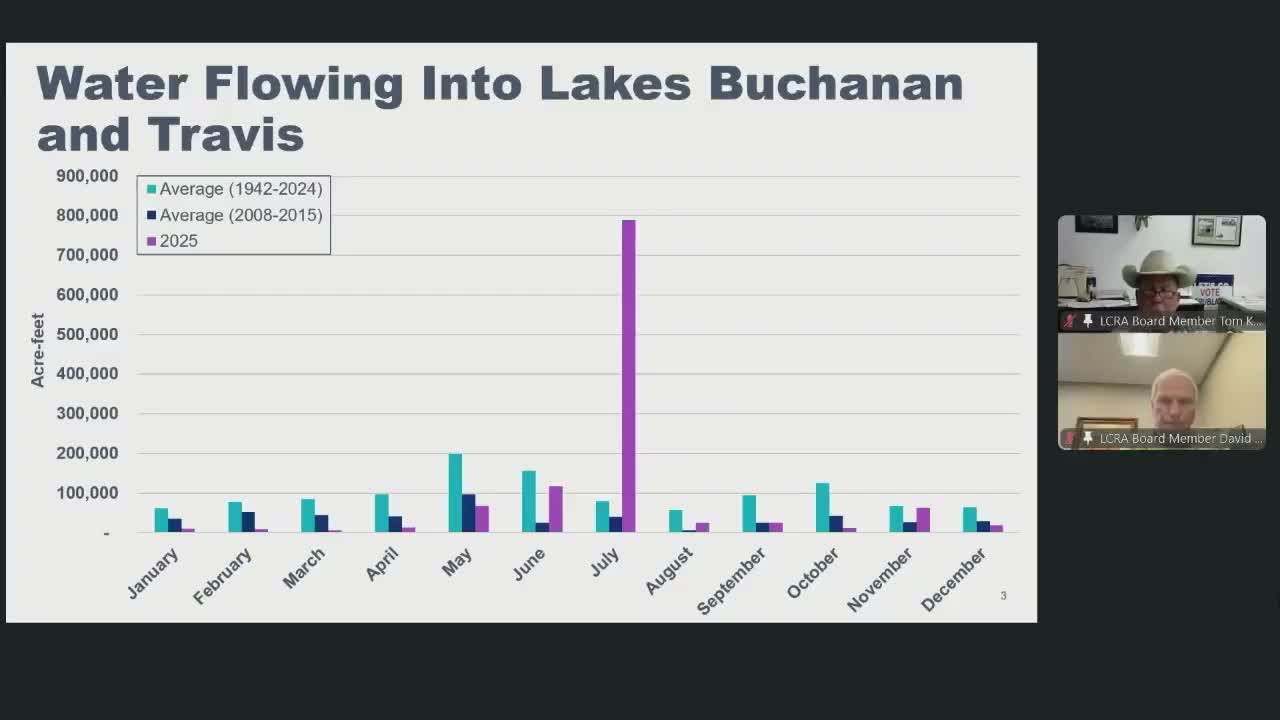
Summary
LCRA staff reported releases of about 31,000 acre-feet to meet environmental flow obligations to Matagorda Bay, using roughly half from Arbuckle Reservoir and half from Lakes Buchanan and Travis; staff said March 1 will determine interruptible water availability for first crop 2026.
LCRA staff told the Water Operations Committee on Jan. 28 that the authority released roughly 31,000 acre-feet in late December and January to satisfy a deficit in environmental inflows to Matagorda Bay. Kelly Payne, LCRA staff, said about half of that volume came from the newly operational Arbuckle Reservoir and the other half from Lakes Buchanan and Travis.
"We provided about 31,000 acre-feet to the bay in late December and January," Kelly Payne said, adding that using Arbuckle allowed staff to exercise the facility and gain operating experience. Payne said the releases made up a fin debit under the state‑approved water management plan and returned operations to normal for environmental obligations.
Payne reviewed basin conditions, saying roughly 80% of the basin is in some level of drought or abnormally dry conditions and that December inflows were about 17,500 acre-feet (roughly 27% of the long-term average for December). Combined storage in Lakes Buchanan and Travis was reported at about 1.7 million acre-feet (near 85% full as of the morning of the meeting).
Committee members asked whether Arbuckle has capacity to meet long-term needs and how releases balance middle-river ecological flows versus bay inflows. Payne said in-stream flow requirements and bay inflow accounting are related but distinct, and Arbuckle can be used to help meet bay inflow obligations without fully replacing releases from the Highland Lakes.
LCRA staff said they have begun pumping some water back into Arbuckle when opportunity allows and will incorporate Arbuckle operations into future release planning. The authority identified March 1 as the next decision point that will also govern whether interruptible stored water is made available for agricultural customers in the first crop season of 2026.
The committee heard that the Climate Prediction Center’s outlook through April leans toward near-normal precipitation but above‑normal temperatures. The next procedural step is the March 1 evaluation of storage and inflows that will determine interruptible availability for downstream divisions.