Get Full Government Meeting Transcripts, Videos, & Alerts Forever!
Get email alerts on the Recycling topic
No spam. Unsubscribe anytime.
Council accepts Recycling Partnership grants to launch cart‑based recycling program
Summary
Fayetteville accepted a no‑cash technical assistance grant and a larger cash grant from the Recycling Partnership to support a citywide cart‑based recycling rollout, including ~28,000 carts, an education program and anti‑contamination cameras; council approved both grants after discussion of contamination controls, processor RFPs and matching funds.
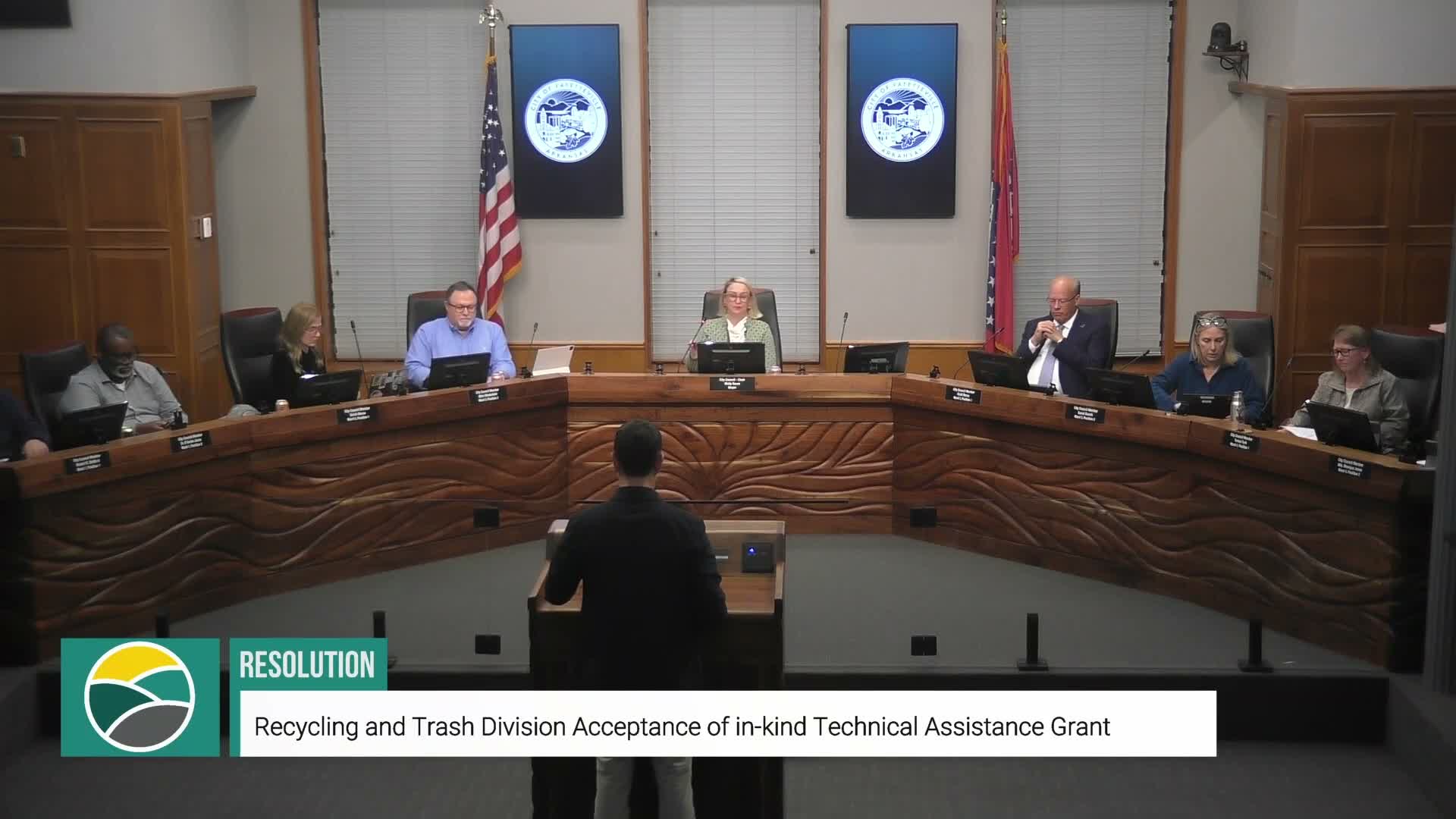
The Fayetteville City Council voted Nov. 4 to accept two grants from the national nonprofit Recycling Partnership that support the city's transition to cart‑based curbside recycling.
Peter Nierngarten of the Recycling and Trash Division summarized two awards: a technical assistance (no cash) grant to help the city develop an RFP and evaluate proposals for a processor of mixed recyclables and a cash grant totaling about $1,648,000 that includes roughly $1.2 million to purchase approximately 28,000 recycling carts, $280,000 for education and outreach and $160,000 for anti‑contamination cameras and software to be installed on six new recycling trucks.
Nierngarten said the cash grant requires an in‑kind match of about $125,000, budgeted in the city's education budget, and that the Recycling Partnership is an independent nonprofit funder (its funders include consumer‑goods manufacturers and the EPA). He told council that the technical assistance will support evaluation of proposals and contract negotiation for the mixed‑material processor.
Council members asked about contamination rates, whether potential vendors are affiliated with the Recycling Partnership, and whether the grant assistance had been provided in neighboring municipalities. Nierngarten said vendors are independent and that the Partnership has supported other Northwest Arkansas communities; he described a three‑part contamination strategy: education, monitoring/feedback (anti‑contamination cameras) and selecting a processor with advanced sorting.
After public and council questions the council approved the technical assistance grant and the cash grant and authorized related budget adjustments. Staff said the processor RFP will require regular contamination reporting and that education and technology will be used to reduce contamination. Council asked that staff provide metrics and updates as implementation proceeds.