Get Full Government Meeting Transcripts, Videos, & Alerts Forever!
Get email alerts on the Ai Copyright Transparency topic
No spam. Unsubscribe anytime.
California lawmakers hold informational hearing on AI training, copyright and transparency
Summary
Joint Senate and Assembly informational hearing gathered academics, industry and creatives to assess training-data transparency, enforcement limits under federal copyright, and technical tools vendors say can detect reused content; creators pressed for AB 412 and clearer disclosure mechanisms.
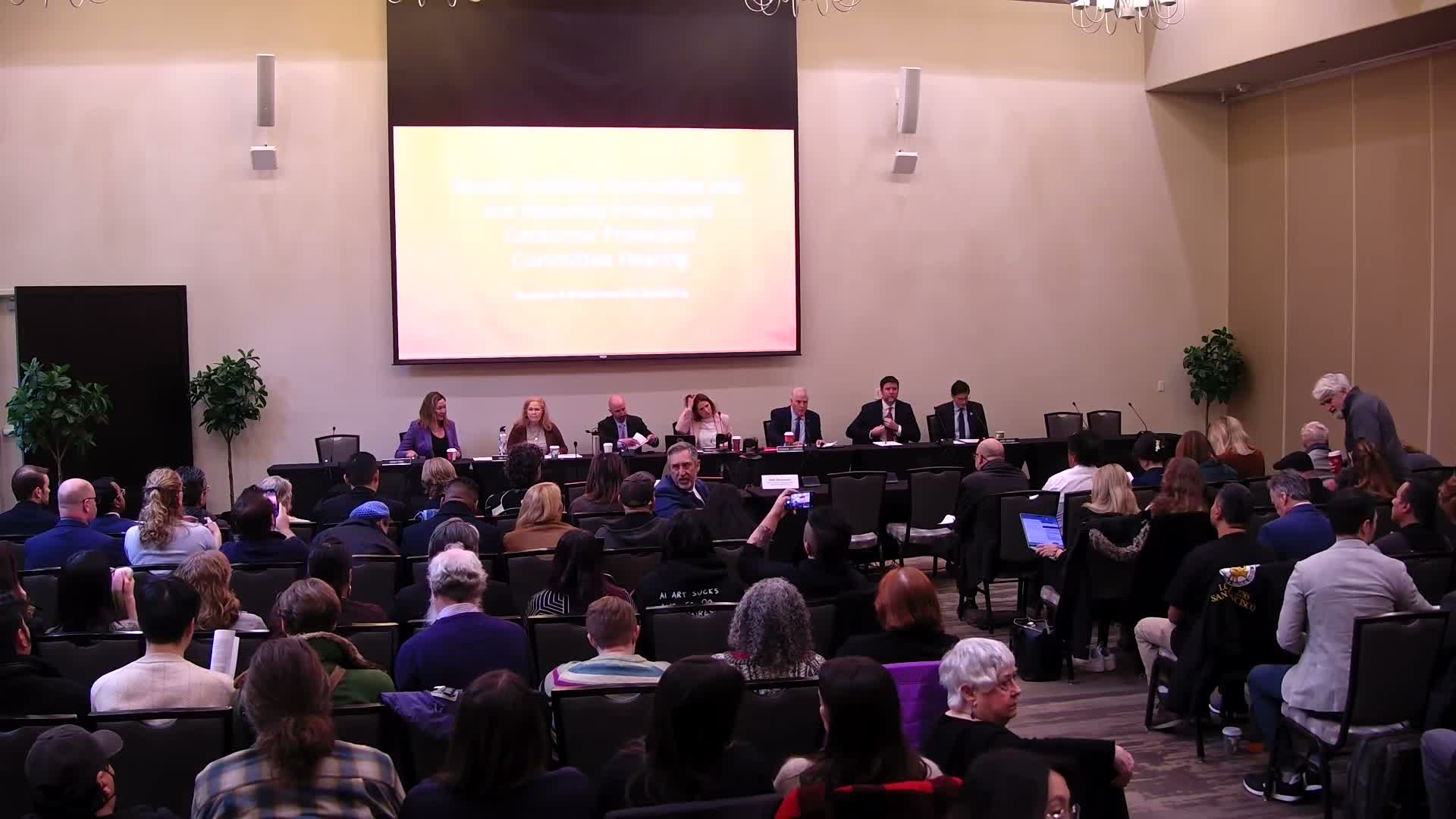
Sacramento — Lawmakers from the California State Senate Judiciary Committee and the Assembly Privacy and Consumer Protection Committee convened an informational hearing at Stanford to gather evidence on how generative artificial intelligence is trained and whether creators should be entitled to notice, credit or compensation.
The hearing’s chairs, Senator Umberg and Assemblymember Bauer Kahan, framed the session as a fact-finding exercise rather than a vote on legislation. “This is truly an informational hearing,” Senator Umberg said, and members repeatedly asked witnesses how state policy could protect California’s large creative economy while preserving innovation in AI.
Academic witnesses described a mixed legal landscape. Professor Pam Samuelson (University of California, Berkeley) told the committees that about 65 lawsuits have been filed alleging copyright claims tied to AI training and that courts are split on whether some uses constitute fair use. “Fair use can enable copyright to adapt at a time of rapid technological change,” Samuelson said, but she warned that conclusions will likely emerge case by case and could take years to settle.
Stanford researcher Rishibh Bommasani emphasized industry opacity about specific training datasets and pointed to gaps in enforcement, disclosure precision and the limits of transparency in meeting creators’ protection goals. Bommasani and other witnesses said AB 2013’s mandatory high-level summaries (already on the books) and the EU AI Act create useful templates, but enforcement and linkage to creators’ rights remain challenging.
The creative sector’s representatives urged stronger disclosure and practical notice. Jason George, a national SAG‑AFTRA board member, called for “a right to know” for performers so rights holders can verify whether their work was included in model training and then pursue licensing or remedies. Danny Lin, president of The Animation Guild, described shrinking contracts and cited a report estimating roughly 21% of film, TV and animation jobs could be consolidated or eliminated by 2026 — about 118,500 U.S. jobs and roughly 39,500 in California — and urged lawmakers to consider labor and licensing remedies.
Industry witnesses described partnerships and technical mitigations. Mark Gray, OpenAI’s copyright counsel, said his company has struck licensing partnerships with news organizations and supports addressing risky applications such as deepfakes through application‑specific guardrails. OpenAI and other firms emphasized implementation complexity for any disclosure regime, including trade‑secret claims and the risk of revealing proprietary curation processes.
Technical witnesses and vendors demonstrated that detection at scale is feasible. Professor Ben Zhao described ‘‘approximate’’ or ‘‘fuzzy’’ fingerprinting and deduplication techniques that can match verbatim or near‑verbatim items inside massive training corpora, and vendors showed prototype searches that matched sample artworks and photographs to known training datasets. Vendors argued that a repository of creator claims plus searchable fingerprints could enable notice, faster remediation and more efficient licensing negotiations.
International witnesses outlined alternative approaches. A European Union representative summarized the EU’s combination of copyright rules and the AI Act, which generally requires authorization to train models on copyrighted works or an opt‑out process for commercial use; the EU has issued templates and a code of practice to guide implementation.
Public comment filled the back half of the hearing. Dozens of visual artists, voice actors, animators, writers and union leaders urged passage of AB 412 (the AI Copyright Transparency Act) and related protections, recounting examples of alleged scraping and saying transparency is the minimum necessary to allow creators to seek compensation and enforce rights.
The committees did not take votes. Chairs closed the session by asking for written submissions and signaling further follow‑up to evaluate whether California should pursue disclosure standards, researcher access, licensing mechanisms or other tools to protect creators while enabling beneficial AI uses.