Get Full Government Meeting Transcripts, Videos, & Alerts Forever!
Get email alerts on the Sb758 topic
No spam. Unsubscribe anytime.
Senate committee advances bill to curb nitrous‑oxide sales and make concentrated kratom alkaloid a misdemeanor
Summary
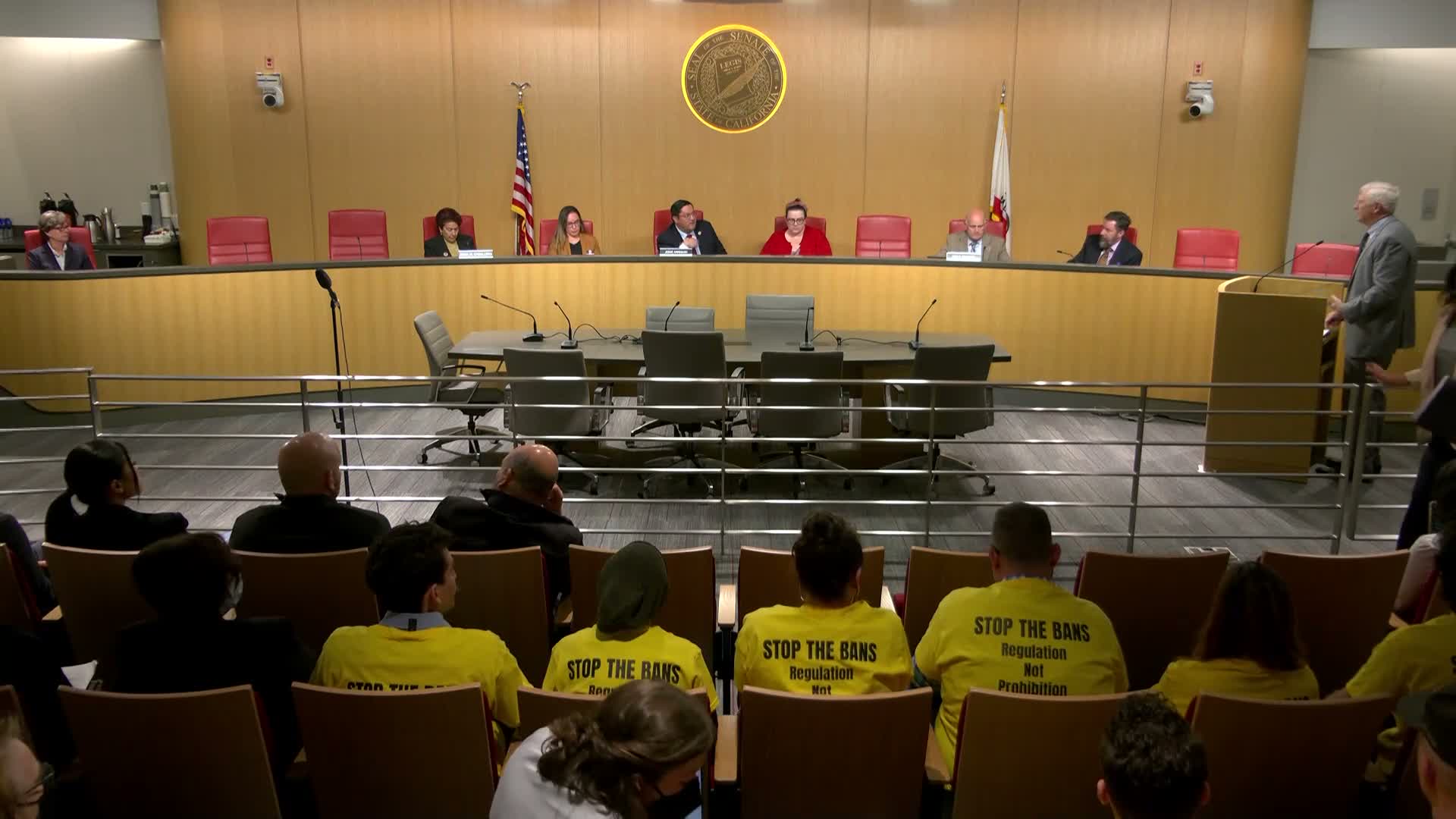
The Senate Committee on Public Safety voted 5‑0 to send SB 758 to Appropriations after amendments that narrow retailer prohibitions for nitrous oxide and make sale or distribution of concentrated 7‑hydroxymitragynine (7‑OH) a misdemeanor rather than a Schedule I offense. Supporters cited youth misuse and poison‑control calls; opponents urged regulation rather than criminalization.
Sen. Umberg, the bill’s author, told the Senate Committee on Public Safety that SB 758 would restrict sales of nitrous oxide in certain retail settings and make the sale or distribution of products containing concentrated 7‑hydroxymitragynine (7‑OH) a misdemeanor while preserving legitimate culinary and medicinal uses.
The bill’s author and supporters framed the measure as a public safety response to what they described as rising recreational misuse. "The availability of nitrous oxide is a scourge on our community and on California," said Mari Roden, a Ukiah city council member representing the League of California Cities, recounting emergency‑room cases and littered whippet canisters in Mendocino County. Ryan Sherman of the California Narcotic Officers Association, a cosponsor, emphasized concerns about synthetically concentrated 7‑OH and cited recent FDA warning letters to firms he said were marketing dangerous concentrated products.
Opponents urged a public‑health approach and warned the bill would criminalize consumers and small retailers. "This is prohibition and criminalization," said Jackie Subeck, founder and executive director of 7 Hope Alliance, arguing many consumers use kratom derivatives for pain management and addiction recovery. John Cleveland of Holistic Alternative Recovery Trust (HEART) called some alarm reporting "an intra‑industry PR battle" and urged regulation that includes age verification, labeling and testing rather than new misdemeanors.
The committee adopted amendments the author agreed to in committee counsel negotiations. The changes narrow the definition of prohibited retailers—exempting grocery and other retailers that sell food so legitimate culinary uses such as whipped cream remain lawful—and reduce criminal exposure by moving concentrated 7‑OH from a Schedule I classification to a misdemeanor for the sale or distribution of concentrated products, with possession not targeted by the amendment.
Dr. Michelle Ross, a researcher and addiction expert who testified in opposition, told the committee that the scientific literature remains contested and that 7‑OH is a metabolite present in kratom users. She said there is no definitive evidence that 7‑OH alone has caused deaths in the United States and urged careful public‑health regulation and further study.
After discussion about whether criminal penalties or a regulatory framework would better protect public health and children, the committee voted to move SB 758 "due passed as amended" to the Appropriations Committee on a recorded set of 'Aye' responses; the chair announced the bill was out on a vote of 5 to 0.
SB 758 will next be considered in the Assembly Appropriations Committee and may be amended further as members weigh public‑safety and public‑health approaches.