Get Full Government Meeting Transcripts, Videos, & Alerts Forever!
Get email alerts on the Residential Parking Permits topic
No spam. Unsubscribe anytime.
Decatur staff lays out enforceable rewrite for residential parking permit program; residents press for equity and speed before WatchFest
Summary
City staff told the commission Decatur's 37-street residential parking ordinance is largely unenforceable and recommended a rewrite with clear eligibility, petition, fee and enforcement rules; residents urged free first permits for households without driveways and asked for new signage and a faster timeline ahead of WatchFest.
Assistant City Manager Angela Threadgill opened the city's Dec. 15 work session by saying the current residential parking permit (RPP) ordinance names 37 streets but omits critical procedural elements that make it unenforceable in court. "When the police department and city solicitor reviewed this, they deemed that this ordinance is unenforceable," Threadgill said, noting the statute-level language in the code does not explain how residents obtain permits, how fees are calculated, or how enforcement and appeals will be handled.
Threadgill outlined the elements staff plans to codify in a text amendment: how a permit district is defined, petition requirements, maximum registered vehicles per household, guest-pass rules, permit fee structure, length of stay for guest passes, hours of enforcement, sanctions for unpermitted vehicles, and an online permit-management system tied to license-plate recognition (LPR). She said other jurisdictions often require a resident petition (samples cited by staff used a 70% property-owner signature threshold), measure occupancy during enforcement windows (a typical trigger is 75% occupancy), and quantify nonresident vehicles (commonly a one-third nonresident threshold).
To help with day-to-day operations, Threadgill said the city proposes an outsourced digital permit portal and LPR enforcement with a progressive education-to-fine approach: warnings and an initial grace period followed by fines for repeat offenders. Tammy Washington, the operations analyst who manages the parking-management contract, was singled out as staff's point person for verification and appeals at the administrative level.
Residents and commissioners pressed staff on the schedule and equity. Several speakers asked whether the city could implement a limited or temporary approach before the international WatchFest events next summer. "Time is of the essence," Mayor Garrett observed; Threadgill replied staff intends to launch a public survey in January'February 2026, circulate postcards to existing zone residents, and bring draft text amendments for legal review as soon as possible so the commission can act ahead of high-demand summer events. She described a year-long evaluation period through the end of 2026, with final recommendations coming back to the commission in 2026.
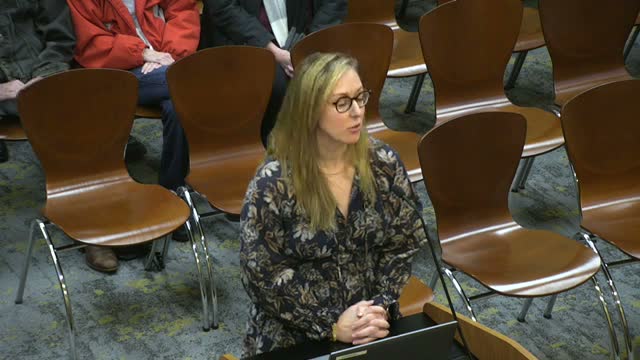
Neighborhood speakers from North Candler and Berry Streets urged the city to prioritize safety and fairness. Kate Breslin said many homes on her block lack off-street parking and asked the city to set fees so the first resident permit could be free for households without driveways. "More than half of the homes on North Candler and Berry Streets lack sufficient off-street parking for residents," Breslin said, asking the commission to reframe permit access as a necessity for some households rather than a convenience. Residents also asked that signage be replaced before enforcement starts, and that the city consider temporary measures for WatchFest if a full program cannot be implemented in time.
On costs, staff presented conservative modeling based on roughly 390 households in the 37 listed streets and a range of fee structures. Using an escalating-permit example cited in other cities (first permit ~$25; up to $100 for a fourth permit) and conservative assumptions about guest passes and citation volume, staff estimated a maximum permit revenue on the order of $97,500 annually plus guest-pass and citation revenues. Start-up costs for the permit-management software, LPR equipment, two enforcement vehicles and initial staff support are likely to exceed early revenues; Threadgill said the program's purpose is to reduce nonresident spillover and improve safety, not to be a revenue generator.
What the commission approved at the meeting was a staff direction to proceed with public outreach and draft ordinance language for legal review. The commission did not adopt final ordinance language on Dec. 15; Threadgill said the next steps would include the January survey, targeted mailings, public postings of sample code language, and a subsequent text-amendment draft to be reviewed by the city attorney and returned to the commission for consideration.
The city's approach emphasizes a staged public process and technical systems (LPR and an online portal) but leaves major fee, prioritization and equity decisions to the ordinance-drafting phase. Neighborhood advocates pushed staff and commissioners to prioritize free or subsidized first permits for households with no off-street parking, to include signage and clear public outreach in start-up budgeting, and to commit to a timeline that clearly states what will be in place during WatchFest.
Ending: Staff said it will bring draft ordinance language and a public-engagement timeline to the commission in January 2026; until then the current ordinance's gaps remain unaddressed and the existing informal zone list stays in place.