Auditors: State Land Department sold 48,000 acres without statutorily required 5‑year plan; lost revenue and safety gaps cited
Loading...
Summary
Auditors told JLAC the Arizona State Land Department sold more than 48,000 acres worth nearly $2.6 billion without an active 5‑year disposition plan, found years of stale agricultural rental rates and missed mineral inspections, and recommended new policies and stronger oversight.
The Joint Legislative Audit Committee heard a presentation from Arizona Auditor General staff that sharply criticized the Arizona State Land Department’s long‑running lapses in planning, leasing and inspections.
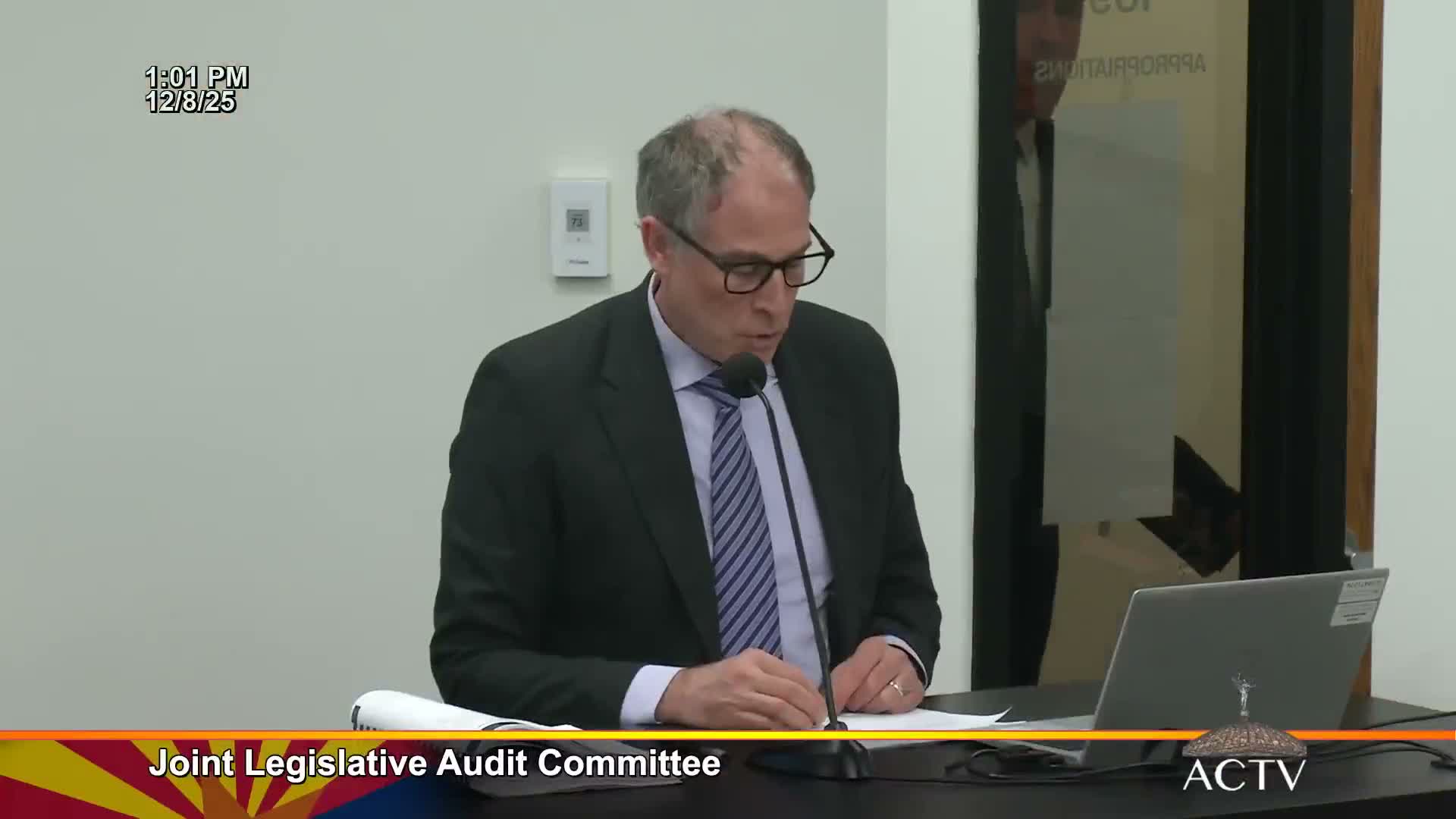
Jeff Gove of the Auditor General’s office told the committee that “since the last land disposition plan expired in 2016 … the department sold more than 48,000 acres of state trust land for nearly $2,600,000,000 without an active disposition plan.” He said auditors reviewed 97 land sale auctions and found that many had only one bidder; auctions with multiple bidders produced average winning bids about 68% higher than appraised value, while single‑bid auctions averaged less than 1% above appraisal.
Gove also said the department failed to update agricultural rental rates for years after a required mass appraisal was missed, which auditors estimated cost trust beneficiaries nearly $3.4 million in calendar year 2023 alone. In addition, auditors reported that staff did not inspect a sample of mineral leases and permits on closure and released reclamation bonds without field inspections, increasing public‑safety and financial risks. The presentation cited a 2020 incident in Maricopa County in which a juvenile fell into an unmarked, abandoned mine shaft; the state settled the resulting suit for $1.8 million.
Auditors recommended the department develop and implement a statutorily required 5‑year disposition plan, complete a mass appraisal for agricultural land and update rental rates, inspect closed mineral leases before releasing bonds, and adopt clear policies to document commissioner‑initiated sales. The audit team said the department agreed to implement nearly all recommendations but declined the recommendation to adopt written procedures specifically covering commissioner‑initiated sales, saying it may conflict with the commissioner’s judgment.
Robin Sahid, the State Land Department commissioner, told JLAC she agrees in principle with improving transparency and that the department has created an internal working group to develop a 5‑year plan or consider statutory changes to better align planning with current needs. Sahid said the department is updating its appraisal work and has begun stakeholder outreach and process improvements, particularly in the minerals division, and is implementing a Salesforce system to track application progress.
Committee members pressed the department on the nine‑year gap without a disposition plan, why the urban land planning oversight committee has not been reconstituted (auditors noted it has had no members since 2018), the backlog of mineral applications, and why weekly internal ASAP meetings for application screening are not treated as public processes. Several members asked the Auditor General to examine specific auctions with unusual bidder restrictions as potential follow‑up items.
Next steps: JLAC asked the Auditor General to include relevant auction data in follow‑up work and to provide additional timeline and documentation about the oversight committee and pending applications. The department said it will provide data and follow‑up information about disposition planning and the minerals backlog.