Get Full Government Meeting Transcripts, Videos, & Alerts Forever!
Get email alerts on the Land Use topic
No spam. Unsubscribe anytime.
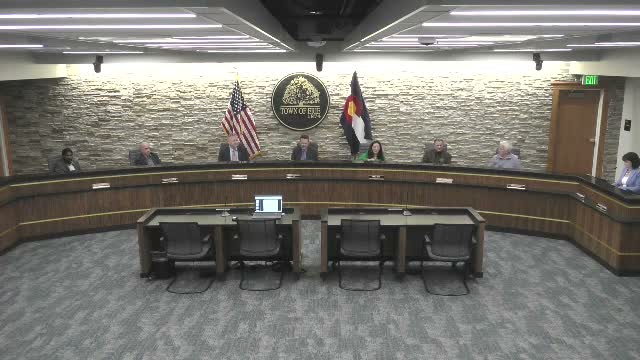
Erie council annexes and zones 87‑acre Erie West parcel as Agricultural Holding
Summary
After a public hearing, Erie Town Council approved an ordinance to annex roughly 87 acres known as Erie West and set initial zoning to Agricultural Holding, with staff saying the zoning maintains existing agricultural and large‑lot residential uses.
Erie Town Council voted to annex and apply Agricultural Holding zoning to about 87 acres known as Erie West after a public hearing on March 11. Special counsel Jerry Dahl explained council had separated the prior annexation (legislative) from the zoning (quasi‑judicial) so property‑owner conversations could proceed; staff recommended the Ag‑Holding designation because it continues the site’s current agricultural and large‑lot residential character.
Kelly Driscoll, filling in for the project planner, told the council the comprehensive plan designates the area for agricultural uses and that staff had completed required reposting and notice; she said staff recommended adoption of ordinance 25‑006 to annex and zone the property.
Two nearby landowners spoke in support at public comment, saying they planned to continue agricultural operations and stewardship of the Boulder Creek wildlife corridor.
Council moved and approved the ordinance with no recorded opposing votes. Mayor Andrew J. Moore welcomed the properties into the town and thanked owners for meeting town requirements.
What happens next: the ordinance will be formalized in the town record and the property will be subject to the town’s Unified Development Code under the Ag‑Holding district. Any future changes to use or higher‑density development would require separate land‑use applications and zoning review.
Speakers quoted in this article are drawn from the council meeting record.