Get Full Government Meeting Transcripts, Videos, & Alerts Forever!
Get email alerts on the Utilities Rate Case topic
No spam. Unsubscribe anytime.
Colorado Springs pauses net‑metering changes after lengthy Utilities rate hearing
Summary
After a daylong public hearing, City Council removed proposed changes to net‑metering from the Colorado Springs Utilities 2026 rate case following extensive public comment and council questions about the proposal’s calculations and outreach.
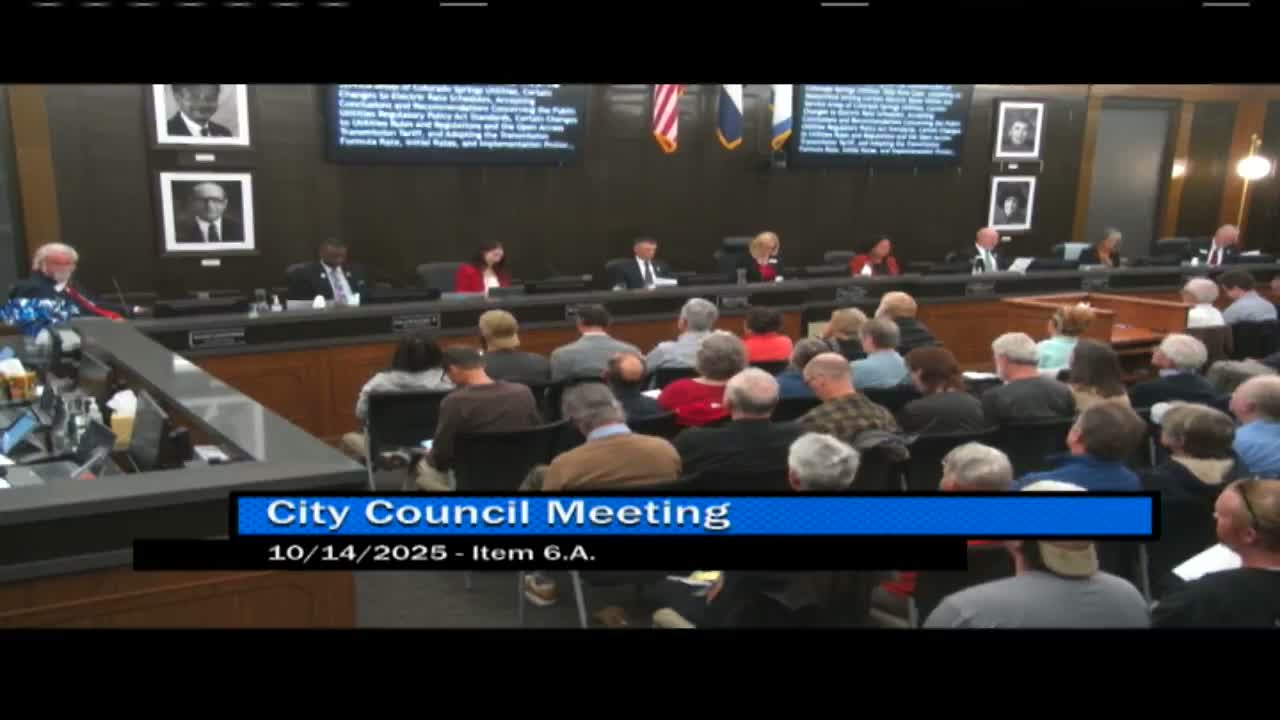
City Council on Oct. 14 heard nearly nine hours of testimony on Colorado Springs Utilities’ proposed 2026 rate case, including a high‑profile plan to change how rooftop solar customers are billed.
Utilities staff told the council and a packed chamber that the city’s net‑metering program, which credits customers for excess solar generation and allows one‑for‑one carryover of kilowatt‑hours, increasingly under‑recovers the cost of serving those customers. Scott Sharola, manager of pricing and rates at Colorado Springs Utilities, said a consultant’s analysis of a stratified sample of net‑metering customers estimated a median under‑recovery of about $600 a year per solar customer and extrapolated that to roughly $5.5 million annually spread across other ratepayers. “That under‑quantification results in cost shifting to other non‑solar customers,” Sharola said during the presentation.
Solar industry groups, dozens of solar owners and multiple installers disputed the math and the policy approach. Casey Becker of the Colorado Solar and Storage Association told council the proposal would “discriminate against customers who adopt solar” and urged the council to reject the plan. Industry witnesses pressed utilities to publish detailed calculations and to prioritize alternatives such as time‑of‑use billing, targeted incentives for batteries, or voluntary net‑billing options.
Council members pressed utilities on methodology, sample sizes and outreach. City Attorney Chris Bilek explained the council’s role as the municipal utility’s regulator and the differences between municipal and investor‑owned net‑metering rules. After hours of discussion the council used a nonbinding thumbs‑up/thumbs‑down straw call on the net‑metering changes; the results recorded by the city attorney were five against and four in favor. The chair instructed staff to remove the net‑metering proposal from the packet that will go to formal vote on Oct. 28 while leaving the remainder of the rate case (tariff changes, large‑load schedule, SPP transmission filings) intact.
Utilities said the net‑metering measures were proposed to align rates with cost causation: demand‑related infrastructure, they argued, must be funded when customers require service during peak periods even if they credited generation earlier in the day. Tristan Gerhardt, Utilities’ CFO, said batteries and optional programs could play a role long term, but that the city’s base net‑metering rules under state law required the one‑for‑one crediting approach for retail kilowatt‑hours. Councilmembers and public speakers suggested a broader public engagement process and time to evaluate alternatives before the city adopts a solar‑specific billing change.
Council did not take a final vote on the net‑metering policy; the remaining rate‑case items will return for formal action later this month.