Get Full Government Meeting Transcripts, Videos, & Alerts Forever!
Get email alerts on the Raw Milk Legislation topic
No spam. Unsubscribe anytime.
House committee hears testimony on bills to allow direct sale of raw milk to consumers
Summary
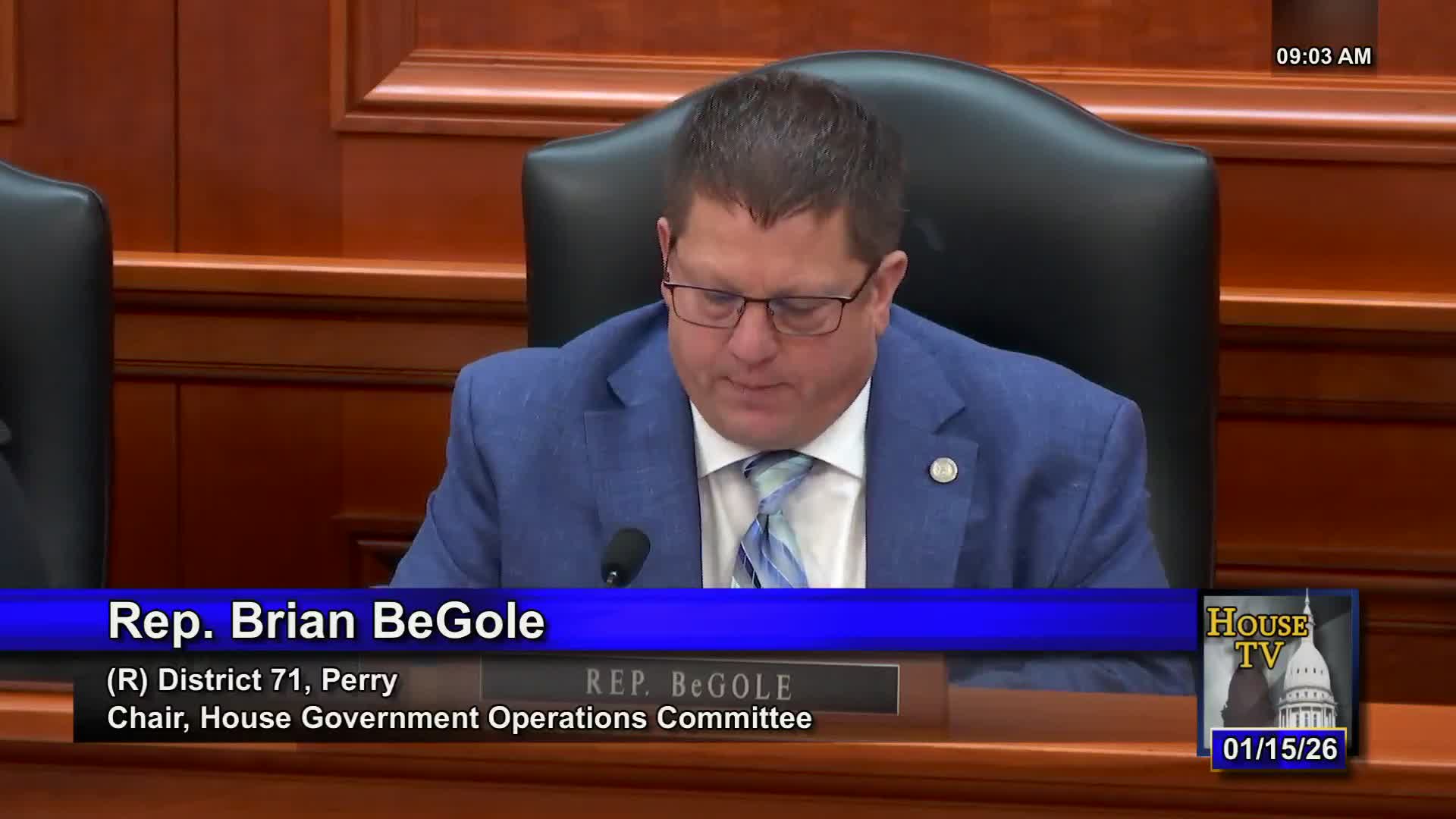
The House Committee on Government Operations heard testimony on House Bills 5217–5219 to permit dairy farmers to sell unpasteurized raw milk directly to consumers; witnesses stressed farm‑level safety practices and consumer choice while members pressed on inspections, outbreak data, labeling and herd‑share rules.
The House Committee on Government Operations heard testimony on bills (House Bills 5217–5219) that would allow dairy farmers to sell raw, unpasteurized milk directly to consumers, but lawmakers and witnesses debated how to balance consumer choice with public‑health safeguards.
Proponents told the committee on the bills’ behalf that properly produced raw milk can be safe and beneficial. "My name is Ashley Armstrong, and I care deeply about the connection between farm fresh healthy food, human health, and the survival of small family farms," said Ashley Armstrong, who identified herself as the owner of Armstrong Farms in Southwest Michigan. Armstrong told the committee, "there are about 30000000 people in The United States who are milk intolerant," and argued raw milk contains enzymes and living compounds that can aid digestion.
Chelsea, a small farmer from Dryden, described the economic pressures on small producers and urged broader access to direct sales. "If I could offer cream, butter, and cheese value added products, then maybe," she said, illustrating how current rules limit small operations’ options.
Rick Hitchcock of Lone Oak Homestead testified on on‑farm practices, saying producers use rapid cooling, daily sanitation and regular testing to control contamination. "Raw milk is a living wholesome food but only when produced with care intention and uncompromising cleanliness," Hitchcock told the committee, detailing tests such as coliform counts and standard plate counts and noting participation in the Raw Milk Institute’s program.
Members pressed witnesses on inspection, labeling and risk. Representative Fitzgerald cited federal public‑health data and asked how the committee should weigh outbreak history against producers’ claims: "the CDC notes from 1998 through 2018, there were 202 outbreaks linked to drinking raw milk and that those actually caused 2600 illnesses and over 200 hospitalizations," Fitzgerald said. Witnesses responded that raw‑milk outbreaks are a small share of total foodborne outbreaks and that pasteurized products can also carry risks.
On regulatory details, proponents said the bills would allow direct‑to‑consumer sales rather than retail distribution and would not replace existing herd‑share arrangements. Witnesses said herd shares, allowed previously by the Michigan Department of Agriculture and Rural Development in 2013, generally lack state testing mandates and that direct sales could include explicit labeling and consumer notices; producers described dating jars at milking and a roughly two‑week refrigerated shelf guideline.
No committee vote was taken on the bills during the hearing. Earlier in the session the committee approved minutes from its Dec. 18 meeting on a motion by Representative Harris. The clerk also reported multiple position cards submitted: several agricultural and industry groups indicated they were "not wanting to speak in opposition," and the chair noted substantial individual support cards were filed.
The hearing provided lawmakers with technical claims and counterclaims to consider — from proponents’ descriptions of farm protocols and digestive‑health claims to CDC outbreak figures and questions about inspection and labeling. The committee did not set a date for further action on the bills during this session.