Get Full Government Meeting Transcripts, Videos, & Alerts Forever!
Get email alerts on the Transportation Funding topic
No spam. Unsubscribe anytime.
Appropriations subcommittee briefed on October 2025 transportation package; new neighborhood road fund shifts funds to counties and cities
Summary
House Fiscal Agency clerk William Hamilton told the Appropriations Subcommittee that an October 2025 seven‑bill package raises the motor fuel tax, creates a neighborhood road fund and reallocates revenue so counties and cities see near‑term increases while some timing and revenue sources remain uncertain.
At a meeting of the Appropriations Subcommittee on State and Local Transportation, House Fiscal Agency fiscal clerk William Hamilton briefed members on the October 2025 seven‑bill transportation funding package and its likely effects on state and local road funding.
Hamilton framed the package as producing two separate impacts: changes to the Michigan Transportation Fund (MTF) and the creation of a new neighborhood road fund with its own distribution model. "The motor fuel tax is now 52.4¢ per gallon," Hamilton said, citing the 20¢ statutory increase plus an inflation adjustment that takes effect Jan. 1, 2026.
The change to the fuel tax is estimated to generate roughly $1,073,000,000 on a 12‑month basis credited to the MTF, Hamilton said, but the package also eliminates a $600,000,000 individual income tax credit that had previously flowed to the MTF. He reported the net 12‑month MTF change would be about $350,500,000 but that FY2026 will show a much smaller recognized amount (roughly $33,700,000) because the fuel tax is effective Jan. 1 and collections are recognized with a delay.
Hamilton described the neighborhood road fund as a materially new distribution mechanism. Its principal revenue sources in the HFA analysis are a corporate income tax earmark (estimated $688,000,000 in 2026, subject to prior corporate earmarks) and a new 24% wholesale marijuana excise tax established in the Comprehensive Road Funding Act (HFA estimated net revenue of about $417,000,000 annually; a partial‑year 2026 estimate of $312,800,000).
The neighborhood road fund distribution shown to members directs $100,000,000 to the Local Bridge Advisory Board for local bridge projects, $40,000,000 to a local grade separation fund, and sets aside $100,000,000 to be split (35,000,000 to the Comprehensive Transportation Fund and 65,000,000 to an Infrastructure Projects Authority fund). After those priorities, the balance would be distributed to road agencies with 52% to county road commissions, 28% to cities and villages and 20% to the state trunk line fund.
Using HFA's flowchart and tables (pages 8–9 of the memo), Hamilton said the agency's estimate for this fiscal year is an additional $408,800,000 for county road agencies collectively and an additional $220,000,000 for cities and villages. Members discussed a roughly "close to 30%" across‑the‑board increase as a simple talking point for constituents; Hamilton characterized that as a preliminary, rounded estimate.
On the Comprehensive Transportation Fund and transit, Hamilton said the fund would receive about $70,000,000 from the motor fuel tax changes but lose about $32,400,000 from lost auto‑related sales tax, for a net roughly $38,000,000 in the MTF column; the CTF also is slated to receive $35,000,000 from the neighborhood road fund's set‑aside described above. Hamilton and members discussed these numbers in rounded terms as near‑term increases for transit and CTF programs.
Hamilton noted timing and predictability issues: the wholesale marijuana tax is new and questions remain about when collections will be credited to the neighborhood fund; corporate earmarks are subject to other priorities before the neighborhood fund receives the full credited amount. He advised members that MDOT posts monthly distributions by county and city and that the HFA memos, flowchart and spreadsheet provide the underlying assumptions.
On statutory limits and matching, Hamilton said Act 51 historically limited how much county road commissions could spend on the local (neighborhood) road system, and that the neighborhood road fund provisions in the enacted legislation permit the use of neighborhood road fund dollars to pay 100% of local road projects (permissive, not mandatory). "So you could go fix those roads, you just have to make sure that the county is on the same page and your township's on the same page," Hamilton said.
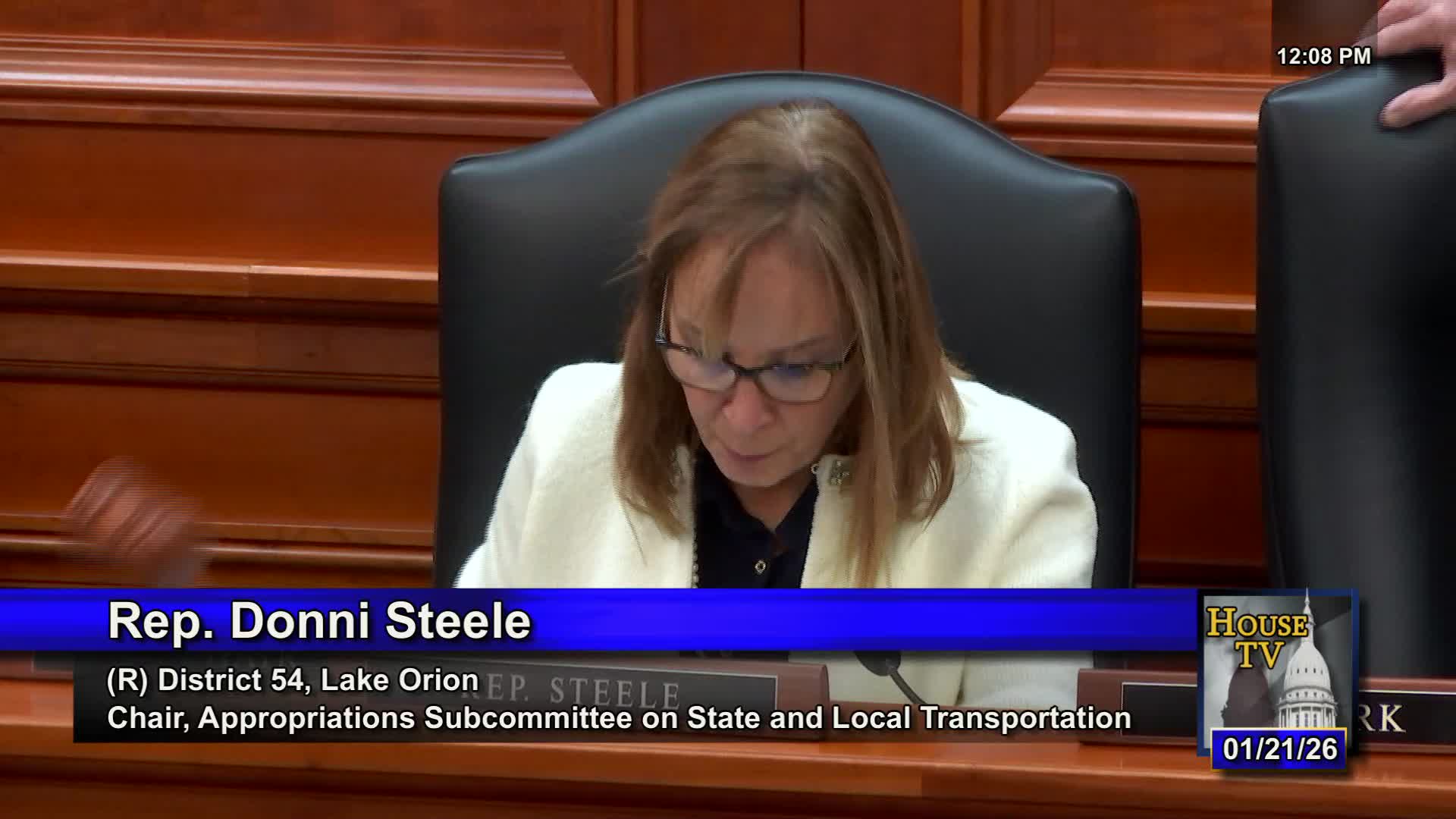
Representative Borton moved to adopt the minutes of the Oct. 29 meeting; the motion carried by unanimous consent. With no further business the chair adjourned the committee.
Next steps identified in the presentation: members were directed to HFA's memo and flowcharts for county‑ and city‑level estimates, to MDOT's monthly distribution site for ongoing monitoring, and to the governor's budget process for any subsequent adjustments to FY2026 recognition of neighborhood road fund receipts.