Get Full Government Meeting Transcripts, Videos, & Alerts Forever!
Get email alerts on the Ai Economics topic
No spam. Unsubscribe anytime.
Justin Wolfers: AI promises productivity gains but winners will depend on ownership and policy
Summary
University of Michigan professor Justin Wolfers told revenue forecasters that AI can raise productivity substantially in firm‑level trials and may add to GDP over a decade, but outcomes depend sharply on market structure, ownership of AI capital and regulatory choices.
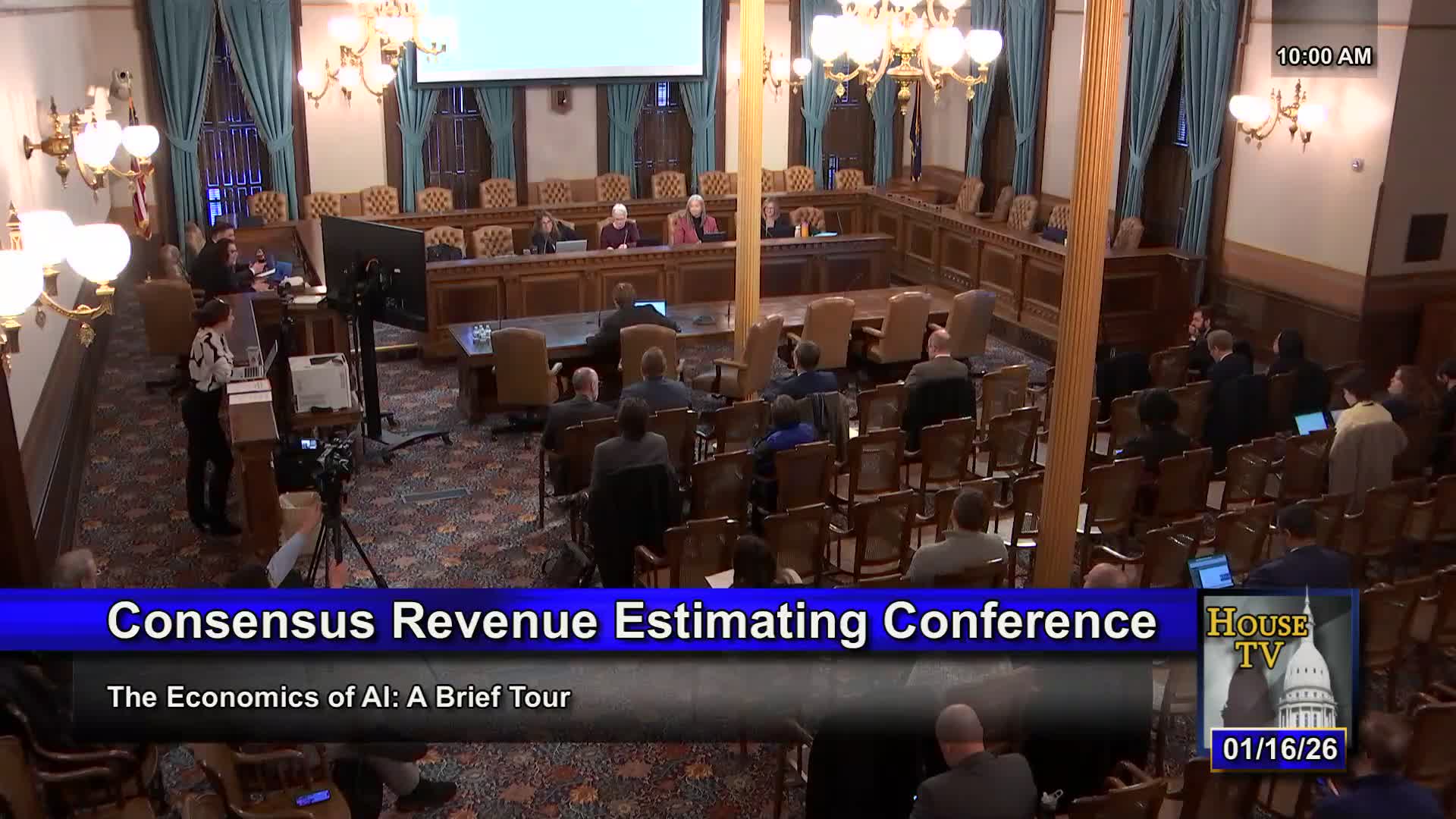
Justin Wolfers, professor of public policy and economics at the University of Michigan, told the CREC that while early experiments and company trials show striking productivity gains from AI, the macroeconomic and distributional outcomes are highly uncertain and depend on ownership and market structure.
Wolfers summarized randomized trials and field experiments in which AI tools reduced task completion times for coders (from 161 to 71 minutes in one trial) and raised productivity in office tasks (a cited 40% reduction in task time using ChatGPT in an experiment). In customer‑service applications, a chatbot assistant reduced resolution times roughly 14% in a company trial, he said. "That's a generation’s productivity growth, in this for this particular firm for this particular task," he said when describing large micro gains.
From micro to macro
Wolfers described arithmetic frameworks that map task automation to aggregate GDP effects. Conservative calculations produce modest changes to GDP over a decade (roughly 1% level), while more optimistic scenarios from Wall Street or some firms could imply multi‑percent increases if AI accelerates innovation and productivity of innovators. He emphasized historical lags in productivity gains from major technologies and said timing is uncertain: "When? Who the heck knows?"
Political economy and ownership
A core message of Wolfers’s talk was that distributional outcomes — whether workers or capital capture AI gains — depend on who owns the AI tools and the structure of AI markets. He used a thought experiment: if workers individually own helpful AI tools they would be better off; if employers or a monopolist AI provider controls the tools, workers may lose jobs and most gains would accrue to capital owners. He warned of scenarios in which upstream monopolists (e.g., chip makers) or a dominant AI service firm could capture large shares of gains.
Policy implications and personal advice
Wolfers suggested preserving competition in AI markets and designing rules that shape ownership and distribution of returns. He also recommended that public officials and organizations experiment with AI daily to understand practical applications; ‘‘Wake up every day and open a tab with your favorite large language model,’’ he said as practical advice to become fluent in the tools.
Audience members asked about sectoral adoption (manufacturing and health care), timing, and small‑business uptake; Wolfers said current adoption is slow but modular software and low barriers to entry mean both large incumbents and nimble startups could drive adoption in different ways.