Get Full Government Meeting Transcripts, Videos, & Alerts Forever!
Get email alerts on the Audit Department Of State Branch Operations topic
No spam. Unsubscribe anytime.
Auditors find gaps in Michigan Department of State branch records and procedures; department says fixes underway
Summary
An Office of the Auditor General performance audit flagged inconsistent wait-time recording, missing Real ID documentation in sampled records, testing-area oversight gaps, and incomplete training records in the Department of State’s branch operations. Department officials say they have rolled out Qualtrics surveys, check-in kiosks and other corrective steps and dispute some audit characterizations about document retention.
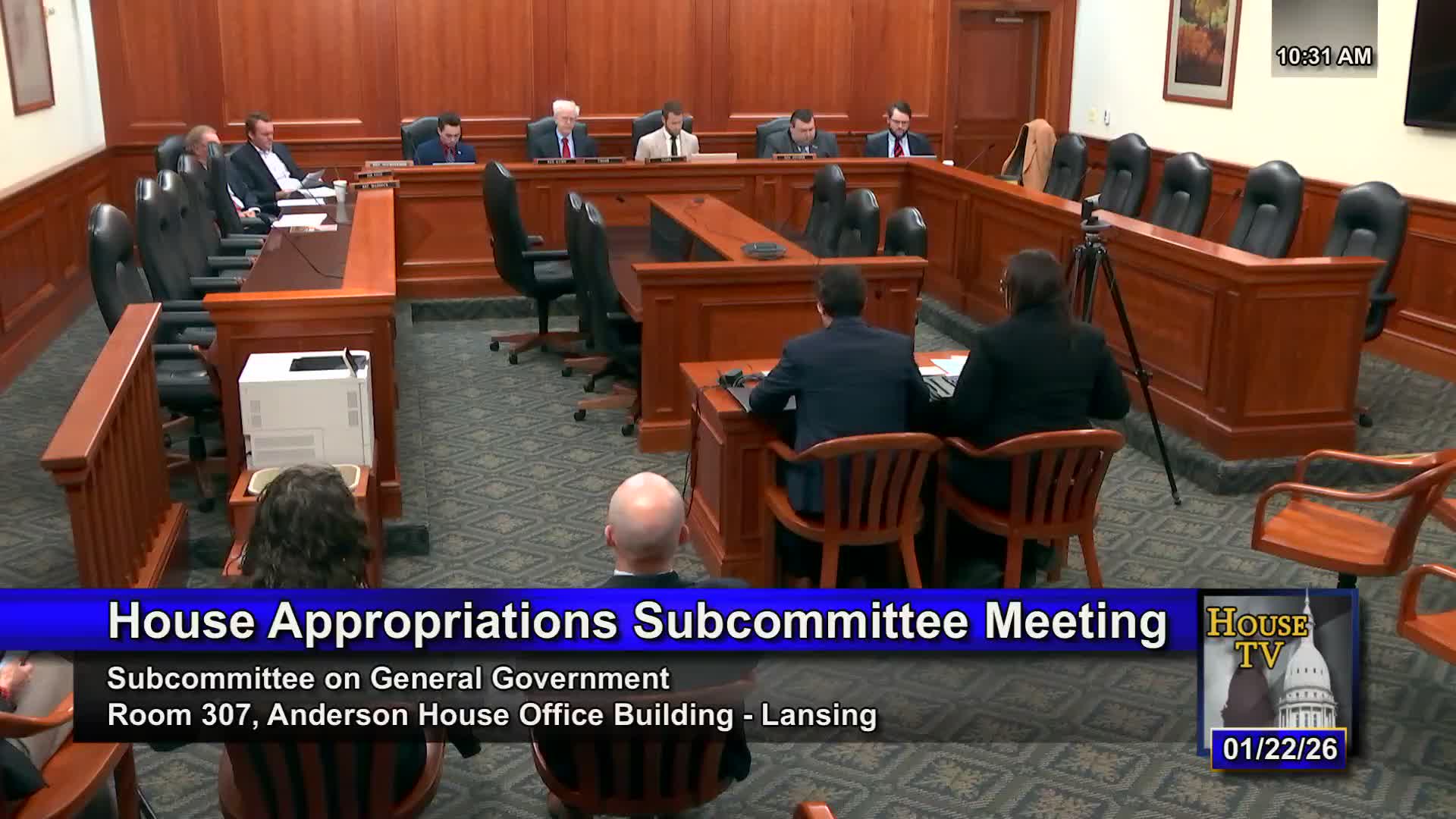
The House Appropriations Subcommittee on General Government heard on Jan. 20 from the Office of the Auditor General and the Michigan Department of State about a recent performance audit of the branch operations division.
Robert Lock, an audit manager, and Katie Snyder, the audit supervisor for the project, told the committee they set three objectives for the review: assess customer-service data collection, evaluate safeguarding of assets, and test compliance with selected state and federal requirements. "We established 3 audit objectives," Lock said, and the audit used on-site branch visits and a sample of branch transactions drawn from the department’s CARS data to evaluate practices.
The audit concluded the branch operations division generally safeguarded assets and provided sufficient customer service but identified four reportable issues. Finding 1 said the division should strengthen collection and use of customer-service information because wait-time measurement varied by branch and the auditors found limited customer-feedback data; the report notes the auditors observed procedures at a sample of 13 of 131 branches and identified 693 customer comments from Oct. 1, 2022, through May 31, 2024 — “less than one-half of 1% of the 7,000,000 customers served” in that period. Finding 2 flagged recordkeeping gaps for Real ID and enhanced ID transactions: from a statewide sample of 60 transactions (12 related to Real ID), auditors reported missing supporting documentation in several reviewed files (for example, missing proof of Social Security number or residency in the records the auditors could examine). Finding 3 said branch staff did not always enforce testing-area procedures (site visits at 13 branches found test-taker belongings left at desks and inconsistent detection of electronic-device use). Finding 4 said the department did not maintain documentation for some required employee training sessions; in a sample of 39 employees, auditors found documentation lacking for 55 of 398 required sessions (14%).
Committee members pressed auditors about sampling and scope. The auditors said the 60-transaction sample was drawn statewide from the CARS population and that Real ID classifications required reviewing transaction detail; they also said the audit reviewed communications with the Transportation Security Administration and that auditors expect some follow-up work may be performed depending on materiality and office priorities.
Christina Anderson, chief of staff for the Michigan Department of State, told the committee the department welcomes the audit and has already implemented or accelerated several changes. Anderson said branch offices processed roughly 11,800,000 transactions during the audit period, collected about $1.3 billion in revenue and spent approximately $136 million on branch operations. She said the auditors ‘‘deemed effective and properly safeguarding assets’’ in their review.
On customer feedback and wait times, Anderson said branches vary in staffing and that 80 of 131 branches do not have greeters; that difference produced inconsistent start points for wait-time measurement. The department has rolled out check-in kiosks and plans to have a consistent check-in start-time method across the state by March. Anderson said, "Last week, we served 94% of our customers within 20 minutes of their scheduled visit time." To strengthen qualitative measures, the department launched a statewide Qualtrics survey on Dec. 17 and reported more than 36,000 responses with an average satisfaction rating of 4.6.
On the Real ID documentation finding, Anderson said the department scans and checks documentation, including Social Security numbers, against federal databases but does not retain images of Social Security numbers because storing scanned SSNs for millions of residents poses a cybersecurity risk. She told the committee TSA audited department practices in December 2024 and found practices “in line with federal regulations,” and she said many other states also retain audit trails rather than SSN images as a cybersecurity safeguard.
Anderson said the department partially agreed with the testing finding and has launched customer-service training, added district-manager checklists to enforce testing procedures, and deployed an online testing portal (launched after the audit field work) that has conducted roughly 3,800 tests since rollout. On training records, she explained that the State of Michigan Learning Center overwrites previous-year entries when an employee re-enrolls; the department is working with the Department of Technology, Management & Budget on workarounds so evidence of yearly completion can be retained without duplicative staffing.
Committee members asked for several follow-ups: the audit team said it will provide the committee the name of the "similar industry" used to benchmark training standards; the Department of State said it will provide additional contract details for Qualtrics and describe survey methodology and the precise training-hour totals cited in the audit.
The committee recorded a procedural motion to approve the minutes of its Dec. 9, 2025, meeting; Representative Van Morecambe moved the approval and there were no objections.
Next steps identified at the hearing include follow-up information from the auditors and the Department of State on survey methodology, the specific benchmark industry used for training comparisons, contract terms for the Qualtrics statewide agreement, and the department’s timeline for completing the kiosk/check-in rollout and training documentation work. The committee adjourned with no vote on policy changes during this session.