Get Full Government Meeting Transcripts, Videos, & Alerts Forever!
Get email alerts on the Rural Health Funding topic
No spam. Unsubscribe anytime.
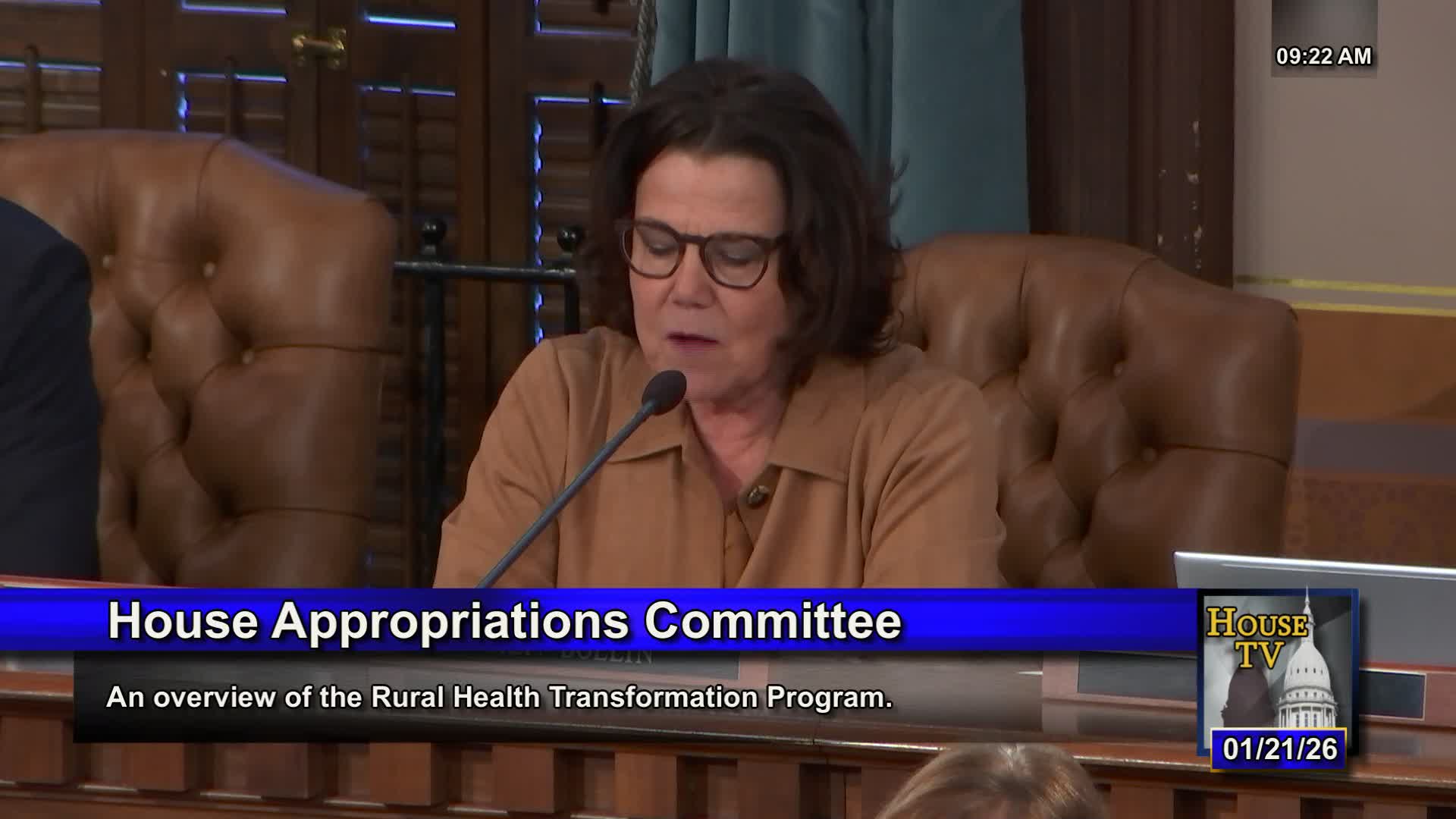
Michigan awarded $173 million for federal rural health grant; lawmakers press MDHHS on how funds will be prioritized
Summary
Michigan received $173,128,201 in the first-year Rural Health Transformation award; MDHHS told the House Appropriations Committee the funds must be innovative and cannot duplicate Medicaid, while lawmakers pressed the department on rural definitions, per-capita ranking, and distribution to fully rural counties and hospitals.
Michigan received $173,128,201 in federal Rural Health Transformation funding for its first year, MDHHS told the House Appropriations Committee on Jan. 21. Beth Nagel, Senior Deputy Director of Policy Planning and Operational Support at the Michigan Department of Health and Human Services, presented the state's plan and outlined CMS requirements that the funding support new, innovative programs rather than replace Medicaid funding.
The award is part of a federal $50 billion, five-year program; CMS released $10 billion for year one. Nagel said Michigan's award amounts to roughly $83 per rural resident using a per-resident analysis cited in the department's materials and that the state received a year-one grant of $173,128,201. She noted the department used HRSA's rural classification (75 counties identified as rural by that metric) and carved out 5% of the state award specifically for tribal governments.
Lawmakers pressed MDHHS on multiple issues during a prolonged question-and-answer period. Representative Green asked why Wayne County census tracts were treated as rural and why Michigan ranked near the bottom among states by total award; Nagel said the department used HRSA data updated in October 2025 and that CMS has not yet provided confidential feedback on scoring. Nagel described CMS's scoring method as 50% equal distribution to states, 25% metrics of rurality and need, and 25% application quality and policy alignment.
House Fiscal Agency analyst Ken Dell told the committee Michigan had applied for a larger award and must submit a revised budget to CMS after the December award notice. Dell summarized the federal allocation mechanics required by the enabling public law, reiterated the CMS guidance that no more than 10% of the award can be used for administration/indirect costs, and said Michigan must resubmit a reduced budget to align proposals with the $173.1 million award.
Committee members also sought clarity about how funds would reach fully rural areas versus partially rural census tracts that are adjacent to larger population centers. Nagel said the department plans to prioritize by rural population at the census-tract level and to consider other factors so that fully rural counties are not disadvantaged by proximity to urban centers. She added that the department posted the state proposal and plan materials at michigan.gov/rhtp and has posted a nomination process for an advisory committee; contracting and lists of funded nonprofits are expected to follow CMS budget approval and are anticipated in the second quarter.
Some lawmakers asked whether the RHT program would stabilize rural hospitals in the face of anticipated Medicaid changes; Nagel and fiscal staff emphasized that CMS designed the program to fund innovation and transformation rather than to replace Medicaid revenues. The department and fiscal staff did not commit to specific dollar amounts to local providers, citing both CMS's 10% cap on administrative spending and the need to await CMS approval of Michigan's revised budget.
The committee indicated it will seek CMS feedback and follow up with MDHHS on contracting and the advisory committee. Representative Beeson moved to approve the committee minutes; with no objections the minutes were approved and the meeting was adjourned.
Sources quoted at the hearing included Beth Nagel (MDHHS) and Ken Dell (House Fiscal Agency). The department listed Sharde Burton as the legislative affairs contact for follow-up.