Get Full Government Meeting Transcripts, Videos, & Alerts Forever!
Get email alerts on the Education Budget topic
No spam. Unsubscribe anytime.
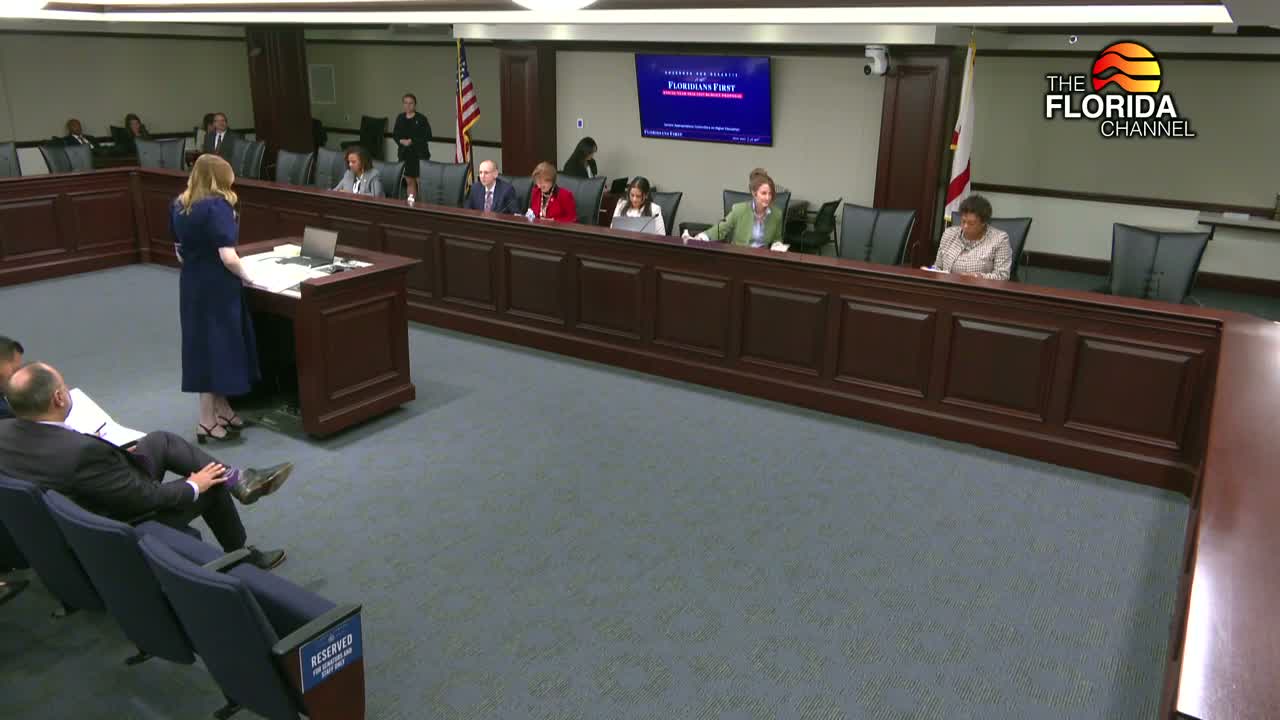
Senate committee hears governor's 2026 education budget preview highlighting scholarships and workforce funding
Summary
The Senate Appropriations Committee on Higher Education heard a presentation from the governor's office outlining a proposed $117.4 billion statewide budget with $32.5 billion for education; presenters highlighted scholarship funding, workforce investments and a $100 million recruitment and retention line for universities.
The Florida Senate Appropriations Committee on Higher Education received a preview of Governor Ron DeSantis’s proposed 2026 budget for education, with the governor’s office saying the plan would keep in-state tuition and fees flat for Florida residents while increasing targeted workforce and college supports.
Shelby Salmons, policy coordinator in the governor’s Office of Policy and Budget, told the committee the governor’s proposed budget totals $117.4 billion and that the education portion is about $32.5 billion, roughly 28% of the total. Salmons said the education share of general revenue in the proposal is about $23 billion, which she described as roughly 45% of general revenue.
The presentation listed several scholarship and aid line items included in the proposal. The presenter said the budget provides approximately $692.5 million for Bright Futures Scholarship recipients and funding for the Benacquisto Scholarship Program (about $36.4 million). The proposal also includes amounts described in the presentation for scholarships serving children and spouses of deceased or disabled veterans (~$34.7 million), continuation of first-responder and law-enforcement scholarship funding (including a $10 million first-responder scholarship line and up to $1,000 for eligible certification exam fees), as well as funding for an Open Door program and other student-aid initiatives.
An unnamed Commissioner of Education who presented details said Florida’s graduation rate was announced at 92.2 percent and framed the governor’s education package as emphasizing affordability and workforce alignment. "The budget contains no tuition or fee increases for Florida residents," the commissioner said, and described continued investments in workforce education and career-technical programs.
Workforce investments were highlighted as a central priority. The presentation cited roughly $487.2 million in workforce development funding (an increase of about $24 million), continued funding for the Pathways to Careers opportunity grant (including $5 million to continue a registered apprenticeship program for teachers), $100 million reinstated for a workforce-development capitalization incentive grant, and $12 million in performance funding to support district workforce programs for industry certification completers. The presentation also referenced a multi-year push—driven by a gubernatorial executive order—to make Florida a national leader in workforce education and stated the administration’s cumulative commitment toward that goal exceeds $12 billion since the initiative began.
Chancellor Ray Rodrigues (State University System) answered a question from the committee about a $100 million recruitment and retention line for universities, saying the funding is in the State University System budget, will be dispersed to universities, and carries no additional directives beyond that it should be used for faculty recruitment and retention. "The funds are dispersed to the universities. There are no directives given to them other than it should be used for faculty recruitment and retention," Rodrigues said.
Committee members asked about how the Guardian program expansion would work at state colleges that already have campus police. The commissioner said institutions could adopt the guardian model, use it to supplement existing security during off-hours, or not utilize it; she said the program is intended to provide a lower-cost, flexible, trained option compared with private security or sheriff’s coverage in some contexts.
The governor’s office presenter also noted higher-education funding changes versus the current year: an overall 3% increase across higher education, with workforce education rising by about 10%, colleges by about 4% and universities by about 1%.
The committee did not take budget votes at the hearing; the session functioned as an informational presentation and an opportunity for senators to ask for clarifications on programs and measures that will be considered during the appropriations process. The presenters said they and other education leaders would be available for follow-up and more detailed briefings as the budget moves through the Legislature.