
Mountain View Whisman trustees weigh $9.5 million in cuts as community urges preservation of preschool and after‑school care
Get AI-powered insights, summaries, and transcripts
Subscribe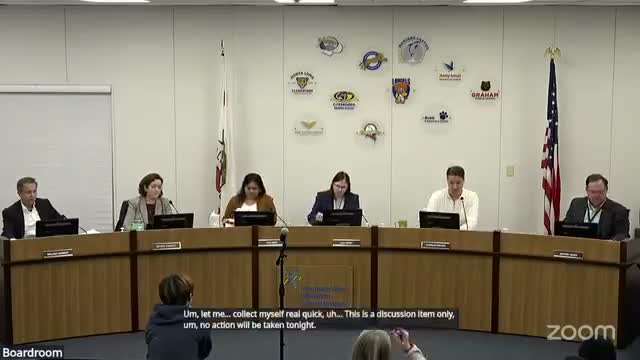
Summary
Trustees reviewed staff proposals to close a projected deficit — including district‑office reductions, custodial schedule changes, device and software cuts, reassigning STEAM/PE instruction, and possible changes to preschool and ELOP — and heard strong public opposition to eliminating preschool or ELOP. No final cuts were adopted; staff will return recommendations by Jan. 29.
Mountain View Whisman School District trustees spent the evening weighing options to close a multi‑million‑dollar shortfall, hearing staff modeling that a roughly $9.5 million package of reductions would flatten the district’s projected deficit and preserve reserves.
“We committed to what has turned into $3,700,000 worth of deficit spend,” Superintendent Bair told the board as he reviewed the district’s budget outlook, warning the figure could grow to roughly $11.3 million next year if no changes are made.
Why it matters: staff told trustees the district’s assessed valuation (AV) growth has slowed sharply and reserves could fall to precarious levels if the district does not reduce ongoing expenses. To avoid steep cuts later, staff proposed a mix of options that prioritize classroom instruction while reducing central office costs and some site supports.
What staff presented: the packet and slides laid out a menu of reductions and reconfigurations. Major elements included district‑office staffing reductions (roughly $3,780,000 in identifiable hard‑cost savings on the slide), reassigning some teacher‑of‑special‑assignment (TOSA) duties back to classrooms, reallocating SCUF/ARIS positions to better match unduplicated pupil counts, possible elimination or reconfiguration of dedicated STEAM or contracted PE ("rhythm and moves") instruction, changes to custodial schedules (every‑other‑night cleaning with daily sanitizing of restrooms), and technology‑use options such as shared carts for younger grades instead of assigned devices.
Program specifics that drew the most attention: staff described three options for the California State Preschool Program (CSPP) contract (maintain the current expanded full‑ and part‑day model; return to part‑day/part‑year alignment with the state contract to be cost‑neutral; or petition the state to allow a mixed part‑day/full‑day contract). Staff said the district is contracted for about $2.1 million annually but currently uses about 65% of that contract and projects the district would need to subsidize roughly $700,000 annually to maintain the expanded full‑day option the community currently uses. Staff also reviewed the Expanded Learning Opportunities Program (ELOP) funding structure and enrollments (staff cited roughly 566 students in ELOP and 337 in Beyond the Bell), and said recent law gives districts the option to opt out of ELOP if funding is insufficient.
Public reaction: more than a dozen parents and community members urged trustees not to eliminate preschool or ELOP. "Eliminating state preschool is not just another budget adjustment. It is a decision that impacts the very beginning of our children's educational journey," said Paula Perez, a parent leader, during public comment. Liliana Camacho of Parent Voices urged the board to leave both preschool and after‑school services intact, saying the programs enable parents to work. Blake Hofstead, organizing director with Parent Voices California, said, "No families who are currently receiving care should lose care."
Board discussion and next steps: trustees largely framed priorities around protecting direct classroom instruction and site‑based supports for the district’s most vulnerable students while seeking central‑office reductions and other changes that can be reversed if revenues recover. Several trustees signaled they would not support eliminating preschool outright and asked staff to return more detailed analyses — including site‑level impacts, options for phasing cuts across years, costs of moving TOSAs back to classrooms (training and curriculum/equipment costs), and subsidy/market‑rate scenarios for preschool families. Staff was directed to bring recommendations and additional analysis back by Jan. 29; the board took no final action on cuts this meeting.
Funding context and tradeoffs: staff emphasized that some proposals (custodial schedule changes, technology reductions) could be relatively quick to reverse, while personnel changes and program reorganizations would be harder to undo. Staff warned that reducing required maintenance set‑asides would affect people (maintenance and custodial staffing) and is not solely a projects line item.
What to watch: the board’s next meeting when staff returns prioritized options and more complete cost and equity analyses; how the governor’s budget and any additional state funding for ELOP/CSPP evolve could also change the district’s decision calculus.
Ending: trustees closed the budget discussion with direction to staff for additional analysis and asked staff to return with recommended actions and implementation details at the January 29 meeting. No cuts were adopted tonight.