Get Full Government Meeting Transcripts, Videos, & Alerts Forever!
Get email alerts on the Governance Policy topic
No spam. Unsubscribe anytime.
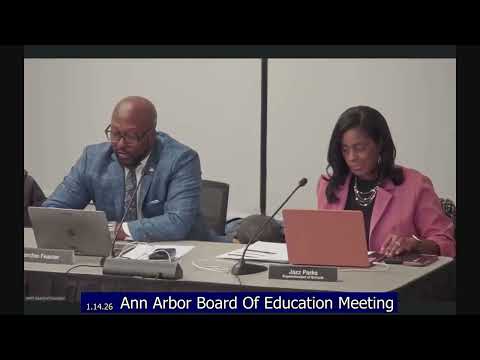
Board adopts trustee professional-development policy and updates vacancy bylaw; one trustee objects
Summary
The Ann Arbor board adopted bylaw updates addressing officer vacancies and approved a new policy (11-80) requiring baseline professional development for trustees; Trustee Rima Mohammed voted No on the PD policy after raising concerns about cost and equivalency rules.
The Ann Arbor Public Schools Board of Education adopted two governance changes at its meeting: an update to bylaw 11-30 governing officer vacancies and a new Policy 11-80 establishing baseline professional-development requirements for trustees.
The bylaw change clarified that when a presidency becomes vacant and the board size is unchanged, the board will vote to choose a new president rather than automatically elevating the vice president. Trustees discussed whether related policies should be updated together but proceeded with the bylaw change; the motion to adopt was moved by Trustee Susan Schmidt and supported by Trustee Wilkes and carried on a recorded voice vote.
The board also approved Policy 11-80, which requires trustees to complete a foundational level of professional development (the MASB level-100 series or an approved equivalent) and includes a process to report courses taken. Trustees debated what organizations should qualify as equivalents, concerns about cost and time commitments, reimbursement by the state for approved providers, and whether a public listing of completed courses is appropriate. Trustee Rima Mohammed raised the concern that MASB should not be the only option and asked that equivalencies be allowed for local offerings or workshops; she voted No on the policy.
Trustee advocates said the policy aims to strengthen governance and oversight. "When you know better, you do better," a governance committee representative told colleagues, arguing that mandatory training helps boards act more effectively on student-achievement issues. Other trustees suggested governance committee oversight to approve equivalent coursework while noting state reimbursement lists for approved providers, including MASB, the National Charter School Institute, and Michigan State University Extension.
The policy will require administrative follow-up to publish procedures for establishing equivalency and for an annual report of courses taken, which the governance committee and staff will provide moving forward.