Get Full Government Meeting Transcripts, Videos, & Alerts Forever!
Get email alerts on the State Budget topic
No spam. Unsubscribe anytime.
State lawmakers tell Ann Arbor board budget talks remain unresolved as schools open
Summary
Sen. Jeff Erwin and Rep. Morgan Foreman told the Ann Arbor Public Schools board that Michigan lacks a finalized school aid budget as classes start, outlined stark differences between the Senate and House plans, and urged community advocacy to protect school programs.
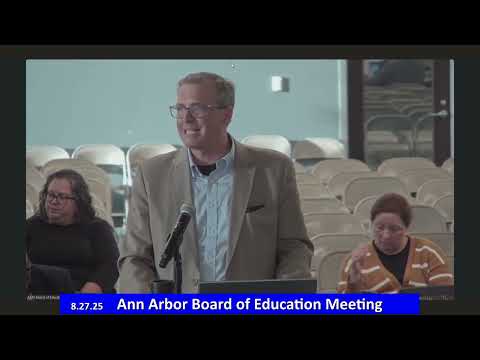
Sen. Jeff Erwin and Rep. Morgan Foreman told the Ann Arbor Public Schools board on Aug. 26 that Michigan still lacks a finalized school aid budget even though schools have started, leaving districts uncertain about funding for meals, mental‑health supports and other services.
Erwin, a state senator, said the Senate passed a budget months earlier but full state budget negotiations remain stalled. "We still don't have a budget, and there haven't been serious enough budget conversations about getting K‑12 done," he said, criticizing a missed statutory July 1 deadline and what he described as political posturing in House leadership.
Erwin outlined the Senate education package (Senate Bill 166, S‑4), saying it would raise the foundation allowance about 4.2% to roughly $10,008, increase at‑risk funding by 25% and invest in literacy supports, mental‑health and school‑based health clinics. "We included a $74.2 million investment" for literacy coaches, materials and teacher training, he said. He also described $85 million in grants for small class sizes and proposed reductions in allocations to cyber schools.
By contrast, Erwin said the House Republican plan (House Bill 4577 as passed in the House) would set a roughly $10,025 per‑pupil foundation but roll many targeted line items into a single per‑pupil allotment with conditions. He said the House proposal would consolidate funding into a roughly $1,975 per‑pupil boost that districts could access only if they met policy conditions, and he criticized provisions that would limit diversity programs and impose restrictions on restrooms and athletic participation.
Rep. Morgan Foreman, whose district includes parts of southern Washtenaw County, criticized the process used to advance the budget. She said lawmakers received an "800‑page omnibus and 45 minutes to read it," and listed proposed reductions she said are harmful to communities, including cuts she characterized as approximately $3.8 billion to Medicaid and behavioral health, a more than $333 million reduction to SNAP, and reductions to state police funding and local revenue sharing. "This budget is being balanced on the back of workers," Foreman said, adding that she voted no.
Both lawmakers urged trustees and residents to press legislators and appropriations leaders. "School boards need to be as strenuous as possible up in Lansing, but also lock arms with the other groups that are interested in schools," Erwin said. Foreman recommended organizing through groups such as statewide education coalitions and meeting with legislators and staff.
Trustees asked for specifics on where to find analyses; Erwin directed the board to the Michigan Legislature website and the House and Senate fiscal agencies for bill text, analyses and district‑level impact reports. When asked whether mental‑health or absenteeism support was included, the lawmakers said school mental‑health grants and school‑based health clinics are part of Senate proposals but they had not identified a discrete absenteeism line item and would continue to review the bill texts.
The board took no formal action on state budget matters; the presentations were offered as information and to encourage local advocacy ahead of negotiations.
The board now awaits final agreements in Lansing and asked district staff to bring updates as negotiations evolve and analysis becomes available.