
Superintendent reports enrollment uptick, cash runway and wide vacancies in special education
Get AI-powered insights, summaries, and transcripts
Subscribe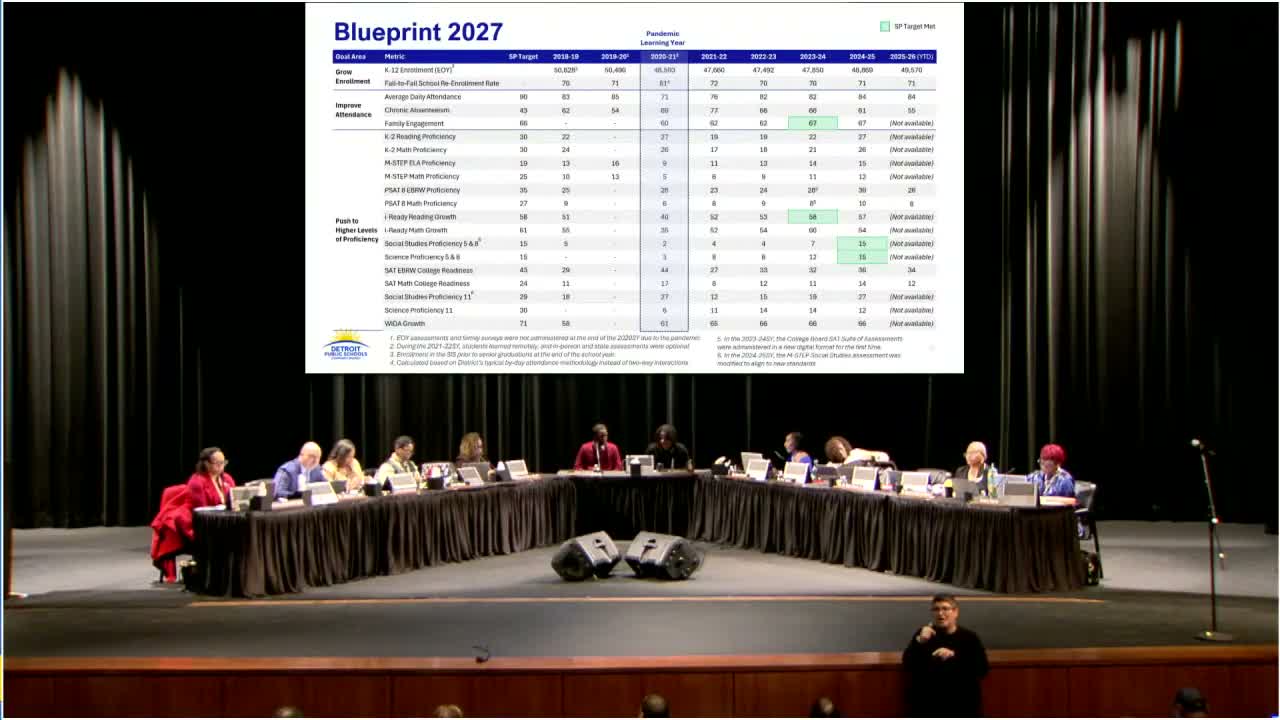
Summary
Superintendent Dr. Nikolai Veedy reported enrollment at 49,570, about 700 above last year, an available cash runway of roughly 11 weeks, and staffing gaps — including 26 teacher vacancies, 11 of them in special education — while outlining strategies for certification and recruitment.
Superintendent Dr. Nikolai Veedy told the Detroit Public Schools Community District board that enrollment is up and finances are on track, but the district continues to face notable staffing shortages, particularly in special education.
Veedy said district enrollment stands at 49,570 students, roughly 700 more than a year earlier, and average daily attendance is about 84 percent. He said the district’s chronic absenteeism rate, if the year ended today, would be about 55 percent. On preliminary PSAT 8th-grade results Veedy said 26 percent of students are considered college ready in the literacy baseline assessment and 8 percent in mathematics; high-school-level college-readiness (grades 9–11) was reported at 34 percent for literacy and 12 percent for mathematics.
Chief Financial Officer Jeremy Bedito reported revenues through November came in ahead of expectations — citing enhanced millage collections, Wayne County tax receipts and federal grant drawdowns — while expenditures were slightly higher due to invoice timing and contracted services. Bedito said the district ended the month with approximately 11 weeks of available cash, and that next bond payments are due in April.
Veedy reviewed staffing: the district reported 26 teacher vacancies and 33 support-staff vacancies. Of the teacher vacancies, he said 11 are special education positions — largely in autism spectrum disorder (ASD) and emotionally impaired (EI) specializations — and he listed multiple other specialized openings including assistant principals, counselors, academic interventionists, speech and language pathologists, occupational and physical therapists, psychologists, cafeteria workers and custodial staff.
Veedy explained that Michigan certification requirements create barriers for substitutes and prospective hires to obtain specialized endorsements; he encouraged collaboration with the state Department of Education and university partners and said the district is using initiatives such as the On the Rise Academy and local teacher career academies to recruit and certify candidates.
In response to board questions, Veedy said the district is not out of compliance with federal or state special-education requirements and that staff will provide detailed IEP backlog numbers in a follow-up to the board.