Get Full Government Meeting Transcripts, Videos, & Alerts Forever!
Get email alerts on the Land Use Eir topic
No spam. Unsubscribe anytime.
Riverside council denies appeals, certifies downtown EIR after hours of public testimony
Summary
After extensive public comment and legal appeals raising air‑quality, noise and soil‑contamination concerns, the Riverside City Council voted unanimously to deny appeals and certify the program‑level environmental impact report for a proposed downtown development (Lote 33).
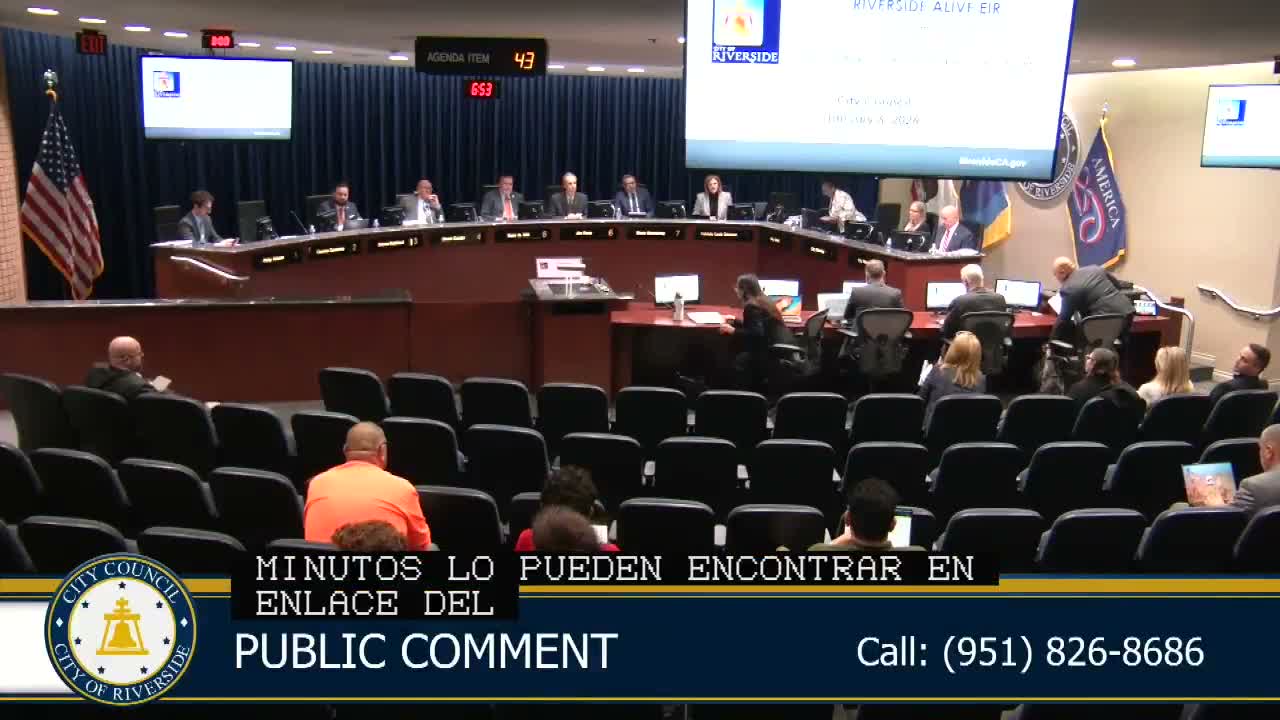
Riverside — The City Council unanimously denied appeals and certified a program environmental‑impact report (EIR) for a proposed downtown development project known in staff materials as Lote 33 (Market & Orange) after more than two hours of public testimony from residents, attorneys and community groups.
Planning staff told the council the EIR was prepared as a programmatic analysis of potential residential, commercial and conference uses and described mitigation measures included in the draft (staff presentation began with Page Montajo). The report identified possible project elements including mixed uses, hotel and conference space, and up to five levels of underground parking; staff said the draft was circulated for public review from May 23 to July 27 and recommended certification with the mitigation package in attachment 4.
Opponents — including an attorney who formally filed the appeal and multiple community members and trade and health‑interest groups — urged the council not to certify without further study. Speakers raised concerns about an imprecise project description, potential chromium and soil‑contamination risks, air‑quality and diesel‑related cancer‑risk calculations, inadequate noise analysis, and the practice of certifying an EIR before a final project application. Several callers referenced a Los Angeles case where a court later found similar programmatic approvals prejudiced the public.
City staff and the city attorney responded that the document is a programmatic EIR intended to analyze a range of potential development scenarios and that site‑specific project applications would return to the city for detailed review and additional mitigation as required. Staff described the EIR process, the public circulation that occurred and why the analysis in hand met legal standards for certification.
Councilmembers debated whether the EIR was premature or legally defensible at a program level. Councilmember Rovelar moved to deny the appeal and adopt the EIR and related findings; the motion was seconded and, according to the clerk, the vote to deny the appeal passed unanimously.
The council’s action certifies the environmental analysis and clears the way for subsequent project proposals to seek permits subject to the measures and conditions the EIR and future review require. The record shows substantial public concern about health, traffic and historic‑area impacts; opponents said they may seek legal review of the council’s decision.
The council concluded the item by directing staff to ensure the record reflects public comments and the recommended mitigations. No specific development permits were approved by this action; those will require follow‑up hearings when and if project applications are submitted.