Get Full Government Meeting Transcripts, Videos, & Alerts Forever!
Get email alerts on the Budget Tax Rate topic
No spam. Unsubscribe anytime.
Fairfax City council narrows FY2026 options; directs staff to prepare budget for 2.5¢ real-estate increase and no meals-tax hike
Summary
After hours of public comment and internal debate, Fairfax City Council asked staff to prepare FY2026 adoption materials for a budget built around a 2.5¢ real-estate tax increase (no change to the meals tax). Council left in a placeholder $1.06M police-related reduction for staff to confirm and asked staff to return with alternatives ahead of May 6 adoption.
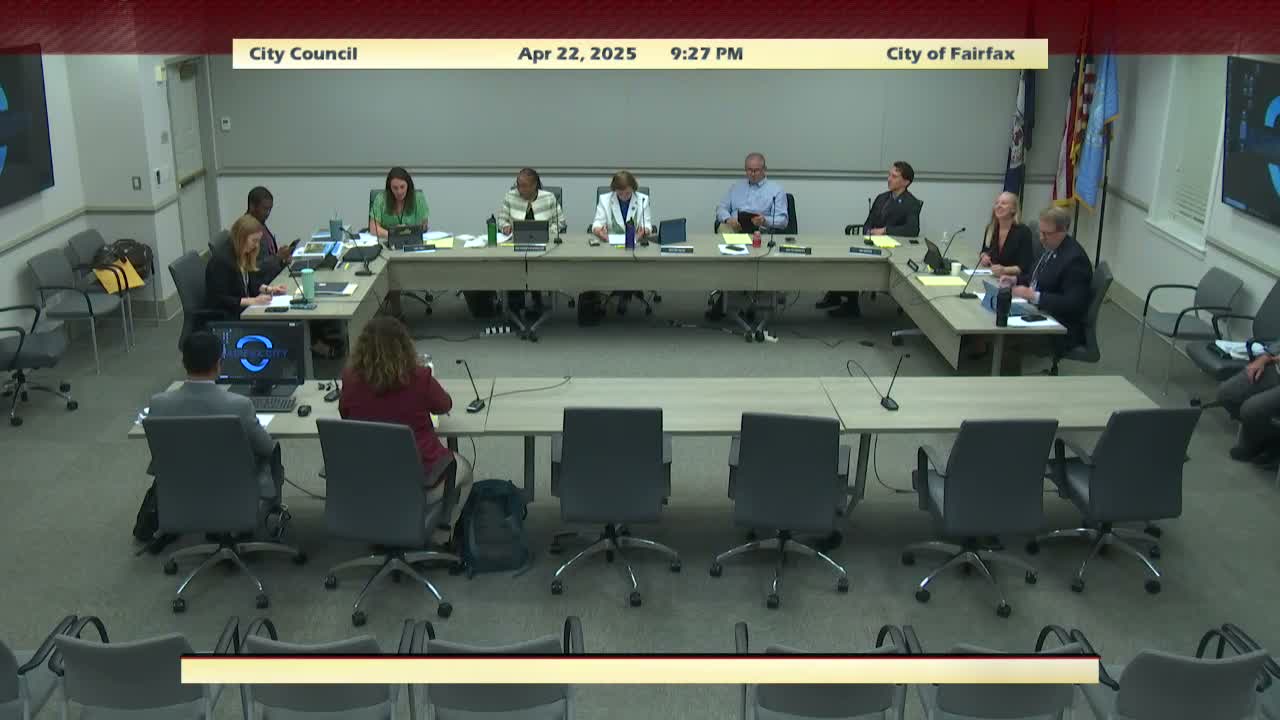
Fairfax City Council moved toward a compromise on the proposed FY2026 budget on April 22, directing staff to prepare adoption paperwork for a real-estate tax increase of 2.5 cents per $100 of assessed value and to hold the meals tax at 4 percent.
The direction followed a long work session and public hearings in which residents and business owners urged caution about higher taxes while staff and council members debated a range of trade-offs—pay and benefits for city employees, a recommended pay-study implementation to correct wage inequities in the city’s property-yard workforce, and several one‑time and ongoing reductions.
Why it matters: the manager’s original proposal included a larger set of revenue and expenditure assumptions; council members said they did not want to add a meals-tax increase after hearing many local restaurateurs warn a higher meals tax would put Fairfax City at a competitive disadvantage with neighboring jurisdictions. At the same time, staff warned that the single largest driver of increased expenses is the city’s tuition contract with Fairfax County Public Schools, which staff has projected to rise sharply in FY2026.
Key council direction and next steps - Tax-rate guidance: Council asked staff to prepare the FY2026 ordinances and appropriation materials keyed to a 2.5¢ increase in the real-estate tax rate and no change in the meals tax. The council requested materials that show the fiscal effect of that single scenario and variants should department figures change before adoption. - Police placeholder: Council left a placeholder reduction of $1,056,500 (a 5% program reduction identified in staff exercises) in the proposal so the police chief and staff can return with a refined recommendation on what elements could be suspended for one year without reducing front-line staffing. Staff noted that amount equates to roughly 1.2 cents on the tax rate if ultimately enacted and that the chief’s office had said the department could maintain current staffing levels while absorbing the listed cuts to training, equipment and temporary help. - Workforce and pay study: Council generally supported implementing a targeted pay-study correction for property-yard and related employees (about $500,000, including fringe) to address internal equity gaps identified in an HR review. Several council members asked staff to provide the distribution of the proposed increases so councilors could see whether a partial or phased approach is possible. - Training and travel: Council asked staff to reduce nonessential out‑of‑town travel and training while protecting mandatory certifications; staff proposed leaving a smaller continuing-education/training budget in place for required certifications (a draft target reduction to about $135,000 was discussed). - Grants and programs: Council agreed to trim but not eliminate certain initiatives—nonprofit grant funding was cut from the newly budgeted $300,000 down to $200,000 in the scenario the council settled on. Council approved continued one-year funding for a former Sprout grant position (about $118,000, including fringe) so community stewardship work can continue while alternatives are pursued.
Public response and context Residents and business owners who testified during the public hearings urged caution on rate increases. Restaurateurs said that a 2% increase in the meals tax (a key component of an alternative proposal) would make Fairfax City less price-competitive with nearby shopping and dining centers. Several residents described unusually large assessment-driven tax bills this year and urged councilors to limit the burden on homeowners.
What happens next Staff will prepare the formal budget ordinances and documents for the May 6 adoption meeting reflecting the 2.5¢ real-estate tax scenario, the no-change meals-tax position, and the placeholders listed above. Officials said they will continue working with the police chief to refine the department’s reduction option and will return to council with updated numbers and options in advance of adoption.
A quote from the record: “The city manager's proposed budget recommends a real estate tax rate of a dollar $1.25 per $100 of assessed value,” JC Martinez said during a staff presentation explaining the advertised rates and the role of school tuition in the spending outlook. At the public hearing resident Rob Dingling said the combined effect of assessments and proposed rate changes “equate to a 16% increase for me personally,” echoing broader affordability concerns expressed by multiple speakers.
The council did not adopt final rates on April 22; action is scheduled for the May 6 meeting.