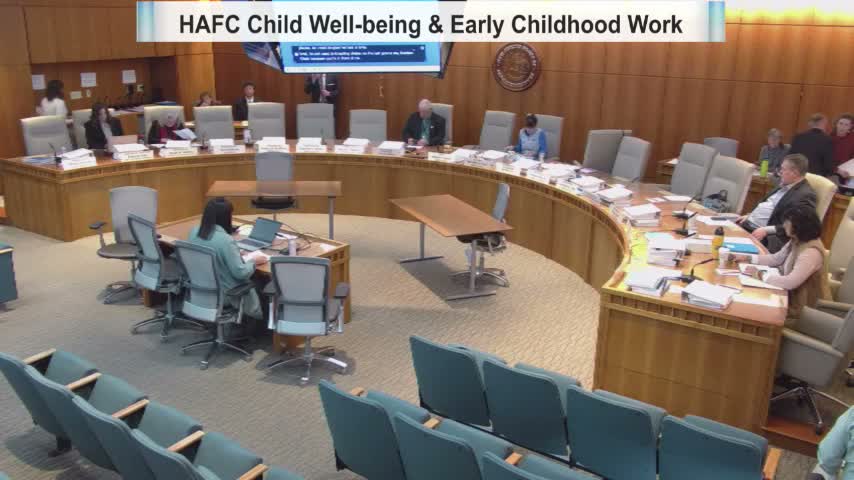
Work group shifts funding toward early pre‑K and childcare assistance; asks for cost estimates
Loading...
Summary
The committee discussed an HAFC scenario that prioritizes early pre‑K and childcare assistance (including a proposed trust‑fund distribution increase) and asked staff to return with per‑child cost estimates for full pre‑K plus wraparound childcare and counts of children affected.
Kelly Flint of the Legislative Finance Committee summarized the HAFC early childhood scenario, which reprioritizes existing revenue and proposes modest increases to childcare assistance and early pre‑K. The scenario would use existing trust fund capacity, a $5 million carryover, a $5 million TANF increase included in the LFC, and seeks legislation to increase the early childhood trust fund distribution by $25 million for the proposal.
"So given the feedback ... we've shuffled around some of the revenues... moved a lot of money into the childcare assistance piece," Kelly told members. The plan emphasizes 0‑3 populations and at‑risk families and adds language that the appropriation for childcare assistance is sufficient for a wage and career ladder program.
Members pressed on scope and costs. Representative Dow outlined concerns about moving toward full‑day, year‑round infant care and noted that per‑child costs would rise if the state adopts an infant‑care model with low staff‑to‑child ratios. "If you want it to be full day, year round… the average would go up," Kelly said, and agreed to provide a followup analysis estimating per‑child cost and headcount for full pre‑K plus childcare wraparound.
Members also raised implementation and continuity concerns (wraparound, staffing, provider capacity and the potential for fragmented family‑level care across multiple sites). Staff said the scenario aims to prioritize youngest children without cutting current school‑age assistance and that some implementation would require additional legislation and multi‑year funding decisions.
Next steps: Kelly will return with calculations showing per‑child costs for full pre‑K plus full childcare wraparound and the number of children affected; staff also flagged the need for policy workgroups to develop the wage and career ladder details.