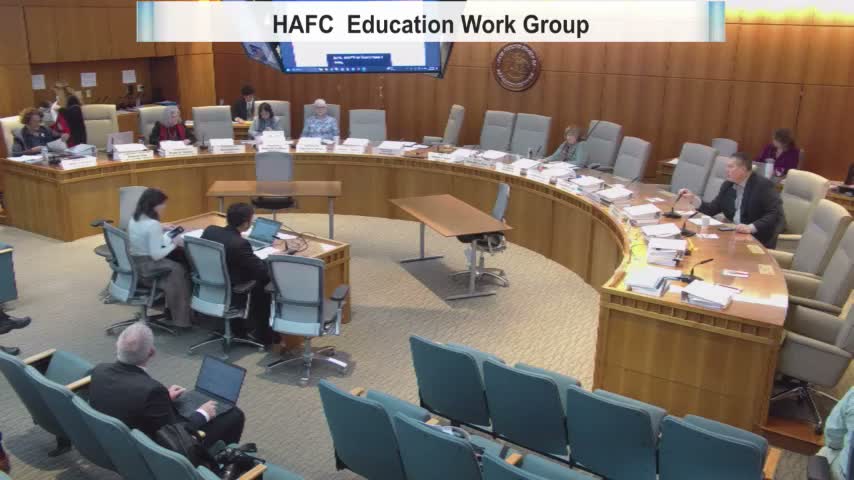
House work group debates CTE funding plan, keeps $12 million pilot with 50% local match
Loading...
Summary
Lawmakers pressed staff on a proposed $12 million career‑technical education pilot that includes a 50% local match, raised concerns about reporting and unspent awards in prior NextGen/innovation grants, and asked staff for LEA‑level data and clearer statutory language to ensure funds reach intended programs.
Sunny, HFC staff, told members the HFC scenario largely adopts the Legislative Finance Committee recommendation but makes targeted changes for public education, including moving an $8.5 million statewide student information system appropriation and adding a $12 million evidence‑based, career technical education (CTE) pilot that requires a 50% local match. "The HFC scenario adds 12,000,000 for an evidence based career technical education pilot. This includes language requiring a 50% local match on participating entities," Sunny said during the presentation.
Members across the work group — including Representatives who identified CTE as a high priority for attendance and workforce pathways — urged caution about shifting to a match model that could burden rural and Bureau of Indian Education schools. Representative Herrera warned that models cited as exemplars "sit on" additional philanthropic or industry resources and may not be replicable in smaller districts. Staff acknowledged the concern, saying the scenario includes match language but that LESC/LFC staff will consider alternative matching formulas or professional development supports for smaller districts.
Several members also pressed staff on prior grant performance and reporting. Committee staff said that roughly a third of NextGen CTE and innovation zone awards reverted in FY25 and that the statutory annual reports on the 7‑year pilot have not consistently been filed with LESC. "We have not heard an official report on the efficacy of the pilot in the last 7 years," Sunny said, noting agency turnover as one possible reason.
Staff urged an intentional, regional approach rather than thin grants across all districts. They also pointed to existing base increases in secondary operational funding — a larger SEG allocation for secondary grades — that districts could use if communities prioritize CTE locally. "The recommendation is to create a new intentional $12,000,000 state CTE (with local match) to increase the overall amount of money for CTE," LFC staff summarized during the briefing.
Next steps: members asked staff to provide LEA‑level breakdowns (awards, unspent balances, and restricted vs. unrestricted cash) and to draft explicit statutory or earmark language ensuring the three education acts named (Black, Bilingual/Multilingual, Hispanic) appear clearly in operating budget language. The work group did not vote; staff will return with followups and more granular cost and distribution data.