
Housing division outlines AB540 application pipeline and near-term awards process
Get AI-powered insights, summaries, and transcripts
Subscribe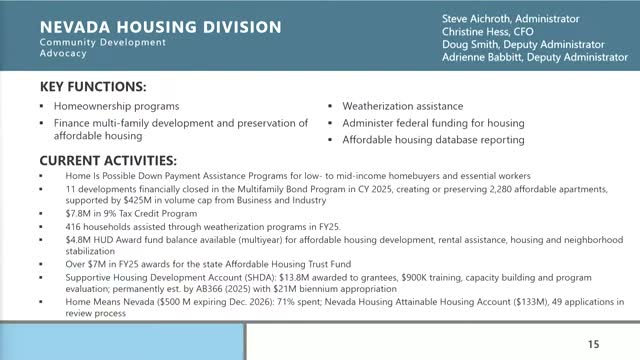
Summary
Nevada Housing Division officials told the Commerce and Labor interim committee they have 43 active applications under AB540(Nevada Attainable Housing Account), are deploying $18 million for a Worker Advantage program, and expect initial award recommendations from the Attainable Housing Council in early February.
Nevada Housing Division officials told the Joint Interim Committee on Commerce and Labor on Jan. 1 that they are processing applications for the Nevada Attainable Housing Account created by Assembly Bill 540 and expect initial allocation recommendations in early February.
"We currently have 43 active applications," said Christine Hess, housing division chief financial officer, and described four funding "buckets" in AB540: land, new development, local government match and homeownership. The division said the local-government match bucket (a $25 million allocation) is noncompetitive for the first nine months and that jurisdictions may apply for reimbursement of certain waived fees or incentives.
Steve Acroft, housing division administrator, said the division has closed 11 multifamily developments through its bond program and has provided $425 million in volume cap capacity to preserve or create affordable units. He said the division is deploying $18,000,000 for the Worker Advantage program (with the Nevada Rural Housing Authority contributing $4,000,000) and has opened $3,000,000 in competitive homeownership applications.
Hess described an active "cure" process for incomplete applications: applicants receive follow-up questions and the division reopens submissions to allow fixes rather than disqualify incomplete packets. "We are currently in a cure process," she said, adding that some applicants unfamiliar with state grant applications needed clarification on items such as organizational charts and narratives.
Members pressed the division on outreach and marketing. Acroft said housing staff used existing networks (realtors, lenders and the Home as Possible program), social media and a rural roadshow to reach developers and local governments. He said that of the 43 active applications, at least six came from local governments including Las Vegas, Clark County, Sparks and Reno; he committed to provide a list of jurisdictions that applied.
Committee members also asked how the division will score and process applications. Hess said allocated review panels will consider completeness and program fit, and that the Nevada Attainable Housing Council is scheduled to meet in early February to review recommendations; the division expects awards to be finalized on Feb. 5 or Feb. 6 after council review and any needed revisions.
What’s next: the Housing Division will finish its application reviews, the Nevada Attainable Housing Council will meet in February to vet funding recommendations, and the division will provide committee staff with jurisdictional application data and other requested program metrics.