Get Full Government Meeting Transcripts, Videos, & Alerts Forever!
Get email alerts on the Payment In Lieu topic
No spam. Unsubscribe anytime.
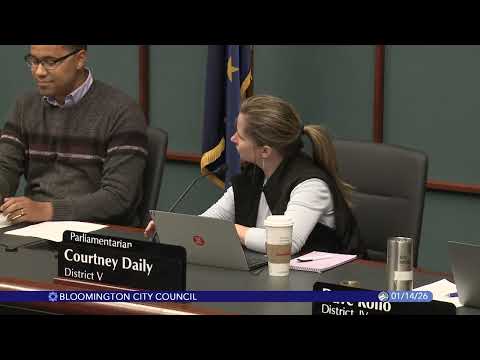
Council postpones vote on payment‑in‑lieu and several incentive changes to Feb. 4 after lender and feasibility concerns
Summary
Council postponed Ordinance 2026-01 to Feb. 4 after hearing mayoral concerns that permanent deed restrictions can suppress mortgage lending for owner‑occupied units; staff proposed raising payment‑in‑lieu calculations (base to 30% of units and per‑unit from $30,000 to $50,000) but council sought legal review and stakeholder input before final action.
The Bloomington Common Council voted Jan. 14 to postpone consideration of Ordinance 2026‑01—intended to change affordable‑housing incentives and payment‑in‑lieu (PIL) rules—until its Feb. 4 meeting to allow legal and stakeholder review of a mayoral amendment proposal aimed at preserving owner‑occupant mortgageability.
Assistant Director Jackie Scanlon presented proposed changes that would limit PIL availability to projects with more than 30 dwelling units, calculate PIL on a 30% unit base (units not beds), and raise the per‑unit payment from $30,000 (staff said the administrative manual showed the prior amount as $30,000 though practice had used $30,000) to $50,000 for units of 1–3 bedrooms, plus an additional $5,000 for each bedroom over three. Scanlon explained the administration's view that increasing the PIL would push developers toward on‑site units and better capture the long‑term value of permanently affordable units.
Mayor John Thompson (identified in the transcript) told the council he planned to propose an amendment to avoid permanent deed restrictions that can make mortgage lending difficult for owner‑occupied units. "When you put a deed restriction on something that says permanent affordability...the mortgage market…will not lend on it and it suppresses the comps," he said, arguing for flexibility such as shared‑equity agreements or soft seconds to enable owner occupancy while preserving long‑term affordability. Chamber and banking representatives spoke during public comment to support careful calibration so the mortgage market is not excluded.
After public comment and extended council discussion on impervious‑surface allowances, stormwater, PIL mechanics and lender feasibility, Council Member Stasberg moved to postpone the ordinance to Feb. 4. The motion passed by roll call, 8‑0, and staff were directed to coordinate with legal counsel and stakeholders to draft possible amendment language for the next meeting.