Get Full Government Meeting Transcripts, Videos, & Alerts Forever!
Get email alerts on the Bison Restoration topic
No spam. Unsubscribe anytime.
Tribal bison restoration draws praise and complaints as state agencies spell out jurisdiction
Summary
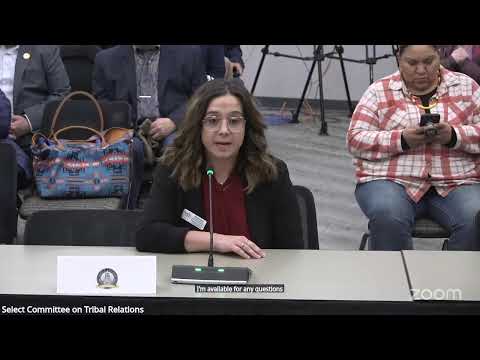
Tribal leaders told the Select Committee on Tribal Relations that bison restoration on Wind River supports culture, ecology and local jobs; ranchers and state agencies warned of trespass, fence damage and legal confusion when animals stray onto deeded (non‑trust) land.
Jason Bridal, an Eastern Shoshone member who works with the National Wildlife Federation, summarized a decade of tribal work to restore bison to Wind River Reservation lands and argued restoring the animal is a treaty, cultural and ecological priority for tribes. "We believe access to Buffalo is a treaty right," Bridal told the Select Committee on Tribal Relations.
Bridal and other tribal speakers said the Intertribal Buffalo Council and partner organizations delivered genetically important animals from refuges and conservation herds and built infrastructure and youth programs to support a sustainable herd. They said more than $10 million has been raised to buy fee land to expand habitat and eventually roll that land into trust status for the tribes.
Ranchers and some county residents described recent incidents in which bison crossed onto private deeded ground and damaged fences and hay. Fremont County rancher Mitch Benson recounted calls to tribal managers, the district brand inspector and the Wyoming Livestock Board after a group of bison entered his alfalfa on Oct. 1. Benson said he followed state law and notified authorities but was later told a complaint had been filed against him for —illegally holding' buffalo. "I did everything legally and correct in following state statutes," he told the committee.
State officials laid out how Wyoming law treats the animals. Angie Bruce, director of Wyoming Game and Fish, said that under state statute 23-1-1102 bison that move off reservation lands are considered livestock and are not managed as wildlife by the department unless the state redesignates them. "These bison when they come off the reservation in the state of Wyoming are still considered livestock under state statute 23-1-1102," Bruce said.
The Wyoming Livestock Board described its roaming‑bison rule: privately owned bison found at large outside designated management areas must be removed by the owner within 48 hours of a request from the board or its designee; if ownership cannot be determined, the board may destroy animals. The board said brand inspectors are the normal route for ownership identification and that its investigators worked with tribal managers during the recent breach.
Public speakers and tribal representatives proposed measures to reduce conflict: open phone lines to tribal managers, early communication when animals escape, increased fencing where feasible, land purchases to expand habitat, and memoranda of understanding to clarify brand inspection or co‑operative enforcement arrangements. Tribal speakers urged an incremental approach to adding range units, citing a $2 million fence cost for a single range unit and local opposition to some trust applications.
Wyoming's state veterinarian, Dr. Hallie Hazel, told the committee that brucellosis is the only disease the state routinely regulates here and that reservation herds are not part of Wyoming's designated surveillance area; surveillance testing is voluntary unless participants request coverage.
What happens next: the committee asked state agencies to continue conversations with tribal managers and livestock officials about possible MOUs and coordination, and members signaled interest in follow‑up briefings. The committee will also take public testimony and may refer the jurisdictional and policy questions to the appropriate standing committees for legislation or rulemaking.