Get Full Government Meeting Transcripts, Videos, & Alerts Forever!
Get email alerts on the Community Outreach topic
No spam. Unsubscribe anytime.
Lanai residents ask OHA for local beneficiary services liaison; trustees say part‑time option feasible
Summary
At an OHA community meeting in Lanai, residents urged the board to place a local beneficiary-services contact and improve outreach; trustees and the COO said a part-time beneficiary services agent or shared space could be pursued and staff will follow up.
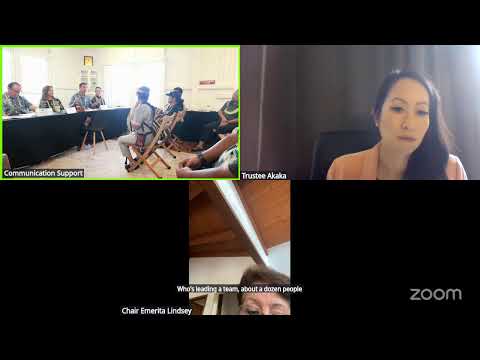
Community members at the Office of Hawaiian Affairs (OHA) board meeting on Sept. 27 urged the board to establish a stronger on-island OHA presence so residents can more easily access programs and benefits.
An attendee who identified herself as working with a Lanai council member asked whether OHA planned a permanent outreach liaison on Lanai to connect residents with scholarships, loans and other programs. Trustees and administration responded with proposals ranging from a part-time beneficiary services agent (BSA) to shared office space or periodic on-island field visits.
Chief Operations Officer Keeshawn Kikina said the agency already staffs beneficiary services agents on Molokai and Maui and that creating a part-time presence on Lanai was feasible. "That's not something that is impossible for us to do. We could do that," he said during the public-exchange segment.
Trustees emphasized the importance of data and outreach to identify beneficiaries and to register them in OHA's Hawaiian registry program so residents can receive updates and qualify for programs. The chair cited U.S. census figures indicating Lanai had roughly 4,000 residents in 2020, about 11% of whom self-identified as Native Hawaiian, and said targeted outreach could identify roughly 400 beneficiaries to enroll and serve.
Why it matters: Community members described barriers including lack of consistent local staff, limited awareness of OHA programs, and scheduling constraints for residents who work during business hours. Trustees framed a part-time BSA or shared space as practical ways to increase access and program uptake.
What happens next: Trustees directed staff to gather contact information for residents interested in follow-up outreach and to route the request to the relevant departments for implementation planning.