Get Full Government Meeting Transcripts, Videos, & Alerts Forever!
Get email alerts on the Housing Homesteads topic
No spam. Unsubscribe anytime.
DHHL outlines aggressive lease pipeline and tests modular housing to cut costs for beneficiaries
Summary
DHHL told the Office of Hawaiian Affairs meeting that it plans to issue thousands of homestead leases over the next 3–5 years, pilot modular construction to reduce per‑square‑foot costs, and use project leases and a mix of financing tools to speed occupancy for beneficiaries on a wait list of about 29,000.
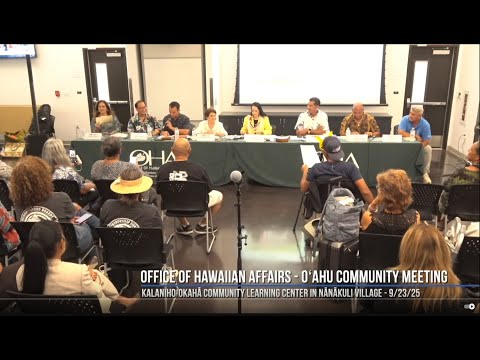
Kalani Franda, acting administrator of the Department of Hawaiian Home Lands’ land development division, told trustees at the Office of Hawaiian Affairs’ Oahu Island community meeting in Nanakuli that DHHL plans to issue thousands of leases over the next three to five years to address a wait list now spread across the islands. “Over the past hundred years, we've had about 10,000 leases equivalent to about 100 per year,” Franda said, describing a new approach that aims to increase that rate and offer options tuned to beneficiaries’ ability to pay.
Franda described “project leases,” a mechanism he said allows a 50-percent lessee’s interest to be transferred to a 25-percent successor without prequalification, enabling families to prepare for purchase. He outlined housing products including rent‑with‑option‑to‑purchase, turnkey developments, self‑help and owner‑build models. The goal, Franda said, is to match development with what lessees can afford rather than forcing one housing model on all beneficiaries.
Elijah Davidson, a DHHL project manager, said the department is testing alternative construction methods to reduce costs that have risen to roughly $500–$600 per square foot for conventional builds. “We have a wait list of over 29,000 and growing,” Davidson said, and noted modular construction and prefabrication could lower costs and speed delivery; one feasibility example cited reduced cost to about $363 per square foot. Davidson and Franda emphasized concerns about quality and cultural fit, and said DHHL is seeking firms that will adapt designs for Hawai‘i and consider bringing a factory to the islands to support local jobs.
DHHL officials also described financing approaches they are pursuing for infrastructure and vertical construction: use of Act 279 funds, private activity bonds, tax credits and the rental housing revolving fund. The department cited projects it has leveraged with mixed financing and called for continued partnership with OHA, which trustees said has contributed debt‑service support to DHHL over the years.
Trustees asked about infrastructure sufficiency (water, roads, electricity) and cost risks; DHHL acknowledged current funding is not sufficient for all projects and described a suite of creative financing strategies under consideration. No formal board action on DHHL projects or contracts was recorded during the meeting.
The next procedural step for many of the projects described is continued design and financing work; DHHL said it will pursue pilots and partnerships that could result in locally‑sited modular manufacturing and expanded small‑lot programs to accelerate awards to beneficiaries.