Get Full Government Meeting Transcripts, Videos, & Alerts Forever!
Get email alerts on the Land Use Rezoning topic
No spam. Unsubscribe anytime.
Hanover planning commission recommends denial of Hunting Hawk data‑center proposals after hours of public comment
Summary
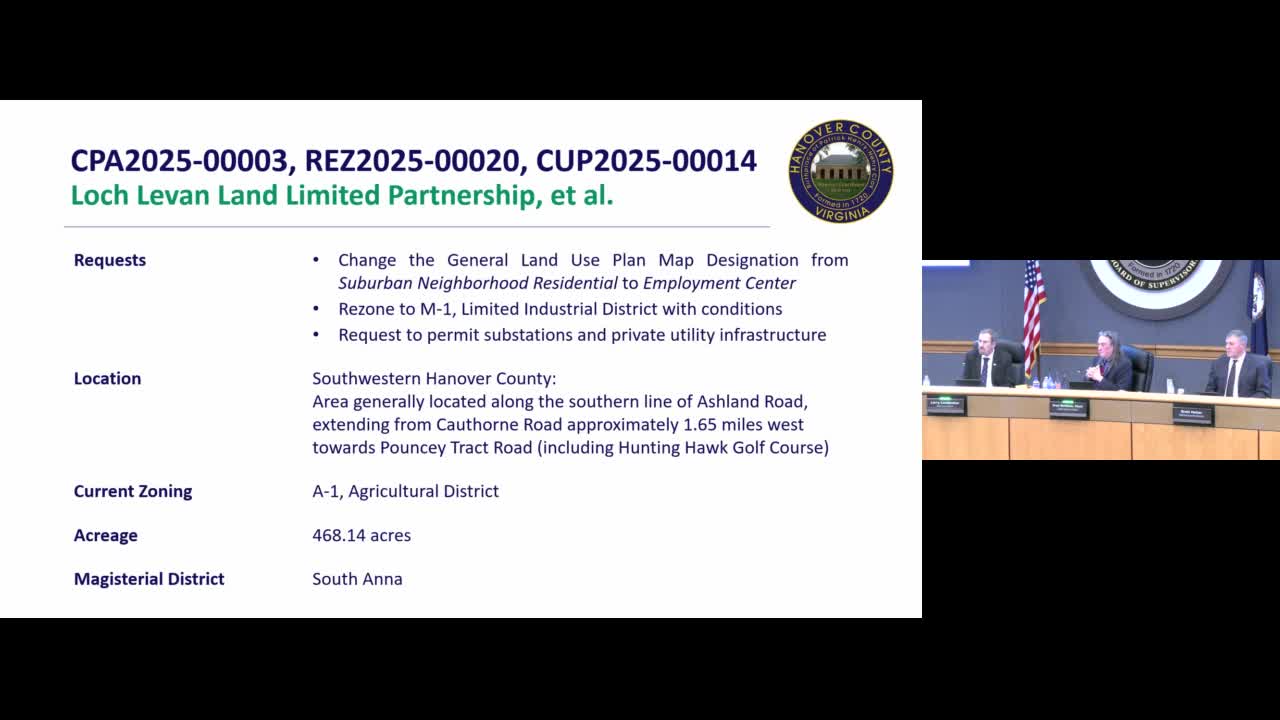
After a large public hearing with dozens of speakers, the Hanover County Planning Commission recommended denial of a comprehensive plan amendment, rezoning and conditional‑use permit for the proposed Hunting Hawk Technology Park — a 468.14‑acre plan for up to 10 data‑center buildings — citing water, traffic, noise and compatibility concerns. The recommendation will go to the Board of Supervisors for a final decision in February.
The Hanover County Planning Commission voted Thursday to recommend denial of three related applications that would have allowed Hunting Hawk Technology Park — a proposed 468.14‑acre campus of up to 10 data‑center buildings with three substations and private infrastructure — to proceed under an Employment Center designation.
Commissioners led by Chairman McGee closed a marathon public hearing that drew hundreds of residents and more than an hour of testimony. After applicant representatives described proffers intended to limit impacts — including a proffered $1,330,000 contribution for intersection improvements, on‑site 250,000‑gallon fire tanks, limits on generator testing hours, and a commitment to closed‑loop or air‑cooled systems — commissioners voted on three motions. A roll‑call vote on the comprehensive‑plan amendment resulted in a 6–1 recommendation to deny the amendment (Commissioner Parker cast the lone no). The commission then recommended denial of the rezoning and conditional‑use permit; those motions passed with no recorded opposition.
Why it mattered: opponents told the commission the project would strain private wells and septic systems, increase traffic on Ashland and Pouncey Track roads and permanently alter viewsheds and rural character. Speakers cited concerns about potential contamination from cooling fluids and drain fields, diesel generator and mechanical noise, and the long construction timeline — in some remarks forecasting a decade of work. "We want Hanover to stay rural," one resident said. Public‑health and environmental witnesses described risks to nearby rivers, wetlands and school neighborhoods.
The applicant, represented by Matt Roberts of the Hershel law firm, countered that the proposal would generate local tax revenue and construction work and that the proffers reduce impacts. Roberts said the campus is designed to avoid using public water for cooling, relying on closed‑loop or air‑chilled systems and on‑site wells and tanks for domestic and fire uses. He also emphasized proffers that limit visible lighting and require noise studies and mitigation if operations exceed local noise standards.
Key technical points and proffers: staff and the applicant said the proposal includes three substations, private wastewater pump stations and community wells, proffered perimeter buffers of 100–200 feet in key locations and limits to no more than five buildings under construction at once. The applicant proffered a $50,000 bond to repair construction‑related road damage and accepted restrictions on lighting levels (no more than 0.5 foot‑candles at the interior buffer edge), building‑mounted lighting heights and generator testing hours (Mon–Sat 7 a.m.–7 p.m.). Staff noted inconsistencies in some proffer language and warned the rezoning would change a portion of the county's comprehensive plan that currently recommends suburban‑neighborhood residential uses.
Public response: dozens of residents from Hanover and neighboring Henrico voiced opposition, frequently citing concerns about groundwater and private wells, septic/drain‑field risks, air and noise pollution from backup generators, and long term infrastructure costs. Trade‑union and construction speakers supported the project for jobs and fiscal gains, arguing the development would produce more tax revenue and fewer public service costs than a large residential buildout.
What the vote does: the planning commission’s recommendation is advisory. The three applications will be forwarded to the Board of Supervisors for a final decision, currently scheduled for the fourth Wednesday in February (advertisement and scheduling subject to change). If the board approves any change to the comprehensive plan or zoning, additional permitting and special‑exception review (for buildings over the standard height) would follow.
Next steps and context: the applicant said it will continue to work with staff on proffer language and technical issues before the Board of Supervisors. The case highlights tensions in rapidly changing data‑center markets in Virginia: proponents point to significant potential tax revenue, while neighbors and some commissioners question infrastructure readiness and compatibility with the recently adopted Envision Hanover comprehensive plan.