Get Full Government Meeting Transcripts, Videos, & Alerts Forever!
Get email alerts on the Agritourism Ordinance topic
No spam. Unsubscribe anytime.
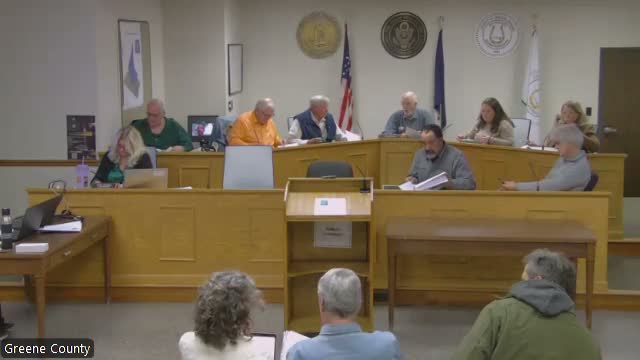
Greene County AFD committee plans landowner workshop and debates role in agritourism/winery ordinance
Summary
Committee members and staff discussed logistics for a first annual landowner education workshop (timing, topics, locations, and budget), and then extensively debated whether the AFD should provide guidance on a pending agritourism/winery ordinance that lacks a clear definition of when on‑farm agritourism is "subordinate" to production.
Greene County’s Agricultural and Forestry District committee spent substantial time on two interrelated topics: planning a landowner education workshop and deciding whether the AFD should provide input on a pending agritourism and winery ordinance currently under consideration by the planning commission.
Staff presented a draft agenda for a "first annual landowner education workshop," proposing a likely March date, a timeline that would limit topics to 15–20 minutes each, and suggested venues including Lydia Mountain lodge and Blossom Ridge. Committee members discussed whether to hold the event on a weekday or weekend, the importance of providing meals to boost attendance, and a proposed budget using contingency funds; staff said they would add a planning and zoning line item for AFD outreach and secure speakers and a date.
The committee then focused on a substantive policy question: the draft agritourism/winery ordinance contains language requiring that wineries, breweries and agritourism be "subordinate" or incidental to farming, but committee members and staff said there are no clear, objective standards in the ordinance to determine when an agritourism use is subordinate. Doctor McGuigan and others said the ordinance lacks "goal posts" (specific criteria, such as income thresholds, production history, or acreage standards) and that much discretion falls to the zoning administrator. Committee members cited practical examples — including a referenced case (Beard Winery) where applicants pursued large event spaces — and noted the difficulty of distinguishing legitimate on-farm production from developments that are commercially focused on events.
Members debated whether intervening now would be fair to applicants who have invested time and money in the revision process, or whether the committee should craft a focused position paper or set of recommendations to present at the planning commission’s public hearing. Staff said the planning commission will hold a public hearing in December, with board consideration possibly in January. One public commenter, Scott McGee (retiree), told the committee it may take initiative under its mandate to advise on ag policy.
The meeting record does not show the committee adopting a formal position on the agritourism ordinance. Instead, members discussed options: (1) prepare limited, timely recommendations or a subgroup statement to submit before or during the planning commission public hearing, or (2) undertake a broader, countywide ordinance review in the future. Staff invited committee members to attend planning commission workshops and suggested that if the board formally asks the AFD to review an ordinance, the committee could prepare a more detailed response.
Next procedural steps recorded in the meeting: staff will continue logistical planning for the landowner workshop (date, location, food, speakers) and will keep the committee updated; planning commission will hold a public hearing on the agritourism/winery ordinance (staff stated December), and the board may revisit the ordinance in January. The committee discussed forming a small subgroup to craft a concise statement for the public hearing but did not vote on forming that subgroup during the recorded session.