Get Full Government Meeting Transcripts, Videos, & Alerts Forever!
Get email alerts on the Agritourism topic
No spam. Unsubscribe anytime.
Greene County supervisors, planning commission continue agritourism ordinance work amid worries over event limits and noise
Summary
At a joint workshop, staff and the Planning Commission presented a revised agritourism draft; residents and advocates urged clearer limits on event centers, louder enforcement for amplified outdoor music, and use of state winery classifications to distinguish true farms from event venues.
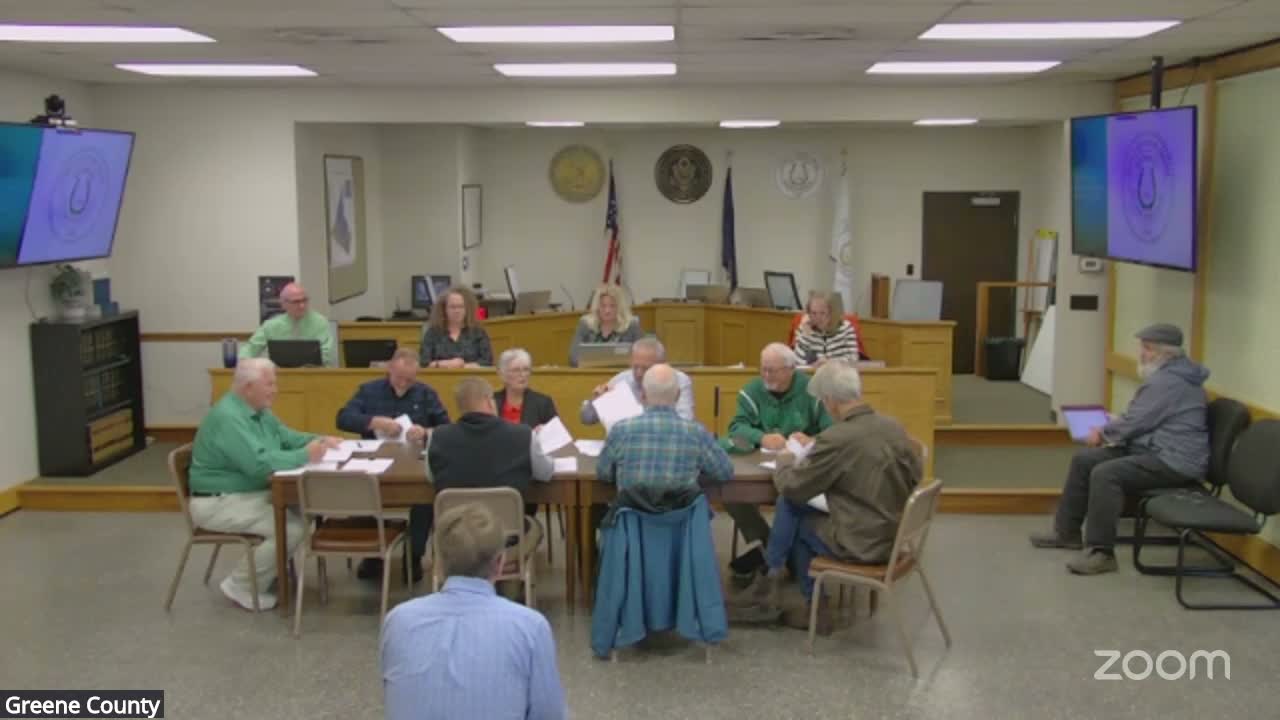
Greene County supervisors and the Planning Commission met in a joint workshop to continue deliberations on a proposed agritourism ordinance that would regulate events on farms, wineries and similar rural properties.
Staff told the board the current draft incorporates comments from more than a year of meetings and aims to be ready for a public hearing to the Planning Commission, likely in January. "We've incorporated from the last round and the comments from the board," staff said, adding the goal is to ensure the final public hearing draft reflects board recommendations.
Why it matters: speakers and residents said loose definitions and administrative discretion risk allowing event centers to operate under farming classifications without meaningful limits. Bill Zut, a longtime critic of the county's farm monitoring law, told the board the draft "fails to remedy any of the deficiencies which motivated this effort to begin with" and urged supervisors to consider an alternative ordinance circulated by community members.
Board and public concerns focused on three enforcement and clarity issues: how to define a bona fide agricultural operation versus an events-driven business; whether to regulate event counts or event sizes (and whether to count events on a per-day basis); and how to control noise from amplified outdoor music. Scott Mingledorff, a resident, urged using a "plainly audible" noise standard tailored for agritourism events, saying Greene County’s general noise ordinance is "expensive and difficult to implement," and that it "fails to adequately account for the low frequency bass sounds encountered in dance music." Several supervisors noted that a 10 p.m. noise cutoff was already in place for many operations.
On definitions and thresholds, the board discussed relying on state code for winery classifications and using acreage, participant counts and the number of events per day as locally controllable measures. One supervisor suggested adopting Virginia's winery classes and production thresholds as a model to distinguish true wineries from event centers. Staff said bona fide agriculture in the county generally tracks the state code but warned that some implementation questions — for example, how to credit rent/operations where the owner is not the operator — remain discretionary and may require additional guidance.
What was decided: the board asked staff to return the ordinance to the Planning Commission for a public hearing; staff said the hearing most likely will occur in January, with December a possibility. No formal ordinance vote was taken at the workshop.
The next steps: staff will refine draft language on participant counts, event counting (per day), setbacks and special-use permit triggers, and will work with legal staff to test any criteria for legal viability. The board and Planning Commission members indicated they will continue to weigh the alternative community-drafted proposal alongside the staff draft.
Quotes: "If this were a football game, the coach would be fired," said public commenter Bill Zut of the draft's failures. "The alternative proposal deals with that concern reasonably," said Steve Phillips, urging supervisors to adopt tighter limits to prevent event centers from operating as farms.
The meeting record shows the workshop concluded without a vote and the Planning Commission public hearing to be scheduled; staff will notify the public when the hearing date is set.