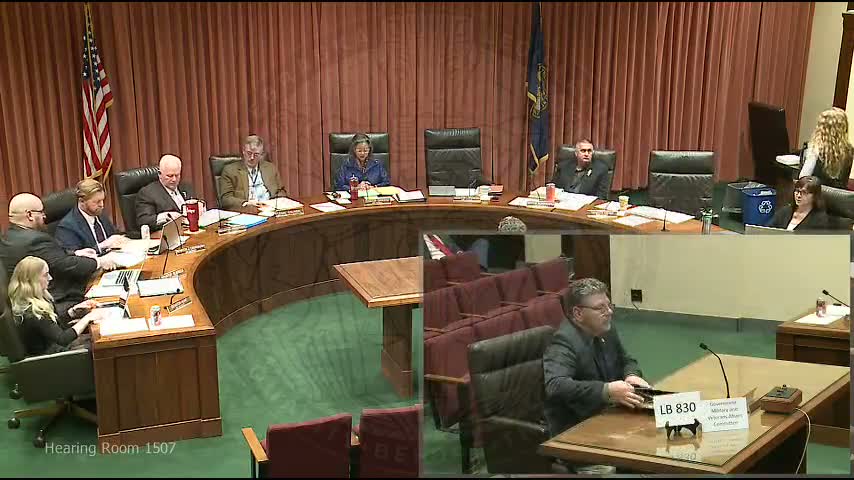
LB 830: Payroll modernization and expanded military building renewal eligibility draw mixed support; courts warn of pay‑transition risks
Loading...
Summary
LB 830 would align statutory pay references to allow a single biweekly payroll schedule, extend building-renewal fund eligibility to certain Nebraska Military Department facilities on federal land, and repeal a duplicative statute; DAS supports the bill tied to a Workday conversion, while the judicial branch warned of implementation costs and pay lag risks for paycheck‑to‑paycheck staff.
Senator Dan Lonowski presented LB 830 on behalf of the Department of Administrative Services to (1) update statutory references from monthly salary installments to equal installments to enable a consistent biweekly payroll schedule tied to a payroll software change, (2) expand eligibility for the Building Renewal/Task Force 309 funds to certain Nebraska Military Department facilities on federally leased land for state match on emergency repairs, and (3) repeal an obsolete statute (referenced as Neb. Rev. Stat. §83-380).
Lee Will (DAS) said the department is transitioning payroll platforms (UKG Kronos to Workday) and expects annual savings (~$1.6M) from one standardized payroll schedule and fewer manual entries. DAS also said it will offer an amendment to address retirement/statutory references for the State Patrol and judiciary.
Deputy Director Stephen Peterson (Nebraska Military Department) supported the bill as a means to make several federal armories eligible for Task Force 309 funding to cover the state share of emergency repair costs. Peterson noted the department receives about 94% of building maintenance funding through federal appropriations and that Task Force 309 is used routinely for state facilities.
The Nebraska Judicial Branch, represented by State Court Administrator Corey Steele, opposed the bill insofar as it would mandate moving some employees from monthly to biweekly pay without an implementation plan. Steele warned that many court employees are paid paycheck to paycheck and that a transition could create a ‘‘lag’’ month with reduced take‑home pay unless mitigated; he described mitigation options (front loading ~ $4.7M or temporary allowances) and said the courts may need an additional FTE to manage payroll.
Committee members asked why the auditor’s fiscal note showed no expected change while several agencies reported implementation costs; DAS said short‑term transition costs may exist but long‑term savings are anticipated and the department will work on amendments and mitigation plans before advancing the bill.
No committee vote appears in the hearing record; sponsors committed to work with the judiciary and other agencies to refine transition details and propose amendments to address implementation risks.