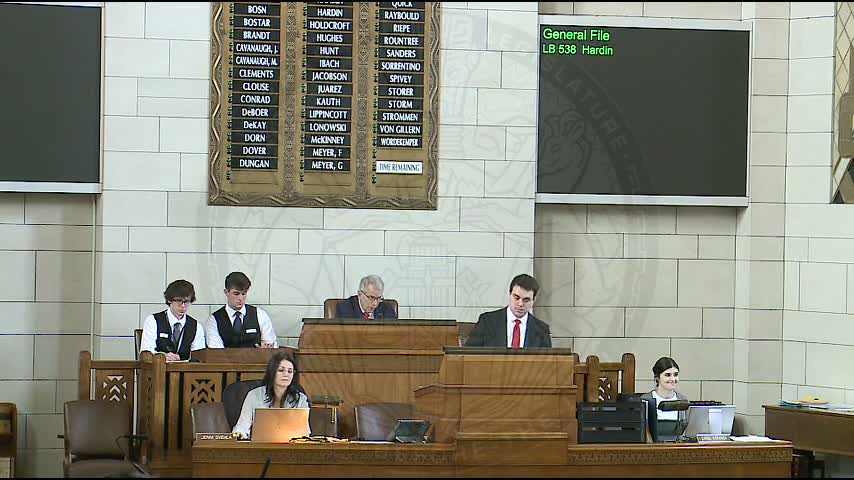
Senator Hardin introduces bill to require schools to address antisemitism; committee amendment would add Title VI reporting and coordinators
Loading...
Summary
LB538 would require public education governing boards to adopt policies addressing antisemitism, referencing the IHRA working definition, and would create Title VI coordinators to receive anonymous reporting. Committee amendment AM13‑85 clarifies scope and reporting; additional amendments to broaden protections were proposed on the floor.
Senator Hardin introduced LB538, a bill directing K‑12 school boards and public postsecondary governing boards to adopt nondiscrimination and harassment policies that explicitly address antisemitism, and incorporating the International Holocaust Remembrance Alliance (IHRA) working definition as guidance for identifying antisemitic discrimination.
Hardin said the proposal does not create a new category of protected speech nor does it curtail constitutional rights, but aims to ensure that antisemitic discrimination is "recognized and addressed under the same civil‑rights framework" as other protected classes. The bill directs education agencies to report aggregate incident data and to designate a Title VI coordinator to receive annual summaries on pending or resolved incidents.
The Education Committee's white‑copy amendment, AM13‑85, clarifies that protections apply when harassment is rooted in ancestry, ethnicity or national origin, outlines nondiscriminatory implementation guidance, and establishes reporting mechanics to protect privacy. Senator Merman outlined the amendment as strengthening protections while aiming to avoid redundancy and to limit fiscal impact.
On the floor, Senator McKinney offered AM18‑66 to add explicit anti‑Blackness and anti‑Indigenous protections; proponents framed the change as ensuring comprehensive protection in schools. Senator Conrad said the body may need further work between general and select files to limit fiscal impacts and reconcile university governance issues under state precedent. No final vote on the bill was recorded before the session adjourned; sponsors indicated work will continue before select file.
Proponents said the legislation is a nonpartisan step to combat documented increases in antisemitic incidents and to provide reporting and oversight mechanisms; opponents and some senators urged refinements to minimize fiscal burdens on local districts and to harmonize requirements with existing federal law.