Get Full Government Meeting Transcripts, Videos, & Alerts Forever!
Get email alerts on the Data Centers topic
No spam. Unsubscribe anytime.
Frederick County residents press commission over data‑center fact sheet as staff outlines risks and safeguards
Summary
At a packed Jan. 7 Planning Commission meeting residents voiced concerns about water use, power demand, noise, and community character in response to a staff 'data center fact sheet.' Planning staff recommended tools for mitigation and the commission voted to ask the Board of Supervisors for a formal county policy and technology land‑use areas.
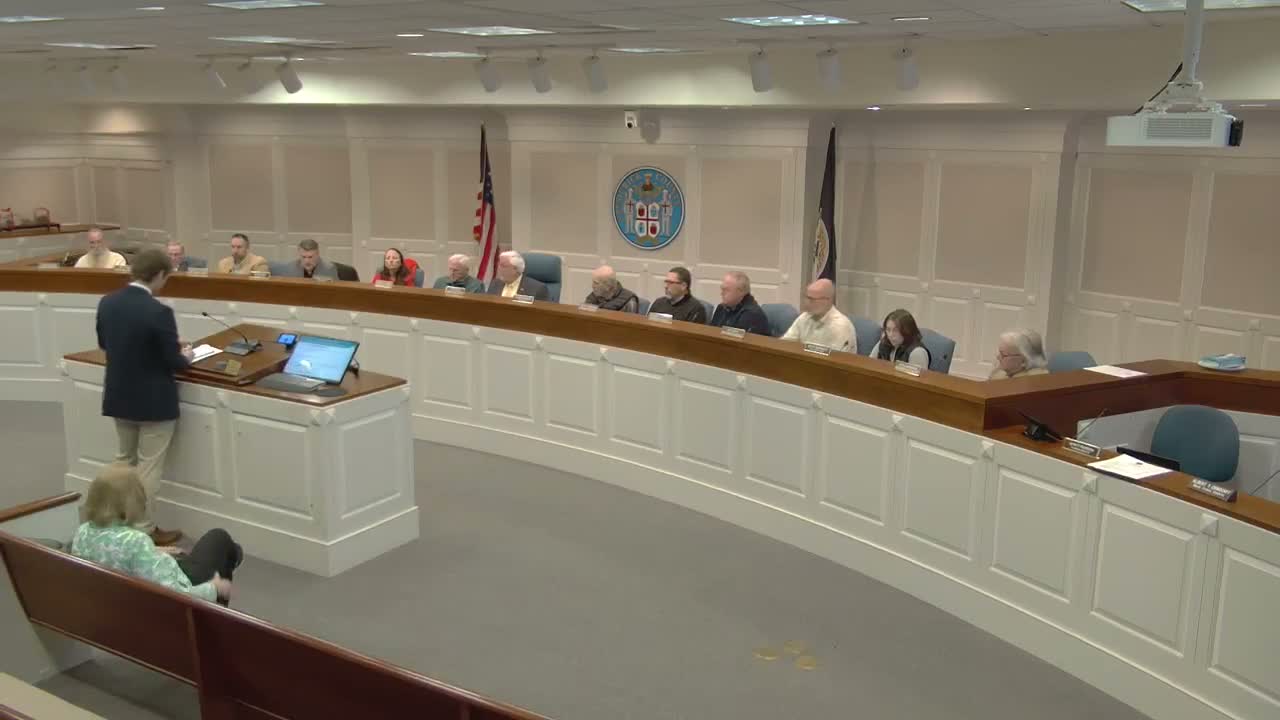
Planning staff presented a 22‑page data center fact sheet Jan. 7 to the Frederick County Planning Commission, prompting more than two hours of public comment from residents who warned that large data facilities could strain water and power systems and alter the county’s rural character.
White Pearson, the county’s planning director, summarized research sources including the Virginia Joint Legislative Audit and Review Commission (JLARC) and regional reports, and described differences among hyperscale campuses and smaller colo facilities. Pearson said county code already requires a rezoning or conditional use permit for data centers and that staff had framed the fact sheet as an informational, “tip‑of‑the‑iceberg” review of typical impacts: power and transmission needs, potential water use, noise and air quality from backup generators, and visual effects.
The nut of public testimony came from dozens of residents who spoke during the citizen‑comment period. John Tagliamento noted Loudoun County’s experience with dozens of data centers and said “you will see that 38% of Loudoun’s budget or property tax is from data centers,” and warned of generator noise and groundwater impacts. Ariel Leibmone, who identified herself as a social worker from the Shawnee District, asked whether the county could protect residents on fixed incomes from estimated electricity increases cited in the report. Multiple speakers cited water‑use estimates and urged that the county require closed‑loop cooling or other standards to avoid stressing private wells and the aquifer.
Several speakers, including former industry engineers and residents who track county water wells, urged stronger transparency and called out nondisclosure agreements (NDAs). Darla Barrett requested “no NDAs in this area,” saying NDAs can prevent localities and neighbors from getting needed operational details. Former Amazon and federal data‑center technologist Jim Jenis said hyperscale campuses tend to expand and provide relatively few local jobs.
Pearson and staff told the commission tools are available in the land‑use process — rezoning, conditional use permits and proffers — that allow the county to require noise studies, water‑use limits, generator siting standards, and other mitigations on a site‑by‑site basis. He also noted that distribution costs are generally handled through local rate classes while generation and transmission are set regionally through PJM and therefore largely outside local land‑use control.
After discussion about balancing fiscal benefit and preservation of the Shenandoah Valley’s rural character, the commission approved two requests to the Board of Supervisors: one asking staff to draft a county data center policy that would establish strict guidelines and expectations for applicants, and another asking staff to amend the comprehensive plan’s future land‑use map to designate discrete “technology” areas where data centers would be considered. Both motions passed on recorded votes.