Get Full Government Meeting Transcripts, Videos, & Alerts Forever!
Get email alerts on the Oil Production Forecast topic
No spam. Unsubscribe anytime.
DNR tells Senate finance committee Alaska oil output could top 650,000 bpd by 2034 as new projects ramp up
Summary
The Department of Natural Resources presented its Fall 2025 oil production forecast to the Alaska Senate Finance Committee, projecting near-term gains from new North Slope projects and a long-term outlook that reaches more than 650,000 barrels per day by the early 2030s; senators requested detailed breakdowns of barrel categories and operator data.
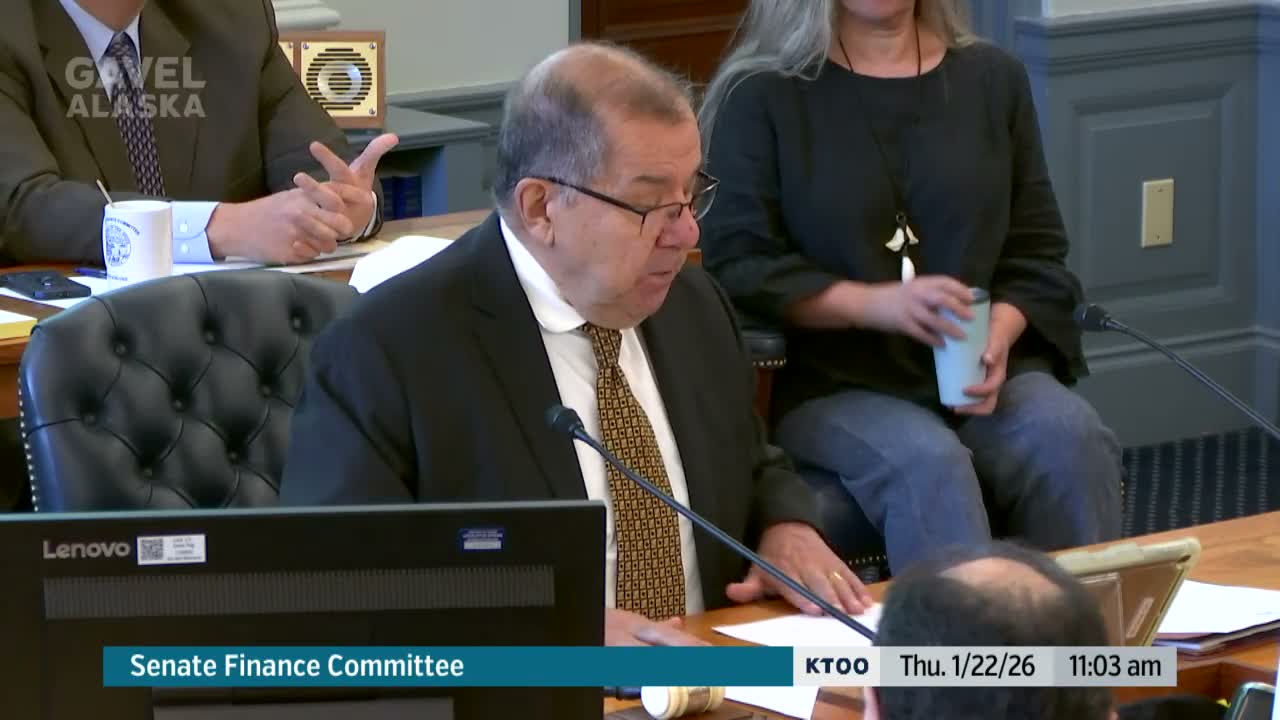
Juneau — The Alaska Department of Natural Resources told the Senate Finance Committee on Jan. 22 that state oil production is forecast to rise over the next decade, driven by a mix of new projects and redevelopment of legacy fields.
"Our production forecast does, at 10 years out, have us over 650,000 barrels per day in the 2034 window," said John Crother, commissioner designee at the Department of Natural Resources, presenting the department's Fall 2025 forecast. "It's a very exciting story to share today," he added.
Why it matters: The forecast shapes expectations for state revenue calculations and planning. Committee members pressed the department for additional detail on which barrels will carry gross-value reduction (GVR) treatment and how that split could affect severance tax revenue even as total production rises.
What DNR presented: Petroleum reservoir engineer Travis Pelletier outlined DNR's methodology and results. The department uses publicly available AOGCC pool data together with confidential operator discussions to build a projects list. DNR said it included 12 distinct North Slope projects (plus one project in Cook Inlet) in this year's forecast and continues to update assumptions twice a year.
Short-term and FY26 numbers: DNR reported a FY26 statewide annualized average daily production forecast of about 464,500 barrels per day, with North Slope production averaging roughly 457,000 barrels per day and an uncertainty range of about ±5 percent (418,400–495,300 bpd). DNR noted its FY25 forecast was within 0.3 percent of actual production.
Projects driving growth: Pelletier identified five projects central to DNR's near- and long-term outlook:
- Pika Phase 1 and Phase 2 (operator: Santos): DNR expects Pika Phase 1 to come online in March 2026 with an eventual peak of about 80,000 bpd; Phase 2 would add another 80,000 bpd at peak for a combined potential of roughly 160,000 bpd when both projects are fully ramped.
- Willow (operator: ConocoPhillips): More than 50 percent complete at the time of the briefing and on track for first oil in 2029; DNR cited a peak rate estimate of about 180,000 bpd for the Willow central facility.
- Colville River Unit CD-8 (operator: ConocoPhillips): DNR said the project has mixed acreage and is subject to a federal environmental review; DNR's internal mid-case rate estimate was about 20,000 bpd, with a draft EIS comment period anticipated and a record of decision expected by early 2027.
- Taiga / Prudhoe Bay redevelopment (operator: Hilcorp): DNR described a new Hilcorp project at Prudhoe Bay called Taiga that extends redevelopment work similar to successes at Milne Point; two new pads (referred to as OmegaPad and iPad) were noted, with OmegaPad first oil expected in 2028 and a combined peak of roughly 40,000 bpd for the two pads.
Field performance and operators: DNR highlighted that legacy fields are generally in long-term decline but that operator reinvestment can arrest or reverse that decline. Pelletier said Prudhoe Bay showed a modest year-on-year decline (about 3,000 bpd) while Kuparuk and Milne Point experienced strong results tied to operator activity. "It's very rare that you see a field like this where...the production actually achieves the same level of magnitude as that primary peak," said Derek Nottingham, director of the Division of Oil and Gas, of Milne Point's recent recovery.
Committee questions and follow-ups: Senator Stedman asked DNR and the Department of Revenue to break out barrels subject to different GVR categories (20 percent versus 30 percent reductions) and to provide legacy-barrel projections; Crother agreed to work with the committee and to share the requested information. Senator Kronk requested data on how much investment Hilcorp put into Milne Point to restore production; DNR said those cost figures may be confidential and could be available only from the operator or Department of Revenue.
Methodology notes: DNR said it includes only pools that were online by June 30, 2025 for its decline-curve analyses and supplements that with known but not-yet-producing projects based on operator plans. The department separates production into current production, underdevelopment (near-term infill drilling) and under-evaluation (years 2–10 projects).
Next steps: DNR pledged to provide the committee with the requested breakouts (including the Pika startup ramp and annualized barrels by project) and facility-level information such as conditioning-plant status and oil/water/gas ratios. The committee adjourned and scheduled a revenue forecast presentation for the next meeting.
Sources: Testimony and slides presented to the Alaska Senate Finance Committee by John Crother (Commissioner designee, Department of Natural Resources), Derek Nottingham (Director, Division of Oil and Gas) and Travis Pelletier (Petroleum Reservoir Engineer, Division of Oil and Gas).