Superintendents tell Alaska education committee CLSD grant works but implementation is inconsistent
Get AI-powered insights, summaries, and transcripts
SubscribeSummary
Two Alaska superintendents praised the federal Comprehensive Literacy State Development (CLSD) grant’s birth‑to‑grade‑12 focus and professional development supports but told the House Education Committee that compressed timelines, eligibility metrics, vendor approvals, and GMS fiscal mechanics created implementation, equity, and cash‑flow problems for some districts.
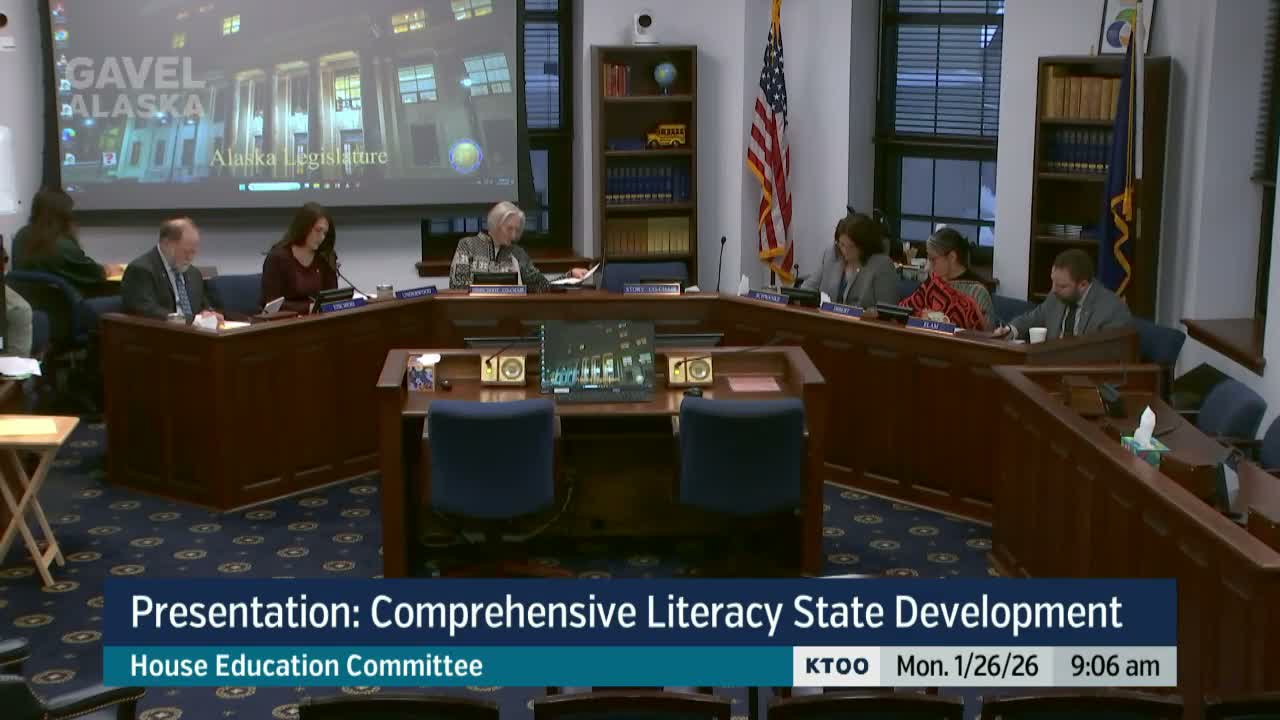
Juneau — Two Alaska school superintendents told the House Education Committee on Jan. 26 that the federal Comprehensive Literacy State Development (CLSD) grant is improving literacy work but that implementation problems are limiting its reach.
Michael Robbins, superintendent of the Bristol Bay Borough School District, and Robin Taylor, superintendent of the Petersburg School District, both praised CLSD’s birth‑to‑grade‑12 approach and its emphasis on sustained professional development and Multi‑Tiered System of Support (MTSS), saying the program helps align early learning through high school and supports teacher retention through ongoing coaching.
"This funding will have significant impact on our students' reading levels," Robbins said, describing CLSD as a vehicle for district‑level planning that can move districts away from one‑time trainings to sustained instructional improvement.
Why it matters: Alaska’s school districts are geographically and demographically diverse, and both superintendents said CLSD’s flexibility is essential. But they told lawmakers that a series of administrative and design choices have created gaps in access and practical barriers to using the funds.
Compressed timeline and eligibility: Taylor said the CLSD application was released April 30, 2025, with a May 30 deadline, which she called a "compressed timeline" that made strategic planning difficult for a multiyear grant. She also said 15 districts were identified as ineligible based on fall 2024 free‑and‑reduced‑lunch data, raising concerns that that single metric does not fully capture district need (for example, districts that do not run traditional meals programs or that underreport the data).
Robbins added that eligibility differences had real consequences: some districts that needed support were not able to access CLSD because of the metric used to determine eligibility.
Vendor approvals and professional development access: Both superintendents described problems with vendor approval and timing. Robbins and Taylor said some districts had proven local professional‑learning partners (for example, providers using John Hattie’s Visible Learning framework and the organization Corwin) that were not on an approved vendor list in time, forcing districts to pivot from partners who had produced measurable gains.
Taylor said the late approval timeline for vendors and for allowable conference attendance produced lost planning time and limited districts’ ability to participate in high‑quality learning opportunities.
Fiscal mechanics and cash flow: Taylor described a technical problem in the state’s grant management system (GMS) that required set‑asides for statewide evaluators before districts’ indirect costs were calculated. "The math simply did not math," she said, describing a period when districts received invoices but could not process payments properly, creating cash‑flow and administrative burdens that took months to correct.
Supplement not supplant: Taylor also explained that the CLSD program’s supplement‑not‑supplant rule prevents districts from using grant funds to restore existing district positions that have been cut for budgetary reasons. She said Petersburg eliminated one of three elementary reading‑interventionist positions between FY2025 and FY2026 and that the grant could not be used to restore that position because doing so would violate the grant’s restrictions.
Evidence of gains and turnover concerns: Robbins said Bristol Bay has seen measurable improvements since adopting aligned reading practices and professional development supported by CLSD, reporting a 75% reduction in the number of students requiring individualized reading plans over two years. At the same time, both superintendents cautioned that staff turnover remains a risk to sustainability because gains depend on ongoing training as new teachers enter districts.
Questions to DEED and next steps: Because the state Department of Education and Early Development (DEED) was not present, the committee agreed to forward specific questions about which districts received grants, how applications were evaluated, vendor‑approval rubrics, and the GMS fiscal setup so DEED can respond in writing. Committee leaders also asked for a demonstration of a school curriculum‑review cycle to provide context on local decision processes.
The meeting concluded with the committee scheduling its next session to focus on state–tribal education compacts and invited testimony from tribal education leaders. No formal votes or motions were taken on CLSD at this meeting.