
Senate Finance hears FY2027 budget overview as OMB flags billion-dollar deficit after including full PFD
Get AI-powered insights, summaries, and transcripts
Subscribe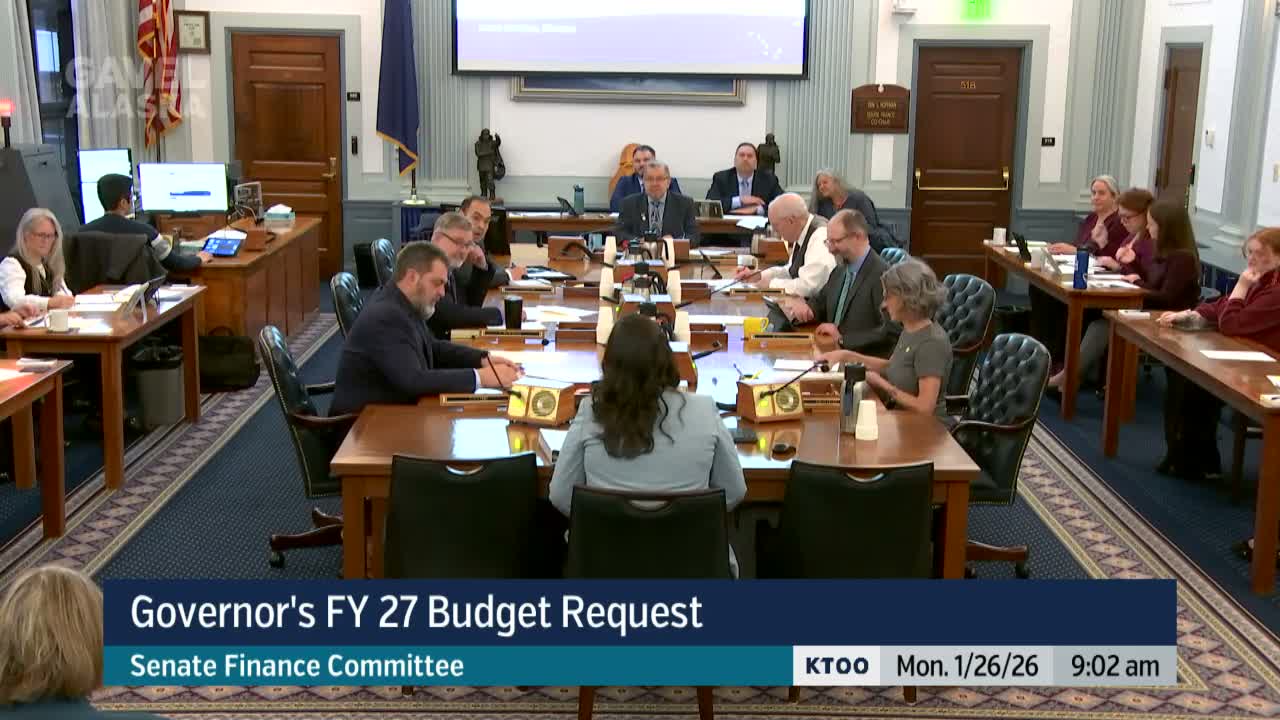
Summary
OMB Director Lacey Sanders told the Senate Finance Committee that the governor's FY2027 proposal, combined with lower oil-price forecasts and a full statutory Permanent Fund Dividend, produces an estimated deficit in the roughly $1.5 billion range; senators pressed on supplementals, use of the Constitutional Budget Reserve and timing for transportation match funding.
Lacey Sanders, director of the Office of Management and Budget, told the Alaska Senate Finance Committee on Jan. 26 that the governor's proposed fiscal year 2027 budget would leave the state with a sizable shortfall after accounting for current oil-price forecasts and the governor's decision to include a full statutory Permanent Fund Dividend.
"Our state is in a difficult position right now," Sanders said, summarizing the shift from the higher forecasts used when the FY2026 budget was developed to lower fall 2025 projections that reduced general‑fund receipts. She and senators said falling oil‑price assumptions reduced revenue forecasts by roughly $120–$200 million depending on the comparison point presented.
Sanders walked the committee through the administration's adjusted base calculations and fixed costs, and noted the governor's inclusion of a statutory PFD. The budget materials provided to the committee show the PFD add as roughly $1.7 billion over the prior year's dividend, which contributes to an overall estimated deficit in the neighborhood of $1.5 billion under current forecasts.
The presentation also identified supplemental requests transmitted with the December budget that total about $294 million for FY2026 and FY2027, including approximately $40 million proposed to recapitalize the Disaster Relief Fund and a restoration of a vetoed $70.2 million transportation match. Sanders said those supplementals are administration requests and that any supplemental that requires a draw on the Constitutional Budget Reserve (CBR) would need a three‑quarter vote of the legislature to access the fund.
Senators used the briefing to press the administration on policy choices and timing. Senator Steadman urged consideration of maintenance and capital needs for K‑12 facilities and public infrastructure and argued that proposing no maintenance was untenable; Sanders replied that the governor's package focused on meeting contractual and statutory obligations and that the administration is open to conversations about revenue and a broader fiscal plan.
Other exchanges focused on whether some supplementals should include a placeholder for expected in‑year needs. Senator Keel questioned the FY2027 proposal's lack of a supplemental placeholder, noting that most years include supplementary requests; Sanders said it is difficult to predict a single appropriate placeholder but said the administration would discuss options with the committee.
Sanders said departments continue to refine revenue estimates with the Department of Revenue and that the office will present the spring revenue forecast in March. The committee scheduled follow‑up hearings and department testimony on specific line items and veto ramifications.
The committee adjourned with the expectation of continued review and supplemental hearings; members were told the next meeting would continue detailed review of the governor's FY27 package.