Federal change on 'dual holds' may cost Alaska about $10 million, Department of Law says
Loading...
Summary
Deputy Attorney General Angie Kemp told a Jan. 26 House Finance subcommittee that a federal policy change ended prior funding for incarceration of defendants with companion federal cases, leaving the state largely responsible and producing an estimated fiscal impact of roughly $10 million; a joint letter to the U.S. Attorney's Office received no response, officials said.
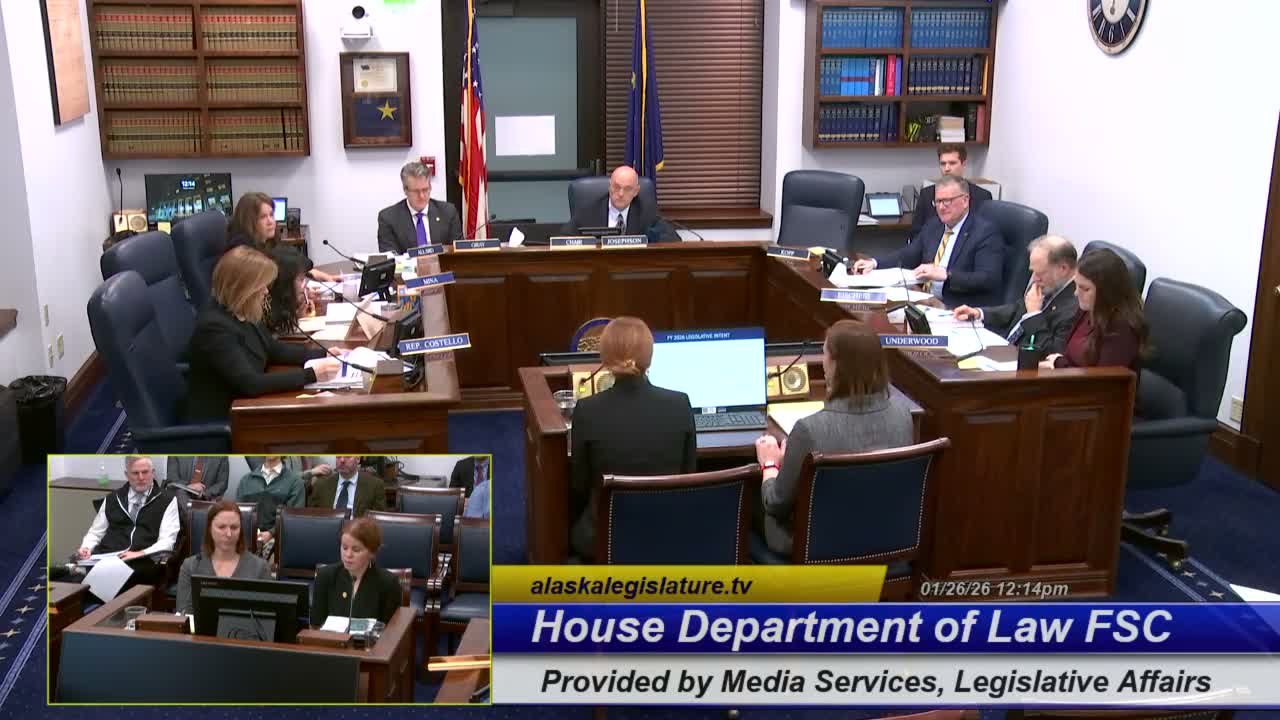
At a Jan. 26 House Finance subcommittee hearing, Deputy Attorney General Angie Kemp described a shift in federal practice that has left Alaska responsible for incarceration costs tied to so-called "dual holds"—cases with companion state and federal charges—and said the department and Department of Corrections are at an impasse after seeking federal engagement.
Kemp explained that a 2016 agreement had the federal government pay incarceration costs for individuals held on federal detainee status when there were companion state cases. In 2023, federal practice changed and Alaska was notified that the U.S. Attorney’s Office would no longer pay those costs. "As far as I'm aware, we never received any response from the federal government after we sent that letter," Kemp said of a joint letter (from the Department of Law and Department of Corrections) sent in 2024 seeking a meeting to negotiate a resolution.
Asked about the fiscal effect, Kemp said she did not have Department of Corrections figures at hand but that, based on prior materials, the change had been "in the neighborhood of approximately $10,000,000." She added that the Department of Corrections would have more precise accounting.
Legislators pressed on possible tactical responses. Kemp said that theoretically dismissing state charges so federal charges alone would drive detention costs could shift the expense, but she cautioned the legislature against adopting that as a policy. "I would not recommend that that be the strategy that this legislature, as a policy, decides to," Kemp said. She framed the matter as a resource and policy choice, not simply an accounting fix.
Kemp said the committee’s intent language directed the department and Department of Corrections to pursue solutions, but with no federal response to the 2024 letter the parties remain at an impasse. The issue will likely return for more discussion as the legislature and agencies consider options to address the fiscal effect.