
Alaska Department of Law: staffing cuts leave prosecutors with heavy caseloads, officials say
Get AI-powered insights, summaries, and transcripts
Subscribe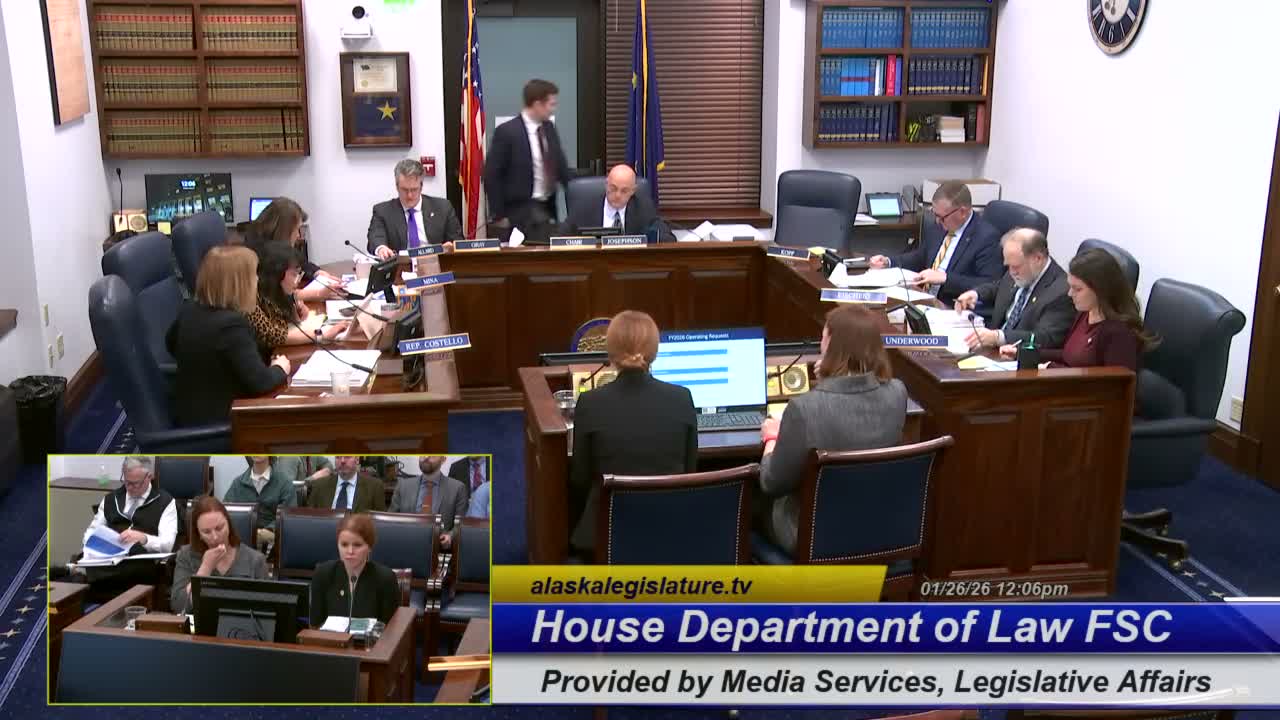
Summary
At a Jan. 26 House Finance subcommittee hearing, Department of Law deputies said several requested prosecutor and support positions were removed from the enacted FY26 budget, leaving prosecutors with average caseloads of about 145 if fully staffed and practical distributions around 165–167 cases; deputies cited recruitment gains from internships but said resource limits forced reallocation to initiatives such as the governor’s Quality of Life effort.
At a Jan. 26 House Finance subcommittee hearing, Deputy Attorney General Angie Kemp and Deputy Attorney General Corey Mills told legislators that the Department of Law’s FY26 staffing requests for caseload relief were not enacted and that prosecutors continue to carry high caseloads.
Kemp said the department had asked last year for five positions intended to reduce caseloads — including three prosecutor positions (for Dillingham, Sitka/Ketchikan, and Palmer), a paralegal in Palmer and a law-office assistant in Southeast Alaska — plus a Brady prosecutor and staffing for post-conviction relief work. “None of those were ultimately enacted,” Kemp said, noting the requests were removed during budget negotiations.
Kemp described the practical effect: “The average, assuming all of our PCNs were filled, the average caseload that our prosecutors would have is 145 cases per attorney,” she said, adding that current distributions—because vacancies are common—are closer to 165–167 cases per attorney in many offices.
The department reported low vacancy rates for some job classes but continued pressure across the workforce: Kemp gave prosecutors a roughly 5% vacancy rate, paralegals about 6% and administrative support about 10%. Mills said parts of the Civil Division show roughly 7–8% vacancy levels, though some specialist roles (commercial, oil and gas, child protection) can remain open for months.
Lawmakers pressed the deputies on how the department is handling work that would have gone to the cut positions. Kemp said the criminal division has used a committee-style approach, distributing responsibilities among several attorneys to meet disclosure and case-preparation obligations. She also cited the department’s internship and fellowship programs as a recruitment pipeline: Mills and Kemp said they had hired at least one former intern as a prosecutor in Bethel and that fellowship placements and improved onboarding have aided retention.
Several legislators asked about the governor’s Quality of Life initiative, a coordination effort with the Municipality of Anchorage to target low-level, recidivist offenses. Kemp said the initiative does not add state positions but repurposes existing resources and includes cross-designation of municipal attorneys and training led by former Deputy AG John Skidmore to help municipal partners take on some prosecutions.
Lawmakers also raised due-process and workload tradeoffs tied to trial calendars and limits on continuances. Kemp cautioned that arbitrary limits on continuances could increase post-conviction-relief filings and appeals if cases proceed before defense readiness, and she urged careful consideration of trial scheduling and staffing to avoid downstream litigation.
The subcommittee scheduled a follow-up hearing on Feb. 2 to hear the governor’s FY27 Department of Law overview.