
Senate committee hears recap of House Bill 78 aiming to add defined‑benefit tier for new hires
Get AI-powered insights, summaries, and transcripts
Subscribe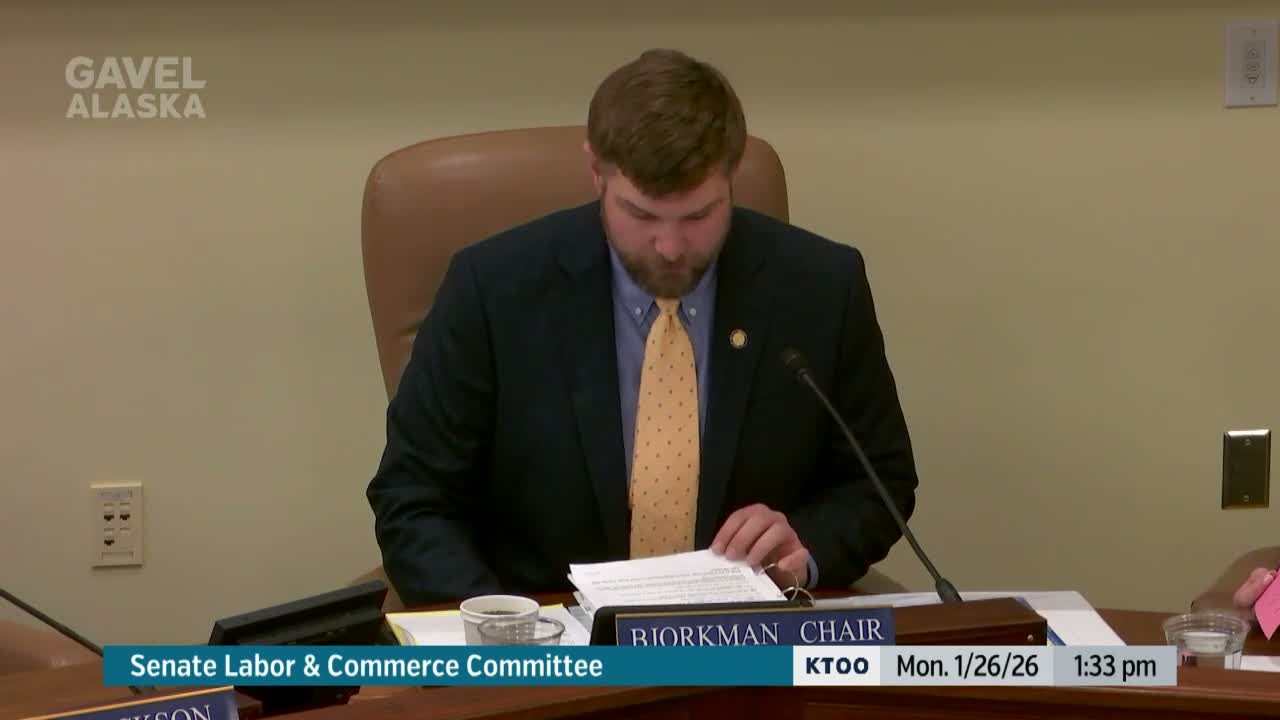
Summary
The Senate Labor and Commerce Committee received a recap of House Bill 78 on Jan. 26, proposing a new defined‑benefit tier to address staff turnover and reduce long‑term costs; a committee substitute with an immediate effective date was presented and the bill was set aside for further consideration.
The Alaska Senate Labor and Commerce Committee on Jan. 26 heard a brief recap of House Bill 78, which would add a new defined‑benefit tier for new hires in the state retirement systems. Representative Chuck Kopp, sponsor of the bill, told the committee the measure is intended to address "the bleeding of talent" — a pattern of turnover among mid‑level and senior agency staff — and to introduce a modern retirement option he described as "affordable, predictable" and focused on recruitment and retention.
Kopp said the proposal is not a return to an old legacy system but "simply about finishing the job responsibly," and asserted the state is on track to pay off obligations from legacy systems by 2039 under current plans. The committee had no questions after the recap, and members were given a proposed committee substitute (CS) to use as the working document.
Actuarial evidence presented by invited witness Dan Doonan emphasized rising early‑career turnover in defined‑contribution (DC) plans compared with legacy defined‑benefit (DB) layers. Doonan summarized experience studies and valuation reports showing higher first‑five‑year separation rates in more recent cohorts, and lower long‑service turnover in the legacy DB tiers (cited figures included DB exit rates around 3.6–3.9% for long‑service teachers versus higher rates in DC plans). Doonan said these patterns appear across multiple plans including teachers, public employees and public safety.
Conrad Jackson, staff to the committee, summarized limited technical changes in the CS, including a title change to add an immediate effective date and insertion of new sections affecting the Teachers' Retirement System and Public Employees' Retirement System that would require new hires to enter the new defined‑benefit tier rather than have the option of a defined‑contribution plan. After discussion the committee set House Bill 78 aside for further consideration.