
Senate Resources Committee hears Gaffney & Klein: Wood Mackenzie assumptions on property tax and fiscal stability need legislative scrutiny
Get AI-powered insights, summaries, and transcripts
Subscribe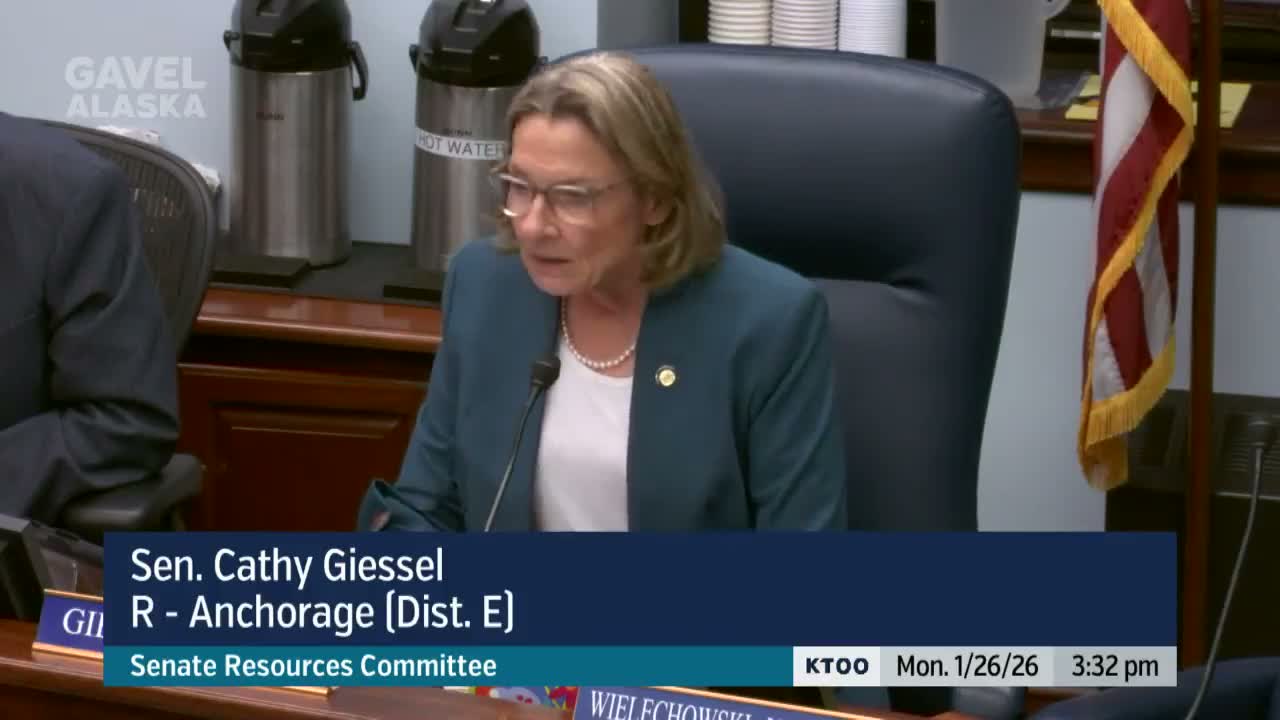
Summary
Gaffney & Klein consultants told the Senate Resources Committee that comparisons with LNG Canada are relevant but that key economic assumptions in the Wood Mackenzie report—especially a modeled reduction in property tax from 20 to 2 mills—are illustrative and not government commitments; they urged legislative review of tax, royalty and pricing risks before any fiscal accommodations are assumed.
Nicholas Fulford, senior director for gas, LNG and energy transition at Gaffney & Klein, told the Alaska Senate Resources Committee on Jan. 26 that comparisons with Canada’s LNG projects are useful but that the fiscal arrangements that supported investment there were the product of lengthy negotiation and specific provincial and federal measures.
Fulford said LNG Canada benefits from low-cost feed gas in the Montney and lower shipping costs and that those economic conditions helped make it an "investable" project. He told the committee that the Wood Mackenzie analysis the committee has is built on illustrative assumptions and should not be read as reflecting any state commitment. "On that sheet…there's a reference to property tax which moves the nominal mill rate from 20 mils down to 2 mils. So it's a 90% reduction in property tax," Fulford said, adding he was not aware of indications from state or municipal government that such a change would be adopted.
Why it matters: The Wood Mackenzie report ("Economic Viability Assessment and Economic Value of Alaska LNG Project Phase 1," 11/19/2024) is being used in public discussion of project economics and potential tax changes. A large reduction in property tax materially alters short-term project cash flows in modelling and therefore affects questions about whether private investors or lenders would view the Alaska project as financeable under current terms.
Committee members asked for more detail about how the Canadian projects persuaded governments to change fiscal terms. Fulford described the evolution of LNG Canada’s fiscal framework over several years, including provincial actions that reduced corporate income tax rates (from roughly 12% toward ~9% in his description), deferment of provincial sales-tax receipts (he estimated a CAD 450 million present-value‑style deferment described as a 20‑year interest‑free effect), and federal measures such as accelerated depreciation that deferred tax collection to later years.
Fulford cautioned that those measures were tailored to specific project negotiations. "The provincial government gave the project what they called nation building status" and while that fell short of a formal fiscal stability agreement, he said it provided commercial comfort that reduced perceived fiscal-change risk for investors.
The presentation also reiterated other quantitative sensitivities that appear in the Wood Mackenzie analysis: Fulford cited an illustrative AECO feed‑gas number for Canadian projects of about $2.53 per MMBtu and said WoodMac used illustrative Alaska upstream transfer prices around $1.25 in some scenarios. He also flagged Coastal GasLink’s cost escalation: an initial pipeline estimate he recalled at CAD 6.6 billion that later rose to CAD 14.4 billion.
Committee Chair Senator Jay Giesel said the committee will invite Wood Mackenzie to present directly and asked members to review the report; Fulford confirmed the report is posted in the committee documents. Fulford told the committee the assumptions warrant further legislative and municipal review before policymakers treat the modeled fiscal terms as likely or binding.
"My understanding is that this has been simply an assumption that was put there for the purposes of an economic illustration," Fulford said of the property‑tax figure.
Next steps: Fulford recommended more detailed analysis and direct presentation by Wood Mackenzie so the Legislature can examine which assumptions are illustrative and which, if any, are supported by governmental commitments or ongoing negotiations. The committee scheduled additional briefings and asked staff to follow up on specific tax‑rate comparisons between Alaska and Canadian provinces.
Sources: Presentation by Nicholas Fulford (Gaffney & Klein) to the Alaska Senate Resources Committee, Jan. 26, 2026; Wood Mackenzie report posted in committee documents.