Get AI Briefings, Transcripts & Alerts on Local & National Government Meetings — Forever.
Senate Education Committee reviews evidence that four‑day school weeks yield small budget savings but mixed student outcomes
Loading...
Summary
Researchers from the HEDCO Institute told the Alaska Senate Education Committee that rigorous studies generally show modest district budget savings (about 1–2%) after adopting a four‑day school week, but they also reported small yet meaningful negative effects on some student outcomes and flagged gaps in Alaska‑specific and indigenous education research.
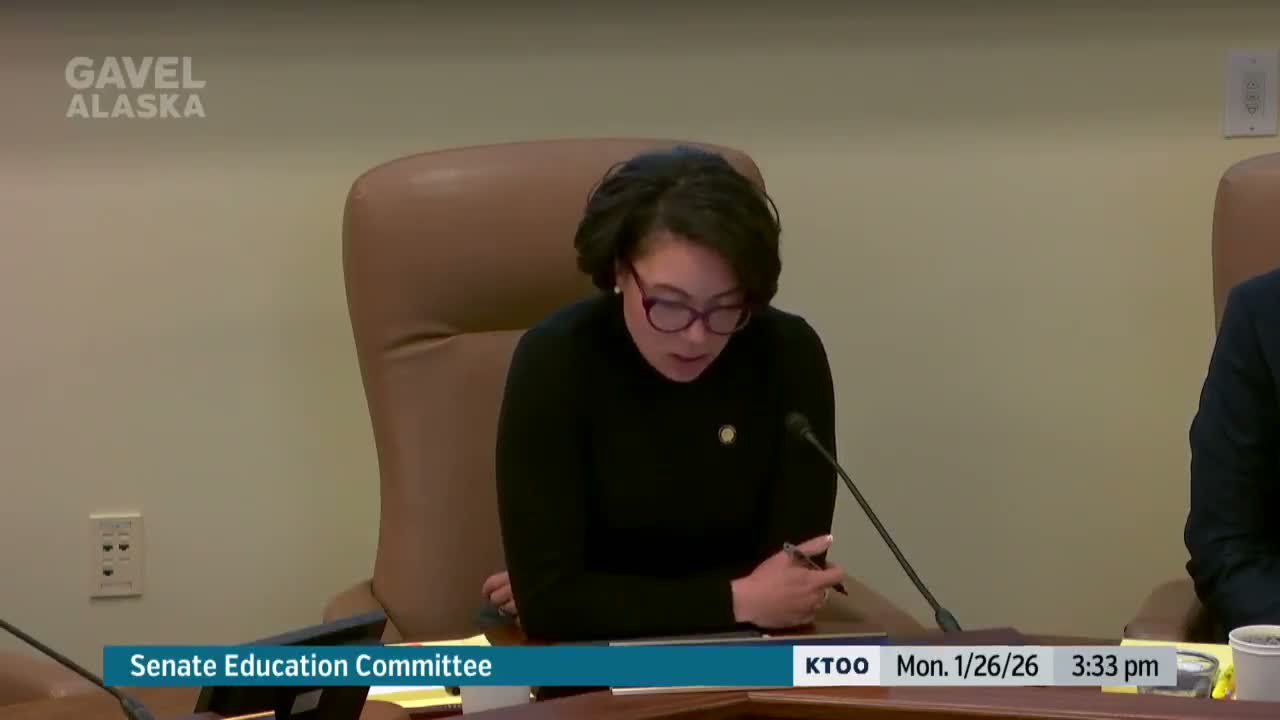
Researchers from the HEDCO Institute at the University of Oregon presented evidence to the Alaska Senate Education Committee on Jan. 26 about the fiscal and educational effects of switching from a five‑day to a four‑day school week.
Sean Grant, associate research professor and assistant director of research at HEDCO, told the committee the Institute conducts systematic reviews of the empirical literature and compiles findings to inform K–12 decision‑making. “We do this alongside K through 12 educators,” Grant said, adding that HEDCO’s funders are not involved in research decisions.
Grant summarized cost estimates from several high‑quality studies. He said a multi‑state analysis covering 1999–2017 and an Oklahoma study from 2004–2017 each found district budgets decreased roughly 1–2% after adopting a four‑day week, with reductions concentrated in transportation, food services and support services. A Colorado study (2003–2022) showed similar patterns and noted declines in federal meal reimbursements linked to fewer school meals served.
On student outcomes, Grant said the best evidence does not show large positive effects. “We found no evidence clearly of any large positive effects for student outcomes,” he said, and added that many studies report small but meaningful negative effects in domains such as academic achievement, attendance (including chronic absenteeism), progression and disciplinary incidents.
The presenters stressed that results vary by grade and context. For rural K–8 students across multi‑state studies, HEDCO found declines in math and reading scores; for some rural high schools (data from Oregon and Colorado) there were small increases in math and graduation rates but also increases in absences, delayed progression and localized juvenile activity concentrated on the first non‑school weekday.
Committee members pressed for clarity about magnitude. Senator Kiel asked the presenters to explain standard‑deviation effect sizes versus percentage‑point changes; Grant replied that the reported effects are statistically significant but small, and illustrated that a student at the 50th percentile might move to roughly the 42nd–48th percentile depending on the estimate. When asked whether those changes could be merely measurement noise, Grant said the literature treats them as real but small effects.
Members raised policy considerations and evidence gaps. Senator Tobin asked about food security for Title I students; Grant said direct research on meal access after a schedule change is lacking and recommended that districts maintain or adapt flexible food‑provision measures or reinvest any savings to support meal access. Senators asked whether differences in daily school‑day length were accounted for; HEDCO said no study fully isolates that variable but emphasized that schools that maintain the same total instructional hours over the year tend to avoid negative academic outcomes.
On the question of mitigating harms, Grant and Elizabeth Day (research assistant professor and director of outreach) said districts can consider reinvesting modest savings (often estimated at about 1–2% of budgets) into programs on the fifth day — remedial instruction, clubs, work‑study or other supervised activities — to reduce absenteeism and youth risk. Grant also cautioned that some positive findings in older datasets (for example, a Colorado sample from 2000–2010) may reflect different motivations for adopting four‑day weeks before the 2008 recession.
The HEDCO team noted a lack of Alaska‑specific empirical studies and limited research on indigenous or tribal community contexts; they offered the Institute’s full report and an interactive database of studies (updated through 2025) as resources for committee staff and members seeking locality‑specific evidence.
The committee did not take any formal votes on policy at the meeting. The chair announced a bill hearing on Wednesday for Senate Bill 204 (substitute teaching and qualifications for school board members), sponsored by Senator Mike Cronk, and adjourned at 4:07 p.m.
What the record shows: the committee received a research brief describing modest potential fiscal savings from a four‑day week, consistent small negative effects on several student outcomes in many studies, and clear gaps in Alaska‑specific and indigenous education evidence. Members requested follow‑up on effect‑size translations, food‑security implications and how instructional hours are measured; staff follow‑up was requested by the chair.