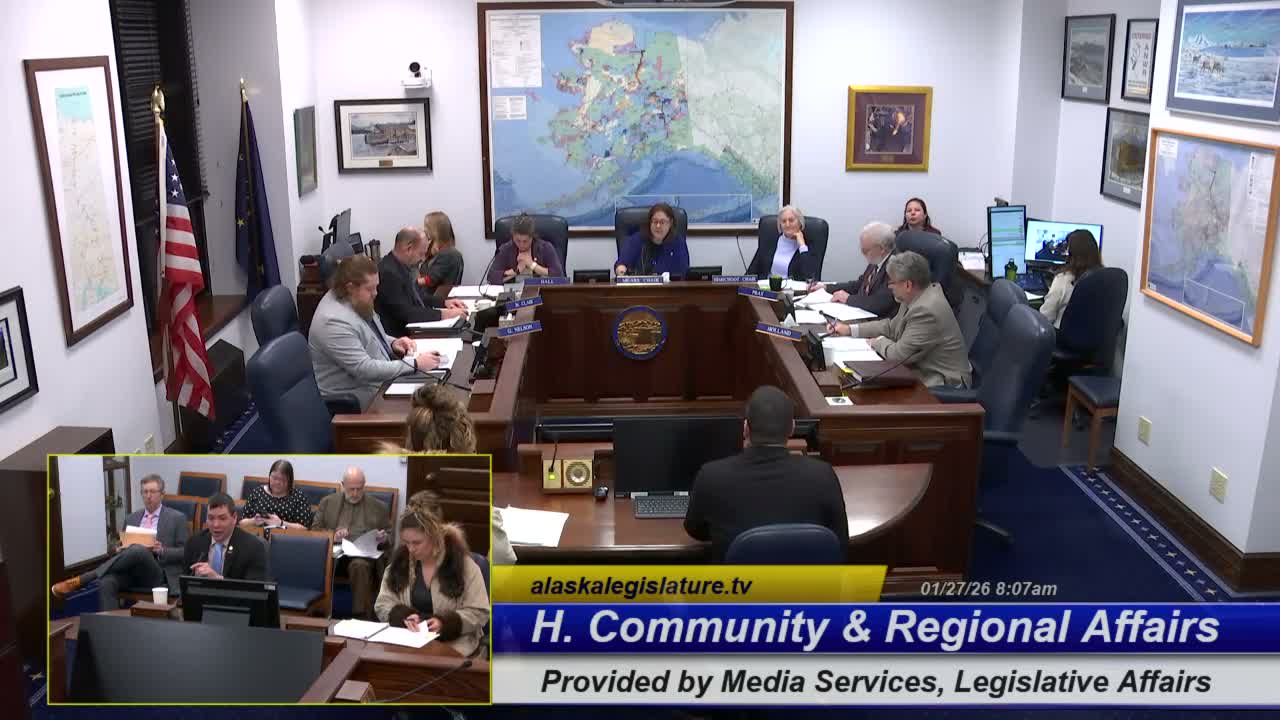
House committee hears HB 255 to create PFD-based raffle for senior services
Loading...
Summary
The House Community and Regional Affairs Committee held an introductory hearing Jan. 27 on HB 255, which would let Alaskans donate portions of their Permanent Fund Dividend to a senior grants raffle; the bill outlines fund structure, a 50/25/25 allocation split and an optional endowment while lawmakers pressed sponsors on capitalization and administrative costs.
An Alaska House committee on Jan. 27 heard an introductory presentation on HB 255, legislation that would let Alaskans voluntarily donate portions of their Permanent Fund Dividend (PFD) to a raffle aimed at funding senior services.
Representative Will Stapp, sponsor of the bill, told the House Community and Regional Affairs Committee the proposal is modeled on the existing PFD education raffle but would direct proceeds to senior support services such as home-delivered meals, transportation and supportive housing. "It's a voluntary way for everyday Alaskans to support senior citizen services," Stapp said, adding the bill would not require a new general-fund appropriation or impose new taxes.
The bill would create two accounts: a senior citizen grants endowment fund and a senior citizen grants dividend raffle fund. Staff explained the raffle fund would receive voluntary PFD donations, pay prizes and administration costs, and transfer excess balances to the endowment. The sectional analysis also proposes statutory edits to clarify that PFD raffles are not criminal gambling under Alaska law and updates Department of Revenue duties to handle multiple PFD donation options and donor prioritization when a donor's selected contributions exceed the declared dividend.
Sponsor's design choices and mechanics
Under the bill as drafted, donors 18 and older could give in $100 increments and enter the raffle. The staff presentation described a prioritization order if customers select more donations than their dividend amount: existing Pick.Click.Give. options (including the Peace Officers and Firefighters Survivors Fund and the Victim Compensation Fund) receive priority, then the education raffle, and then the new senior raffle. The statutory draft also includes formulaic distribution language that would direct 50% of donated funds to annual grant distributions, 25% to the endowment fund and 25% to the raffle prize/administration fund; sponsors said those percentages are adjustable by the committee.
Advocates and agency input
Vivian Steinberg, testifying as a private citizen and with ties to senior services, told the committee Alaska's aging population is growing and current funding is insufficient. "These funds will ultimately benefit every Alaskan," Steinberg said, noting wait lists for Meals on Wheels and other in-home services in communities such as Fairbanks.
Tony Newman, director of the Division of Senior and Disability Services at the Alaska Department of Health, told lawmakers the division currently distributes roughly $18 million in grants for seniors and people with disabilities and that one of its largest programs, described as a nutrition, transportation and support grant, is about $7 million. Newman said the department follows a funding formula to ensure statewide distribution and that staff would need to decide whether the new raffle funds should supplement existing programs or create new grant types.
Questions and concerns from lawmakers
Members pressed the sponsor on how the raffle would relate to existing Give/Pick.Click.Give. mechanisms and on fiscal details. Representative Kai Holland questioned the bill's endowment-capitalization benchmark, noting the draft sets a target corpus of about $1,000,000,000 before the endowment would begin providing distributions. "It looks like it will take hundreds of years before this might get to the billion-dollar threshold," Holland said, and asked whether a lower capitalization target would be more realistic. Stapp said the figure was chosen as a conservative benchmark and that the committee could pick a different threshold.
Lawmakers also asked for better fiscal estimates for startup and ongoing administration. Stapp's staff cited the initial education raffle startup cost as about $4,400 and said the committee would seek Department of Revenue input on administration costs so the fiscal note is less indeterminate.
Next steps
Committee members discussed trade-offs between creating an endowment that preserves capital for long-term distributions and dedicating more funds for immediate grant-making. Sponsor Stapp said he would consider adjustments to the mechanics and thresholds. The committee set HB 255 aside for a later date. Co-chair Donna Meers said the committee will return for further review and noted a joint informational hearing with the House Tribal Affairs Committee on the Alaska State Emergency Operations Center is scheduled next.
What the bill would and would not do
The bill, as presented, is intended to create an additional, voluntary revenue stream for senior services and does not replace existing federal or state funding. Several procedural and technical clarifications remain to be resolved: the committee flagged the endowment capitalization threshold, the precise definition of "supportive housing" and the department-level decisions required to implement distributions. If advanced, the bill's draft sets an effective date of Jan. 1, 2027.
(Reporting from the House Community and Regional Affairs Committee hearing on HB 255.)