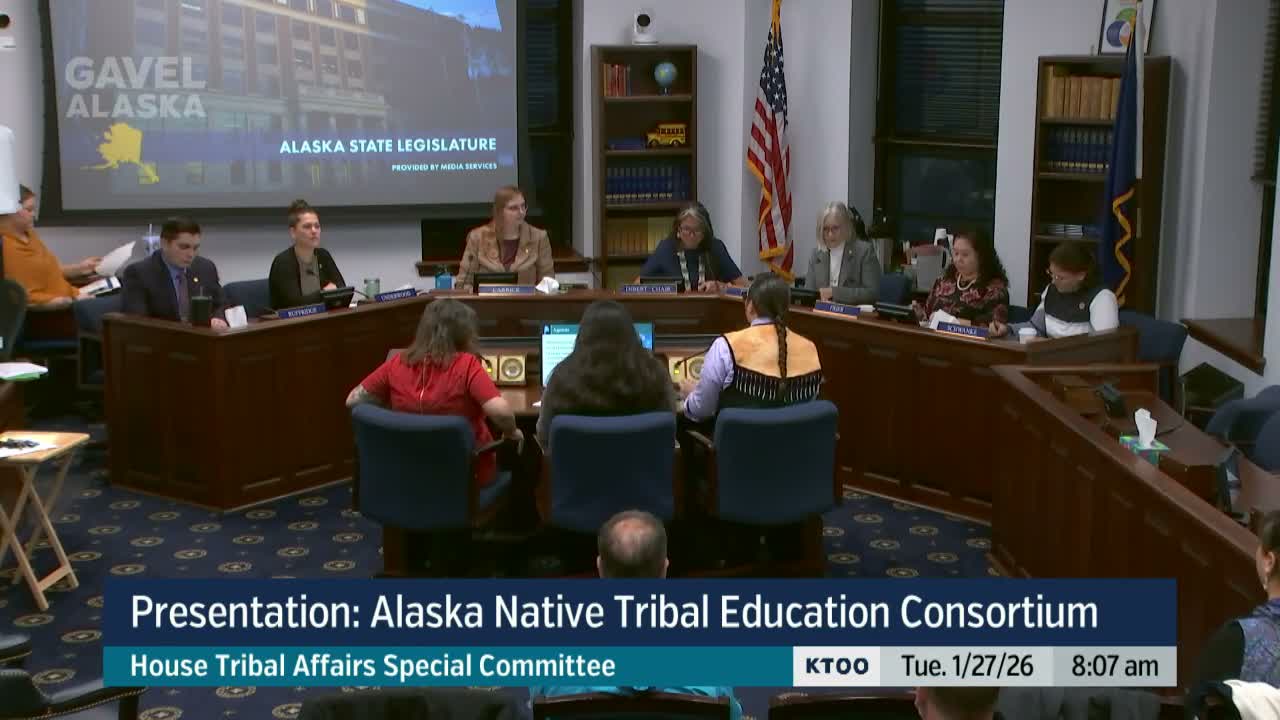
Alaska tribes form ANTEC to coordinate education advocacy, say founders

House Tribal Affairs Committee · January 27, 2026

Get AI-powered insights, summaries, and transcripts

Subscribe
AI-Generated Content: All content on this page was generated by AI to highlight key points from the meeting. For complete details and context, we recommend watching the full video. so we can fix them.

Summary

Presenters told the House Tribal Affairs Committee that the Alaska Native Tribal Education Consortium (ANTEC) formed this year to amplify tribal voice in education policy, provide a clearinghouse for culturally aligned curriculum and push for direct funding access amid legal and data barriers.

Anchorage (House Tribal Affairs Committee) — Tribal leaders and education officials told the House Tribal Affairs Committee on Jan. 27 that the Alaska Native Tribal Education Consortium, or ANTEC, has been established to "uphold and advance tribal sovereignty in education." Joel Isaac, director for language and culture for the Kanitesi Indian Tribe and a contractor with the Department of Education, said the consortium aims to give tribes a unified, tribally led voice on education policy and to coordinate advocacy and curriculum sharing.

"The mission of ANTEC is to uphold and advance tribal sovereignty in education by empowering tribes to collaborate, coordinate, and advocate on matters affecting the success of Alaska's Native students, families and communities," Isaac said. He told legislators ANTEC's constitution became active in December and that Ketchikan Indian Community has agreed to be the consortium's fiscal agent so ANTEC can accept funds.

Why it matters: Presenters said ANTEC is intended to address recurring problems that tribal governments and tribal-serving organizations face when trying to support Alaska Native students: inconsistent access to student data, fragmented curricula, and limits on direct federal education funding in Alaska. Isaac and co-facilitators described ANTEC as a tribally sanctioned organization with voting membership reserved for federally recognized tribes and nonvoting affiliate membership available to tribal-serving nonprofits and local education agencies.

Key details: Presenters said ANTEC currently has eight voting tribal members representing roughly 50,000 tribal citizens and that membership becomes active when a tribal government transmits a signed resolution. Isaac explained the legal rationale for limiting voting membership: to preserve ANTEC's status as a tribally sanctioned organization under federal law. Nonvoting affiliates, the presenters said, can join working groups, serve on committees and contribute technical expertise.

Funding, data and law: Presenters repeatedly cited two structural barriers. First, data access: tribes often cannot routinely access student-level education data because districts cite FERPA protections — presenters said that hinders tribes' ability to monitor how tribal students are doing in the public system. Second, federal funding pathways: Isaac described the long-running effect of the "Stevens rider," which has shaped how Bureau of Indian Affairs and Bureau of Indian Education funding interact with Alaska state systems. He said ANTEC's advocacy will include asking federal and state partners to develop mechanisms that allow tribes to receive steady operational funds, such as tribal compacting or other statutory pathways.

"One of the things tribes don't have is the data to be able to track how our students are doing," Isaac said. "FERPA often gets used against tribes to have access for their citizens even though it's federally protected under title VI."

Partnerships and process: Presenters said ANTEC has engaged the Alaska Federation of Natives (AFN) and other statewide organizations; AFN leaders have been invited to meetings and reviewed draft constitution language. The consortium's structure relies on working groups to vet policy initiatives before bringing recommendations to tribal voting members.

Voices from the field: Mark Roseberry, director for education for the Inupiat Community of the Arctic Slope, told the committee that tribally run schools use local staff and culturally grounded practices to reduce student stress and support learning gains. He said tribal schools often operate with unpredictable funding and rely on grants, donations and local support for operations.

Next steps: Presenters asked committee members to share outreach templates and contact information for tribes or organizations that might join ANTEC. The consortium said it is actively seeking funding for staffing and plans ongoing engagement with federal delegates and the U.S. Department of Education.