Alaska lawmakers hear divided testimony on bill letting conflicted fisheries board members speak during deliberations
Loading...
Summary
At a Jan. 27 Senate committee hearing, proponents said House Bill 33 would let Board of Fisheries and Board of Game members share expertise during deliberations while still recusing from votes; opponents warned it would allow conflicted actors to influence allocation decisions and undermine public trust.
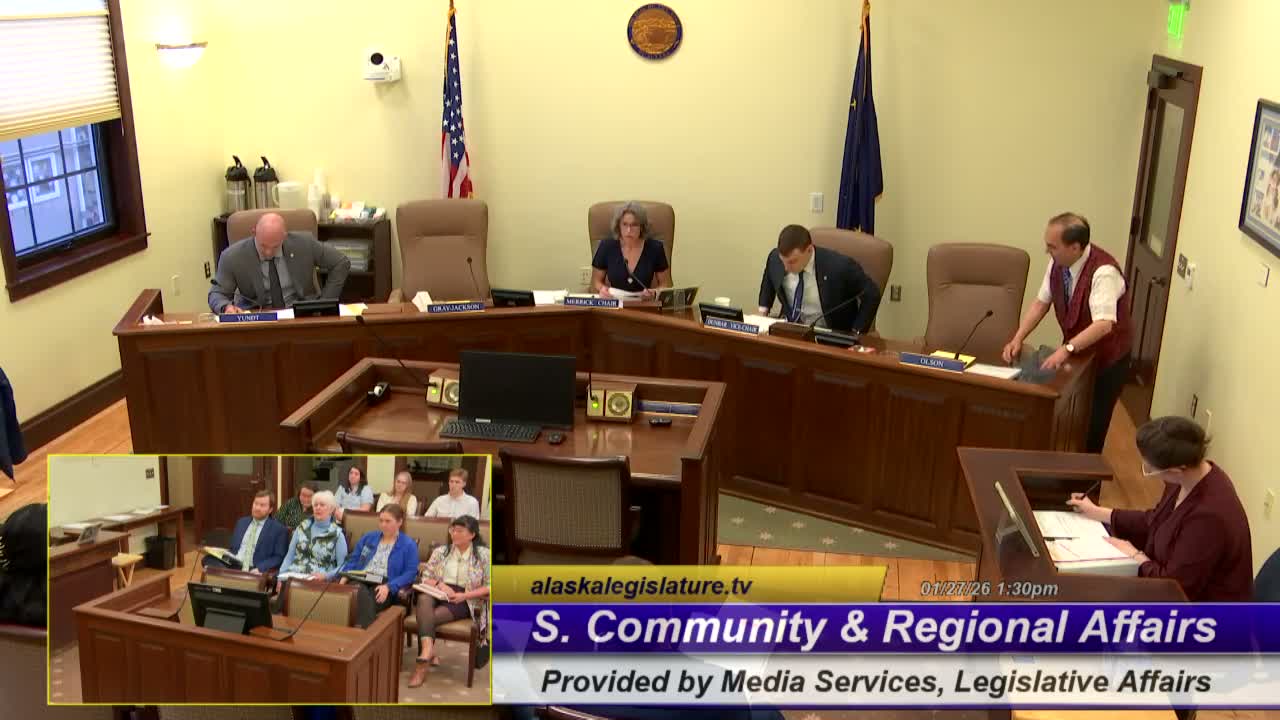
Representative Louise Stutes introduced House Bill 33 at the Senate Community and Regional Affairs Committee hearing on Jan. 27, saying the proposal would let members of the Board of Fisheries and the Board of Game speak during formal deliberations on proposals where they have a declared conflict, while preserving the current rule that conflicted members may not vote.
The sponsor argues the change would improve transparency and decision-making by allowing board members with local, fishery-specific knowledge to put expertise on the record before recusing themselves from the final vote. Matt Greening, chief of staff to Representative Stutes, told the committee the bill would align practice with the ethics act (AS 39) by permitting debate but not voting, and he cited recusal rates of about 28% for the Board of Fisheries in 2021–22 and 27% in 2022–23 as illustrative of the issue the bill addresses.
Supporters included Tracy Welch, executive director of United Fishermen of Alaska, who said UFA represents 34 commercial fishing organizations and backed allowing conflicted members to participate in debate ‘‘but to abstain from voting’’ because local expertise often falls outside the knowledge base of many board members. Welch told the committee the bill would ‘‘improve the deliberative process’’ and lead to more informed fisheries management decisions.
Opponents, including Shannon Martin of the Kenai River Sportfishing Association and Ted Spraker, a former Board of Game chair and retired ADF&G wildlife biologist, argued the current system already allows conflicted members to participate as members of the public (Committee of the Whole) and that moving influence into formal deliberations risks unfairly swaying decisions. Shannon Martin said the Committee of the Whole and public testimony phases allow conflicted individuals to provide information while preserving the integrity of formal deliberations. Ted Spraker told the committee, ‘‘I worry about transparency and integrity of the board if a person that has a financial benefit is allowed to sway other board members.’’
Charles Derrick, president of the Chitina Dipnetters Association, said allowing conflicted members to speak during deliberations would create an unfair advantage in determining harvest allocations because the boards set allocation and harvest limits for all user groups.
Committee members asked for clarifications about statutory definitions and practice. Senator Dunbar probed whether ‘‘personal’’ conflicts—such as subsistence or sport fishing participation—are treated the same as financial conflicts; Greening said both categories exist, with financial conflicts tied to a monetary threshold he cited as $5,000 and personal conflicts defined more broadly. Senator Yount asked whether written testimony from a conflicted member can be referenced during deliberations; Greening said he would check and follow up.
No vote occurred. The committee set House Bill 33 aside for further consideration and took a brief recess. The committee also asked staff to confirm the historical change Greening referenced (likely from the late 1980s) and to clarify whether written or submitted materials from conflicted members may be referenced during deliberations.
Next steps: the committee left HB33 ‘‘set aside’’ for further consideration; committee staff said they would provide follow-up on statutory history and procedural clarifications.