Legislative Finance outlines revenue shift that turns FY26 surplus into deficit; NPRA classification and POMV draw raise forecast uncertainty
Loading...
Summary
The Legislative Finance Division told the House Finance Committee that a fall revenue forecast reduced projected FY26 revenue by about $181 million—turning a projected $130 million surplus into a roughly $51 million deficit—and flagged disagreements over NPRA revenue classification and one‑time lapses that complicate the budget outlook.
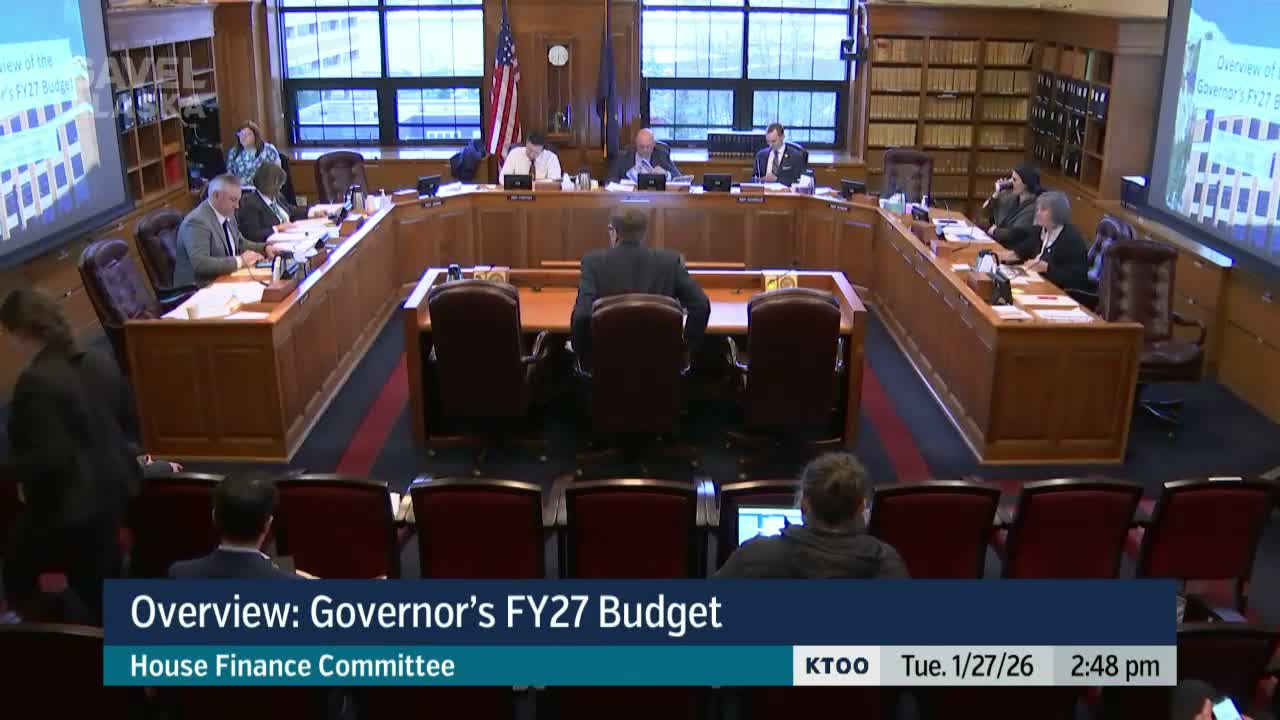
Alexi Painter of the Legislative Finance Division provided a broad overview of the revenue and appropriation context for the FY26–27 budgets. Painter summarized last year’s budget history, the impacts of vetoes and overrides, and how the fall revenue forecast changed the FY26 picture: where the legislature had earlier anticipated about a $130 million surplus, the fall forecast produced a roughly $181 million downward revision that leaves a known $51 million deficit before any supplemental appropriations.
Painter outlined several structural issues complicating the budget outlook: the use of lapse (unspent) dollars to smooth costs—particularly money routed to the Group Health and Life Benefits Fund—reduces available laps for other priorities; agency overspends that will come to the legislature as ratification requests; and a change in how National Petroleum Reserve–Alaska (NPRA) royalties are classified between LFD and the governor’s office. Painter said legislative legal counsel advised that NPRA royalties should be treated as federal revenue for long‑term planning and that LFD therefore counts those amounts differently than the administration, a difference that affects roughly $9.6 million in the short term and larger long‑term projections.
Painter also walked through the percent‑of‑market‑value (POMV) draw on the permanent fund, noting a temporary increase in the FY27 draw because of the 20‑24 balance window but cautioning that the boost is one‑time and FY28 will be more constrained. He explained vacancy and lapse dynamics in FY25, how lapsing dollars were used for group health claims and other needs, and the risks of relying on laps rather than policy changes to stabilize funds.
On NPRA specifically, Painter said legislative legal advised the division to treat NPRA receipts as federal for projection purposes, but Department of Revenue and OMB forecasting treat some of it as unrestricted general fund receipts; the committee asked for the legal memo and further detail on the divergence.
Painter closed by noting additional updates are expected (including refined disaster numbers) and by flagging the timeline to complete the LFD presentation in a follow‑up meeting; the committee paused the slide deck mid‑presentation and planned to reconvene on the remaining fiscal issues at the next meeting.