
Acting commissioner outlines staffing, facility upgrades and new apprenticeship at DFCS
Get AI-powered insights, summaries, and transcripts
Subscribe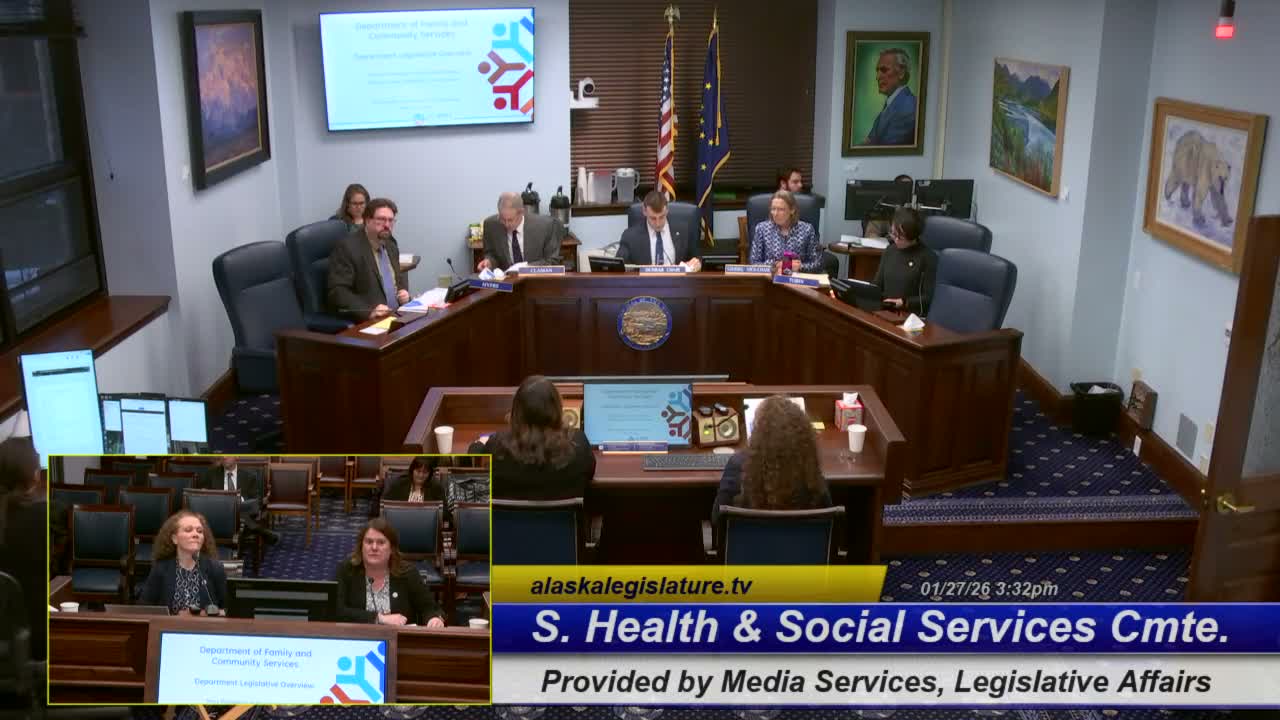
Summary
Acting Commissioner Tracy Dompling told the Senate Health and Social Services Committee that staffing is the primary constraint across Alaska Pioneer Homes, Alaska Psychiatric Institute and juvenile facilities; DFCS plans a CNA-to-LPN apprenticeship, EHR rollout at API and targeted facility renovations while reporting modest improvements in child-welfare reunifications.
Acting Commissioner Tracy Dompling told the Senate Health and Social Services Committee on Jan. 27 that the Department of Family and Community Services is seeing incremental improvements in workforce stability and service delivery but still faces critical staffing shortages that limit capacity at several facilities.
"Most of our homes have an occupancy rate above 90 percent," Dompling said, adding that the Fairbanks Pioneer Home is keeping rooms vacant because of direct-care staff shortages and flooring upgrades. She told senators the Pioneer Homes system employs more than 400 full-time workers and has a budget just over $117,000,000.
Why it matters: Workforce shortages and facility limits affect bed availability for elderly Alaskans, capacity for acute psychiatric care and the state's ability to provide timely placement and services for youth and children in state care.
Dompling said staffing—not physical space—was the primary constraint on expanding capacity systemwide. To address recruitment and retention at Pioneer Homes, DFCS and its partners are developing a CNA-to-LPN apprenticeship in partnership with the Department of Labor and the Alaska Vocational and Technical Center. The Alaska Board of Nursing has approved the apprenticeship framework; curriculum and accreditation steps remain before launch.
At the Alaska Psychiatric Institute, new CEO Ken Cole described a push to increase transparency and capacity. API operates five inpatient units with 80 licensed beds, provides state-only competency restoration services and reported about 75 restoration cases in 2025 with an average restoration-program length of stay of 73 days. API is also publishing a public dashboard that reports census, wait lists and clinical indicators, Cole said.
Cole and Assistant Commissioner Marion Sweet said API is replacing a legacy Meditech electronic-record system with Avatar NX (Netsmart). The department reported approximately $1,600,000 encumbered for the EHR implementation and additional smaller costs for a Pyxis medication-dispensing system; the deployment target date is May 1. "We've been working hard...with the vendor," Cole said, committing to user-acceptance testing in the coming weeks.
On juvenile justice, Division director Matt Davidson said planning is underway to renovate the McLaughlin Youth Center detention-and-court unit in Juneau after lawmakers reappropriated funds. DJJ operates six youth facilities and 13 probation offices statewide; the division has seen vacancy-rate improvements (overall vacancies from 14.9 percent in FY24 to 11.4 percent in FY25 and frontline facility vacancy reductions from about 21 percent to 14 percent), which DFCS credited in part to a July 2023 base-pay increase.
To improve continuity of care, Dompling said youth transitioning out of DJJ now have Medicaid activated 30 days prior and 30 days after release, and DFCS is conducting prerelease telehealth screenings to connect released youth with local medical, behavioral-health and dental providers.
On child welfare, Director Kim Guay told the committee the Office of Children's Services has reduced the number of children in out-of-home care from 2,923 in 2021 to 2,363 in 2025 and increased family reunifications: 60 percent of closed cases in 2025 were due to reunification, compared with 55 percent in 2024. Guay credited tribal partnerships, increased training and work with lived-experience advisory groups for some of that progress.
Guay also said the agency has prioritized relative and kin placements and is piloting a parent-advisory committee and resource-family advisory board. The division reported roughly 99 vacant OCS positions and continues active recruitment.
Other operational updates included nearly completed roof replacement at the Palmer Veterans Pioneer Home (funded largely by a Veterans Administration grant), near-complete flooring work at Fairbanks Pioneer Home that will allow reopening of the wing, and Wasilla field-office expansion to better serve children and families in the region.
What the committee asked for: Senators pressed DFCS for data and follow-up. CEO Cole agreed to provide API length-of-stay figures the committee requested; DFCS promised to provide additional data on foster-home counts and other metrics. Chair Dunbar closed the hearing by scheduling the next committee meeting on Jan. 29 for a Department of Health briefing on the behavioral-health transformation program.
The hearing produced no formal motions or votes.